
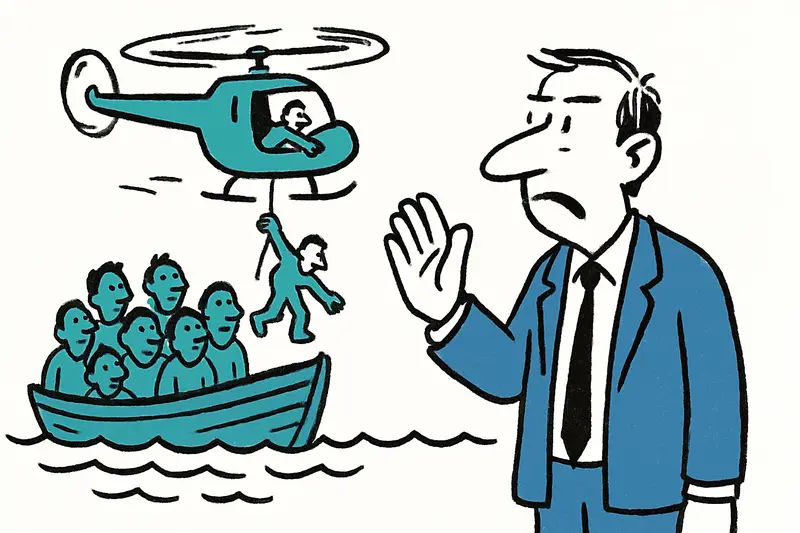
131 Boat Arrivals in Four Days: When Will Madrid Act?
131 Boat Arrivals in Four Days: When Will Madrid Act?
In the first four days of January, 131 people reached the Balearic Islands. The regional government calls it a structural crisis — but what is missing from the debate, and which solutions are immediately possible?
131 Boat Arrivals in Four Days: When Will Madrid Act?
The Balearic Islands Are Once Again on the Front Line of a European Migration Issue
In early January a slightly frosty air lies over the Passeig Mallorca, fishermen untie nets in Port de Sóller, and the sea on the horizon looks gray and cool. These days not only the usual winter waves shape the image of the islands, but also a number that concerns authorities and aid services: 131 people arrived by boat on the Balearic Islands in the first four days of the year. The regional government sees a worsening compared with the previous year (97 in the same period) and points to more than 7,300 registered arrivals in 2025, a trend discussed in Mallorca under pressure from rising boat arrivals.
Key question: How long should Mallorca and the neighboring islands bear the main burden of an increasingly entrenched migration route without Madrid, the EU, or international partners providing visible relief?
Those who know the structures here recognize patterns: arrivals are increasing regardless of season, support facilities are thin, and minors are particularly vulnerable, as when 337 people arrived in one day. Currently around 750 unaccompanied young people are in state care — about 300 of them from Algeria. Social services report being overwhelmed; staff and space are lacking; cases pile up in offices and accommodation lists grow longer.
Critical analysis: The problem is not just a local logistics issue. It has several levels that can hardly be solved at once. First: the humanitarian emergency on board and on land — people arrive, often weakened. Second: the operational side — pick-up, registration, initial medical care, accommodation. Third: legal and diplomatic dimensions — asylum procedures, possible returns, bilateral agreements, as highlighted when 122 people were rescued in a single day. Fourth: the criminal background — smuggling networks that profit from uncertainty.
What is missing in the public discourse: the discussion often remains fixated on numbers or degenerates into blame games between regional and central governments. Almost never is there talk of legal alternatives that systematically address the causes of flight, or of transparent, consistent search-and-rescue rules. Also underexposed are the costs of small but necessary intervention steps, such as mobile teams for psychological first aid, or rapid reinforcement of youth services before emergency shelters become a permanent solution.
Everyday scene: On a stormy morning near Cala Major I watch volunteers handing out blankets and tea. An old man passes by with his dog, stops and quietly asks about the fate of the young people who were brought ashore yesterday. Between the voices of the helpers and the sound of the nearby road lies a mixture of compassion and helplessness — exactly this mixture reflects the island.
Concrete approaches that can be tackled now:
Short term: 1) Immediate deployment of additional specialists in child protection and psychology; 2) temporary, weatherproof reception places with clear care and transfer plans; 3) coordinated data sharing between the regional government, Guardia Civil and social services to avoid duplicate work.
Medium term: 1) Bilateral agreements with countries of origin for identity-verified returns and readmission measures; 2) targeted investigations against smuggling structures in cooperation with European partners; 3) deployment of the EU border agency Frontex with a clear mandate definition including search-and-rescue tasks.
Long term: 1) Creation of legal pathways to Europe (work and study visas, humanitarian programs) to reduce pressure from dangerous boat crossings; 2) development partnerships that strengthen local prospects in countries of origin; 3) sustainable funding for the Balearic infrastructure so that schools, youth services and health services can be permanently expanded.
Another topic: transparency in mortality statistics. NGOs report more than 1,000 deaths on the western Mediterranean route, while official bodies so far cite much lower, documented cases. As long as figures diverge so widely, the debate will be polarized rather than factual. Clarity requires standardized data collection and independent investigations, and reference to independent datasets such as the IOM Missing Migrants Project for the Mediterranean.
The islands cannot handle everything alone. A combination of pragmatic immediate measures and strategic European action is needed. Madrid must deliver concrete commitments — not just words — and Brussels must share responsibility.
Conclusion: The situation is not an episode; it is a long-term problem with a human face and political sharpness. Anyone standing on the coast does not only hear the sea but also the ringing of alarm bells. Those who look away now risk turning acute emergencies into lasting crises. To act means: plan, coordinate, set humane limits and show European responsibility.
Frequently asked questions
Why are boat arrivals in Mallorca and the Balearic Islands increasing?
How cold is Mallorca in January, and does that affect the sea?
What happens when people arrive by boat in Mallorca?
Why are unaccompanied minors a concern in Mallorca’s migration response?
Is Cala Major affected by boat arrivals in Mallorca?
What support do volunteers provide after boat arrivals in Mallorca?
What solutions are being discussed for the migration pressure on Mallorca?
How reliable are the figures about migrant deaths in the western Mediterranean?
Similar News

Released with Conditions: The Plus Ultra Suspicion and a Mallorcan Finca as Residence
A Dutch entrepreneur, sought in connection with the Plus Ultra case, was extradited to Spain after his arrest in Germany...

Haute Nuit in Puerto Portals: Fashion, Art and Indulgence by the Water
On October 2 the Lobster Club in Puerto Portals will be transformed into a stage for curated fashion, art and culinary e...
Magaluf: Watchtower Alarm – Lifeguards Pull Unconscious Beachgoer from the Water
After a drama in the late afternoon, two lifeguards at Magaluf beach rescued an unconscious 44-year-old man. He was stab...

Turquoise in the City: How dangerous is the color play of the Sa Riera?
The Sa Riera in Palma suddenly turned turquoise — a pretty motif, but behind the effect lies a discharge of saline waste...

Jeckliner at Sunnesching: Cologne spirit sets sail from Palma
In September 2027 the Mein Schiff 2 briefly becomes a floating carnival stage: four days with Cologne bands, comedy and ...
More to explore
Discover more interesting content

Can Cap de Bou

Townhouse Lleo 72
