
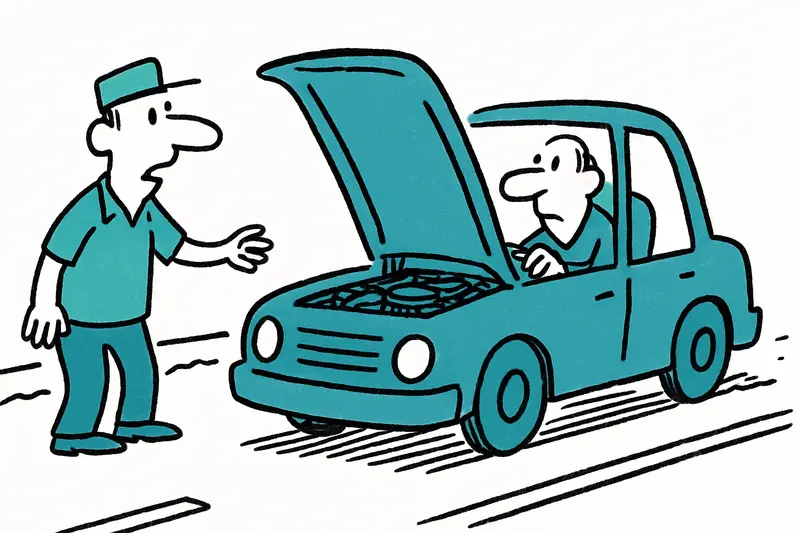
19 kilometers with an open hood on the Ma-15: What the case means for safety on Mallorca's roads
19 kilometers with an open hood on the Ma-15: What the case means for safety on Mallorca's roads
A 26-year-old drove at least 19 kilometers on the Ma-15 with an open hood after an accident. The public prosecutor is demanding imprisonment and a driving ban. What is missing from the public discourse?
19 kilometers with an open hood on the Ma-15: What the case means for safety on Mallorca's roads
Prosecution demands prison, authorities tracked the route to Artà — but many questions remain
In the early hours of a summer day a young driver left the Ma-15 near Algaida, hit the guardrail and kept driving — with the hood raised. According to the indictment, the vehicle covered at least 19 kilometers in this condition before the journey ended in another accident in Artà. The public prosecutor is now seeking six months in prison, a two-year driving ban and around €9,500 in civil liability.
Central question
How can someone drive almost 20 kilometers on a major road while clearly creating a danger without immediate intervention — and what does that say about surveillance, prevention and law enforcement on the island?
The sober facts: the car lost a license plate in the first collision, maintenance work does not protect against bizarre accident consequences, and the route was traced by traffic cameras as far as Villafranca. On some sections the car reportedly drove up to 80 km/h, according to the indictment. In Artà the vehicle also struck the outdoor seating of a bar; the owner alerted the local police. Officers found the 26-year-old disoriented; a breath test was positive.
The picture is on the one hand astonishing and on the other troubling: cameras recorded the trace, yet the existing surveillance measures apparently were not sufficient to stop the journey earlier or to warn other road users. Responsibility is spread across several levels: driver error and alcohol on the one hand, road infrastructure and monitoring mechanisms on the other.
What is often missing from public debate are technical and organizational gaps. On Mallorca cameras are not comprehensive, and many stretches of the MA roads are thinly monitored at night. Field fire near Manacor: What the operation on the Ma-15 reveals about Mallorca's fire risk notes similar limits in coverage during night operations. A vehicle driving with its hood raised has reduced visibility and altered braking distances, increasing the danger for oncoming or following vehicles. There is also the question of whether the road maintenance operator who reported the incident was sufficiently trained to forward dangerous situations to the Guardia Civil in real time.
An everyday scene from Palma or Artà helps put this into context: it is just before four in the morning, it is still quiet, the garbage trucks have already passed the side streets, road signs still shine from the night's rain. Instead of a normal early-morning calm there is suddenly distant engine noise, the clattering sound of a hood, and in a bar in Artà the tables rattle as a car hits the outdoor seating. The owner stands there with a flashlight, the Guardia Civil arrive in their green uniforms — for him this is not just a news item but real damage, a bill and a shock for guests and staff.
Concrete approaches: first, better networking between road maintenance, traffic control centers and the Guardia Civil with fixed reporting channels for dangerous situations. An automatic alert for lost license plates or for unusual camera traces could help remove vehicles from traffic more quickly; public information and roadside signalling may also change soon, see V16 Mandatory in Mallorca: What Drivers Really Need to Know. Second, targeted prevention work: bars and pubs need clear training on their responsibilities when serving alcohol, and drivers must be better made aware of the risks of driving under the influence — an approach similar to recommendations in Cruising Safely on Mallorca: What Tourists and Authorities Should Finally Do Differently. Third, reconsider infrastructure measures at critical points such as roundabouts and guardrail design so that vehicles which briefly leave the road do not uncontrollably re-enter the carriageway.
Legally, the punishment of the driver is now the focus: the requested prison sentence, the driving ban and the financial claim aim at retribution and compensation. At the same time, it would be sensible to use the proceedings to examine systemic shortcomings — for example to check whether reporting and response chains are sufficient and where improvements are needed.
Conclusion: the case is more than a curious headline. It exposes weaknesses — in the behaviour of individual road users, in the island's prevention culture and in the technical monitoring of the roads. Anyone driving on the Ma-15 early in the morning does not just hear engines, but a piece of responsibility: from drivers, from authorities and from infrastructure. Talking only about penalties is not enough; we must also discuss how to prevent such nocturnal ordeals in the future.
Frequently asked questions
Is it dangerous to keep driving after a car has hit the guardrail and the hood is open?
What happens if someone drives under the influence on Mallorca roads?
Why are some dangerous incidents on Mallorca roads not stopped immediately?
What should I do if I see a dangerous car on the Ma-15 in Mallorca?
How far did the car travel after the first crash on the Ma-15?
Why is Artà mentioned in the Mallorca Ma-15 accident case?
Could better road monitoring prevent accidents like this on Mallorca?
What should drivers pack for night driving on Mallorca roads?
Similar News
By Boat Instead of the Road: Palma's Water Bus — a Reality Check
The 'Bus Nàutic' launches in two stages — but questions remain over interim operations, fares and environmental requirem...
Several Days of Rain Approaching: How Well Is Mallorca Prepared?
Aemet says: rain from Thursday until at least Tuesday, especially heavy on Monday. Temperatures remain mild. A reality c...
Nervous Reaction at a Traffic Stop: Why Campos Is Not Just a Sniffer-Dog Problem
At a traffic stop in Campos a 37-year-old German was arrested with a bag full of drugs. Our reality check explains why s...

Cameras Against Illegal Dumping: Porto Cristo Monitors Problem Areas – a Reality Check
Manacor has installed four surveillance cameras at particularly problematic waste spots in Porto Cristo. A local check a...
Reality check: Palma's "white" torrent — harmless salt or neglected warning sign?
White crusts on the Torrent de Sa Riera are causing a stir. Emaya describes them as salt deposits. Our reality check: wh...
More to explore
Discover more interesting content

Can Cap de Bou

Townhouse Lleo 72
