
85 Tons of Steel at Palma Airport: Who Pays When Precision Becomes Expensive?
85 Tons of Steel at Palma Airport: Who Pays When Precision Becomes Expensive?
At Terminal A of Son Sant Joan, an 85-ton bridge element was installed. The engineering dazzles — the invoices and questions about financing remain open. A reality check from Palma.
85 Tons of Steel at Palma Airport: Who Pays When Precision Becomes Expensive?
A large lifting operation, roaring chains and many unanswered questions — what the new passenger boarding bridge concretely means for residents and travelers
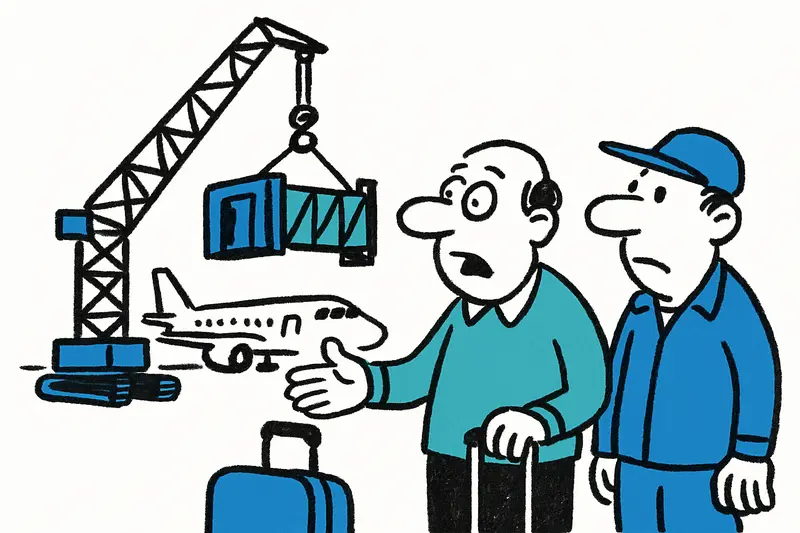
The images were impressive: special cranes, heavy-duty platforms, workers in safety vests and helmets handling a steel behemoth for hours. On the grounds of Son Sant Joan, a prefabricated bridge element was recently assembled that, according to the construction management, weighs around 85 tons. The individual parts, some well twelve meters long and almost five meters high, had already been fitted together on the ground before they were lifted into position in two major maneuvers. In total, the lifting and installation reportedly took almost 14 hours.
Such operations impress not only through engineering, they also raise questions: Who bears the additional costs for special cranes, road closures and the transport of heavy modules? How much of the bill will later end up in the airport fees passengers already pay today? And: How transparent is the schedule for the remaining work? How safe are the major works really?
The construction site is part of a broader modernization plan for the airport that envisions large sums in the coming years, as explained in Son Sant Joan becomes a major construction site: How Palma is organising the winter at the airport. From an infrastructure perspective that makes sense — better routes for passengers, more reliable runways, and energy measures like solar roofs sound good. But “sensible” does not automatically mean “light on the wallet.” Even the mention of an average increase in fees per passenger sparks controversial conversations in cafés along Avinguda de Gabriel Roca.
Also critical is the question of local communication. Residents, taxi drivers and bus drivers at the forecourt report short warning times when larger transports are about to take place. In tight spaces like around Son Sant Joan, half- or full-day closures are enough to cause long back-ups on the access road in the morning. Not all neighbors know the exact steps of the construction phase — that creates uncertainty.
What has been missing in public discourse so far can be summarized as follows: First, a clear breakdown of how investments are financed and how they affect fees and tickets. Second, a binding schedule with milestones so residents and businesses can plan. Third, binding environmental and noise protection requirements for each construction phase — not just for the final project.
A quotidian scene shows what this is about: In the early morning, when the espresso in the bar opposite the terminal still steams, you see crane operators talking over radio, hear the clatter of diesel generators and watch tourists with wheeled suitcases bypass barriers because the route to baggage claim was moved at short notice. These small disruptions add up in perception and affect people who rely on the airport daily — airport staff, commuters, and local businesses.
So what to do? A few concrete proposals that are achievable without great effort and are effective at the same time:
- A transparent cost statement that, in addition to total investments, also shows the expected effects on fees per passenger. A semi-annual public update would reduce distrust.
- A local construction advisory board with representatives from the neighborhood, businesses and the airport operator to coordinate dates, traffic disruptions and noisy work.
- Phased work in low-traffic times: transport of heavy modules at night or outside peak holiday periods, accompanied by pre-announced detour routes for buses and taxis.
- Stricter noise and emissions limits on the construction site as well as mandatory documentation of photovoltaic and energy improvements so that climate protection does not remain just a buzzword.
- Reuse and recycling of components where possible; this saves costs and provides locally visible sustainability.
Technically, the operation was a success: prefabricating modules and assembling them on the ground reduces risks at height and saves time. Similar documentation of the broader modernization and coping measures can be found in Palma Airport: The construction site that never stands still — and how we cope with it. But technology alone is not an argument when residents have no plan and travelers end up paying for improvements whose benefits are not clear to them.
The message to decision-makers is simple: Major construction must be accompanied by equally major transparency. Otherwise, well-intentioned modernizations will create frustration in the districts around the airport and distrust among those who ultimately have to foot the bill. The crane pointers may tick with millimetre precision — answers to the public should be no less precise.
Conclusion: The installation of the heavy bridge element is a visible step forward toward modern infrastructure. What is missing is a clear, comprehensible roadmap for costs, burdens and benefits. If Aena and politicians act honestly and openly here, the construction site will ultimately benefit everyone. If not, the Biarritz-like hustle in front of the terminal will leave mainly one thing behind: noise and unanswered questions.
Frequently asked questions
Why is Palma Airport carrying out so much construction work at the moment?
Will passengers at Mallorca Airport have to pay higher fees because of the works?
How long did it take to install the 85-ton steel bridge at Palma Airport?
Why do road closures around Palma Airport cause so many delays?
What does the Palma Airport modernisation mean for local residents and businesses?
What should Mallorca expect from airport construction in low-traffic periods?
How transparent is the Palma Airport building schedule?
What does the new boarding bridge at Palma Airport change for travellers?
Similar News

Fewer Airlines, Fewer Destinations: What Palma's Winter Flight Schedule Means for Mallorca
Analysis shows: Winter at Son Sant Joan Airport will be quieter, with significantly fewer airlines and destinations. Who...
German tourist dies in Sa Calobra – a reality check for emergencies on Mallorca's beaches
A 40-year-old tourist died at the Torrent de Pareis. The emergency call, a doctor who happened to be present, a defibril...

Deadly Tractor Accident in Bunyola: What Needs to Be Done Now
In a work accident on an estate near Bunyola, a roughly 40-year-old man lost his life. His wife and a small child were o...
Head-first dive into the shallow part of Cala Fonoll: An accident and the unresolved question of responsibility
A young tourist dove into Cala Fonoll and was seriously injured. Key question: Why are clear warning signs missing at da...

Mistaken identity with fatal consequences: Brutal assault in S'Aranjassa — what's missing in the follow-up?
At S'Aranjassa a visitor to a finca was tied up, beaten and thrown out of a van. Three men have been arrested, including...
More to explore
Discover more interesting content

Can Cap de Bou

Townhouse Lleo 72
