
Advertising Billboard at the Airport: Who Decides How Mallorca Is Portrayed?
Advertising Billboard at the Airport: Who Decides How Mallorca Is Portrayed?
A huge German-language advertising billboard at Palma airport has sparked outrage. Who decided this — and what is missing in the debate about responsibility and oversight?
Advertising Billboard at the Airport: Who Decides How Mallorca Is Portrayed?
A guiding question that demands answers
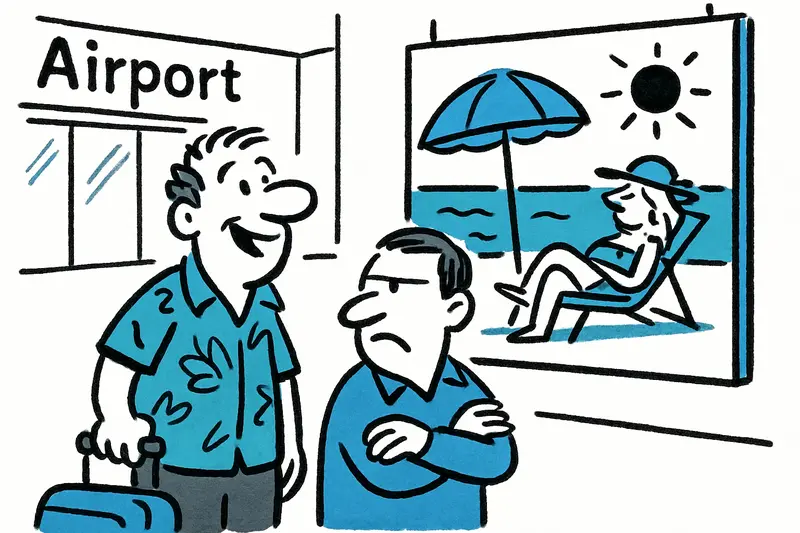
Who is allowed at the "gateway" to the island to decide which image of Mallorca is shown to hundreds of thousands of arrivals? This question is now being asked after a large German-language advertising billboard was placed on the exterior facade of the airport (Posters, Provocation, Polarization: How Mallorca's Streets Become a Campaign Ground), playing on a well-known phrase and causing unease among many residents.
The regional tourism minister Jaume Bauzà publicly criticized the airport operator Aena for allowing such a campaign. He sees it as contradictory to the Balearic government's policy, which in recent years has emphasized promoting tourism that is compatible with everyday life on the island (Reality Check: Why Mallorca Can Hardly Escape Massification). The reaction in the streets of Palma shows that the debate is perceived not only politically but also personally.
Critical analysis: More than a poster
The problem is not just the sentence on the banner. It is about the signals emitted from a place where thousands of people arrive every day: families, workers, hotel staff, retirees returning home. An airport is more than an advertising space. It is a public place with strong symbolic significance.
Aena operates the airport and has the right to allocate advertising space. At the same time, a regional administration is trying over the long term to change the island's image. That these two sides are coming into conflict is not surprising. What is surprising is how opaque the approval process for such large-scale advertising appears to be: What criteria were applied? Who assessed possible impacts on the island's image? Was the municipality informed in advance? (Poster Dispute in the Balearic Islands: How Much Provocation Can Public Space Tolerate?)
What is missing in the public debate
1) The advertisers' perspective is missing: Why was this particular wording chosen? Was it about provocation, brand building, or simply revenue? 2) The procedural question: Which internal airport rules govern "image" versus "commerce"? 3) The impact assessment: Are there measurable effects of such campaigns on tourist behavior or neighborhood burdens? (After Eleven Years at the Top: What Mallorca's Tourism Radar Really Needs to See) 4) The revenue question: How dependent is Aena on advertising income, and how does that influence decision-making?
An everyday scene from Palma
Late in the morning at Plaça d’Espanya you see the same faces that arrive at the airport: the cleaner with the blue cart, the young family with the stroller, the English-speaking student with his bicycle. On the walk back to bus XI they casually discuss the billboard; some smile, others shake their heads. A café on Avinguda Gabriel Roca fills up, the barista pours milk into a cappuccino — and a regular customer asks on the side: "Is that our image of Mallorca?"
Concrete approaches to solutions
1) Transparent advertising guidelines for airports: A publicly accessible rulebook should clearly define which advertising content is allowed at representative gateways. Criteria could include compatibility with the island's image, local impacts and social context.
2) A responsibility committee with local representation: An advisory board including municipalities, the island administration, hotel industry representatives and citizen initiatives could mediate and make recommendations in advance.
3) Legal remedies and rapid review: If a campaign causes outrage, there should be an expedited review process that can quickly decide on removal or modification.
4) Alternative revenue models: If economic pressure on Aena plays a role, lump-sum payments or public subsidies should be considered to reduce reliance on advertising.
5) Accompanying campaigns with positive imagery: Instead of only issuing bans, the island should proactively develop its own communication lines that promote respect for residents and responsible behavior.
What politicians can do now
The discussion comes at a time when stronger regional participation in airport management is also being negotiated. A draft law is pending at the national level. If political co-determination is a goal, it must be linked to clear rules on advertising and public spaces — otherwise a change in control will remain symbolic.
Concise conclusion
The giant billboard is only the trigger. The real question is how an island with millions of arrivals wants to define which image of itself is presented to the outside world. Advertising contracts are commercial acts — but this is also about the common good, neighborhood and dignity. A purely technical solution is not enough. We need rules, participation and fast procedures so that such decisions are no longer made behind closed doors. Otherwise we'll keep discussing over morning coffee whether what happens in Mallorca should really stay only in Mallorca.
Frequently asked questions
Who decides what advertising can be shown at Palma de Mallorca Airport?
Why did the billboard at Mallorca Airport cause such a reaction?
What does Mallorca want its image to be for visitors?
Can airport advertising affect how people experience Mallorca?
What rules should apply to advertising at Palma de Mallorca Airport?
Why is Palma de Mallorca Airport such a sensitive place for public messages?
What can Mallorca authorities do if they disagree with an airport ad?
Is there a wider debate in Mallorca about tourism and public space?
Similar News

When the Wallet Becomes a Danger: Attack in Peguera and Lessons for Mallorca
In Peguera, two women are said to have stolen the wallet from a 75-year-old German couple. When the victim intervened, t...
Plata stays Plata: Young people take over, Llonguets remain
A small bar on Carrer de l'Argenteria will continue: Tolo Serra hands the place over to young Mallorcans at the end of t...

Unnoticed in the Luggage Compartment: How a Boy Traveled More Than 100 Kilometers in a Team Bus
A minor traveled in the undercarriage of a team bus for more than 100 kilometers until his cries for help were heard. A ...

Cap Vermell Grand: Second Michelin Key – a Gift for the East
The Cap Vermell Grand in Capdepera has been awarded its second Michelin key. For the region this elevates the luxury off...
Eurowings lets four aircraft carry names – a friendly idea that also reaches Mallorca
Eurowings is launching a campaign: four Airbus A320s are to carry the first names of people who help others in everyday ...
More to explore
Discover more interesting content

Can Cap de Bou

Townhouse Lleo 72
