
Digital Blackout in Palma and Binissalem: Why One Hour of Outage Here Is More Than Just an Annoyance
Digital Blackout in Palma and Binissalem: Why One Hour of Outage Here Is More Than Just an Annoyance
A major outage in the telecom network brought parts of Palma and Binissalem to a standstill. Key question: How vulnerable is our digital infrastructure — and who pays the price when it fails?
Digital Blackout in Palma and Binissalem: Why One Hour of Outage Here Is More Than Just an Annoyance
On Tuesday afternoon phones fell silent, video conferences were interrupted and many websites were unreachable – around Palma and especially in Binissalem much of the digital world suddenly went offline. According to a municipal statement and residents' reports, the cause was apparently a fault at a distribution unit on the Plaça de sa Quartera; the major network operator announced it would restore connections during the following day. The disruption hit authorities, shops and households alike.
Key question
How can a failure at a single node practically cut an entire town and parts of the capital off from the digital outside world?
Critical analysis
The short answer: our networks are too centralized in places. When a distribution or repeater unit fails, there are often no redundant routes on site. This becomes clear from a simple fact: citizens working from home, pupils researching online, and small shops processing electronic payments are immediately affected. Authorities had to switch to analogue procedures because online services were inaccessible. This is not merely a technical problem but a structural one.
Communication compounded the issue: in the hours after the outage many affected people were confused because information was sparse. Lack of live outage maps, unclear repair time estimates and conflicting statements between the town hall and the network operator increased the feeling of helplessness.
What is often missing in public debate
We talk a lot about new fiber-optic connections and high bandwidth. Rarely do we talk about resilience: who checks the redundancy of routing paths? What obligations does a provider have towards municipalities? What sanctions exist for recurring outages? And last but not least: how are the most vulnerable protected – seniors, small businesses, people without mobile data?
A daily scene from Binissalem
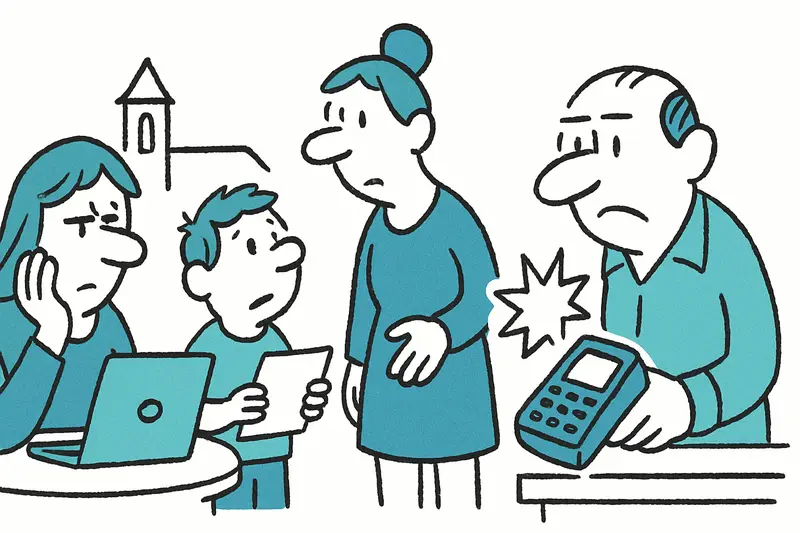
On the Plaça de sa Quartera in the late afternoon a few people sat outside the bakery. Espresso steamed, the church clock struck five, and behind the shop window the owner rummaged through a thick paper order book – her card reader was useless without a network. Next door a mother explained to her son that homework would have to be done on paper this time. Scenes like these are happening far too often.
Concrete approaches to solutions
- Create technical redundancy: plan networks so that important nodes have several physical and wireless fallback routes (e.g. radio links as a backup to fiber).
- Emergency SLAs and transparency: binding service-level agreements with clear response times, published incident reporting and a publicly accessible outage map.
- Municipal backup infrastructure: municipalities should maintain minimum facilities for critical services – local emergency lines, temporary microwave bridges or public Wi‑Fi hotspots with priority for authorities and healthcare services.
- Protection for the vulnerable: schools, senior centers and medical practices need prioritized access to radio backups or battery-operated routers.
- Decentralized accountability: more competition and clear legal requirements for operators so that maintenance and modernization are not left solely to the economic calculus of large providers.
What matters now
In the short term repairs must be accelerated and municipalities better informed. In the medium term we need investments in resilience, not just in bandwidth. In Mallorca, where many services are highly centralized, accepting outages because they occur "rarely" must not be the answer.
Conclusion: The incident in Binissalem is a wake-up call. A digital network that only focuses on glossy claims but has no fallback routes is not infrastructure — it is a ticking disturbance. Anyone who wants to be able to pay by card not only at the café on the Passeig should use this as a reason to demand louder answers from decision-makers.
Frequently asked questions
Why did a single network fault cause an internet outage in Palma and Binissalem?
How long can an internet outage in Mallorca take to be restored?
What should shops and small businesses in Mallorca do when card payments stop working?
How can an internet outage affect remote work and school in Mallorca?
What is the problem with relying too much on one digital network point in Mallorca?
Why is public communication so important during a digital outage in Mallorca?
What backup infrastructure do municipalities in Mallorca need for internet outages?
Is a short internet outage in Mallorca just a minor inconvenience?
Similar News
German tourist dies in Sa Calobra – a reality check for emergencies on Mallorca's beaches
A 40-year-old tourist died at the Torrent de Pareis. The emergency call, a doctor who happened to be present, a defibril...
Deadly Tractor Accident in Bunyola: What Needs to Be Done Now
In a work accident on an estate near Bunyola, a roughly 40-year-old man lost his life. His wife and a small child were o...
Head-first dive into the shallow part of Cala Fonoll: An accident and the unresolved question of responsibility
A young tourist dove into Cala Fonoll and was seriously injured. Key question: Why are clear warning signs missing at da...
Mistaken identity with fatal consequences: Brutal assault in S'Aranjassa — what's missing in the follow-up?
At S'Aranjassa a visitor to a finca was tied up, beaten and thrown out of a van. Three men have been arrested, including...
High heel slips, car accelerates: accident on Camí de Son Hugo
A woman lost a high-heeled shoe on the forecourt of the sports facility at Camí de Son Hugo. The car accelerated, mounte...
More to explore
Discover more interesting content

Can Cap de Bou

Townhouse Lleo 72
