
Reality Check: Littered Seabed off Can Pastilla
Reality Check: Littered Seabed off Can Pastilla
A diver's video shows cans, plastic and clothing on the seabed between Es Carnatge and Cala Estancia. Who looks after the underwater world off Can Pastilla — and what is missing from the public debate?
Reality Check: Littered Seabed off Can Pastilla
A diver's footage brings the problem directly to Palma's doorstep
Key question: How is it possible that directly off a heavily used stretch of coast — between Es Carnatge and Cala Estancia, off Can Pastilla — the seabed is in such a state that you can find cans, closures, packaging remnants and even items of clothing?
When you walk along the promenade in the morning, you hear the steady rocking of boats, the voices of people having breakfast in the chiringuitos and the clatter of sunbed frames. Yet, if you dive a few metres down, the seabed tells a different story: a local diver's video showing a recreational diver pulling nets full of plastic shows that rubbish has accumulated over years — at a spot that residents and holidaymakers pass every day.
The immediate proximity to residential areas and entertainment districts makes the situation painfully visible: here urban life meets sensitive underwater ecosystems. Currents gather light, thoughtlessly discarded items and wash them onto rock edges and into crevices. You find aluminium cans next to plastic caps and textile remnants — not a pleasant picture for a bay used for snorkelling and swimming.
Critical analysis: the problem has several layers. On the one hand the obvious: people throw things away or fail to secure them properly on boats. On the other hand organisational gaps: waste bins at beach access points, collection rhythms, clear labelling for recycling and the presence of controls. Added to this are physical factors: winds and waves transport and deposit waste in places that are hardly visible from the shore.
What is missing from the public discourse: discussions often revolve around beach cleaning and tourist behaviour, but the underwater perspective rarely becomes a topic. There are hardly any figures on how much rubbish actually lies on the seabed — although recent counts reported almost 6.5 tons recovered in July, which items are particularly problematic (e.g. microplastics) and how this affects local fish stocks and marine flora. Also rarely discussed: the role of hospitality businesses and recreational boats moored nearby, or the effectiveness of measures that the municipality already has in place.
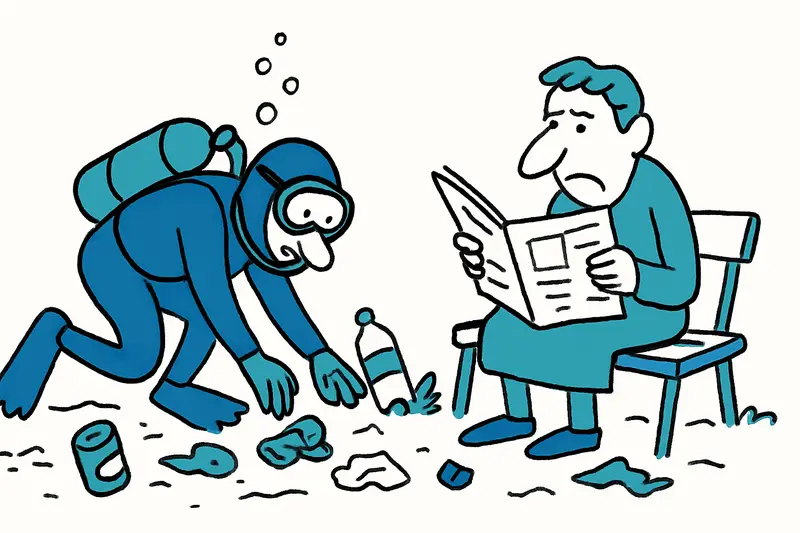
Everyday scene: on a hot July day an elderly woman sits on a bench near the Avenida Marítima, fans herself with a newspaper and watches young people rush to the beach with beer cans. No one sees how some of those same cans later end up, in part, back in the water. The sounds of the place — radio, children's laughter, motorboat noises — overlay the quieting underwater world, where plastic pieces slowly catch in the folds of the Posidonia seagrass.
Concrete solutions, not just wish lists:
1. Regular, professional dive operations: Funded by the municipality and tourist fees, certified teams could systematically work through hotspots, document and remove waste.
2. Structured volunteer programmes: Volunteer divers accompanied by professional coordination — as when volunteers and authorities pulled almost eight tons of waste — with plans for sorting and processing collected waste.
3. Targeted information: Multilingual signs at access points (Spanish, Catalan, English, German) and targeted notices in tourist centres, guesthouses and boat rental outlets.
4. Shoreline infrastructure: More waste bins, separate collection points for cans and plastics, more frequent emptying during high season.
5. Preventive measures for boats: Mooring buoys to avoid anchoring in Posidonia meadows, rules for taking waste back on board, checks in harbours.
6. Technical solutions: Filters for rainwater drains that discharge into the sea; sensors and citizen apps to report pollution; transparent reports on carried-out clean-up actions.
Does all this sound technical? Yes — but without concrete, funded measures it remains only outrage. The diver who published the footage is not seeking sensation; he is holding up a mirror: the underwater world does not have the lobby of a promenade, but it is just as vulnerable.
Conclusion: the video is a wake-up call. It shows how close the problems are: not somewhere else, but on Palma's doorstep. The promise to the island must not be limited to cleaner sunbeds and less rubbish on the promenade — it must include the duty to remove items before they break down and become microplastics in food webs. The municipality, local businesses and the neighbourhood are called upon. And if, after a walk along the promenade, you are holding a can — please: take it with you or put it in a bin. It is not enough, but it is a start.
Frequently asked questions
When is the best time to visit Mallorca for sunny beach days?
Is the water in Mallorca suitable for swimming most of the year?
What should I pack for a Mallorca trip?
How can I get around Mallorca without a car?
Are there must-see places to visit in Mallorca?
What activities suit a relaxing break in Mallorca?
How should I plan a short Mallorca trip for a long weekend?
What should I know about Mallorca’s weather in shoulder seasons?
Similar News

From the Reality Studio to the Pitch: Aleks Petrovic Makes Mallorca His Base
The former participant in numerous TV shows moves from Dubai to the island and launches a project with FC Germania Mallo...

When the Phone Falls Silent: Concern for Sarah Joelle in Mallorca — and What It Reveals
After days without a response, the TV personality's unreachability in Mallorca sparked concern. Shortly afterwards an al...

Ultraluxury on the Ground: Four Seasons Jet in Palma — a Reality Check for Formentor and the Island
A high-priced flight crosses Mallorca and its guests stay for days at the Formentor resort. What does the island get bes...

Death of a Witness and the Justice Backlog: Why the Kegel Brothers Trial Matters in Mallorca
A witness in the Playa de Palma fire case has died, and the trial against eight German holidaymakers has been delayed un...

Champagne Reception, Red Carpet and Mini Originals: The Pre-Nit del Art at Gallery Mensing
Almost 400 guests, champagne, pop-art feats by Tom Boston and a raffle for the Parkinson's foundation: Gallery Mensing t...
More to explore
Discover more interesting content

Can Cap de Bou

Townhouse Lleo 72
