
Alcudiamar in Alcudia harbour: Court blocks hotel operation
Alcudiamar in Alcudia harbour: Court blocks hotel operation
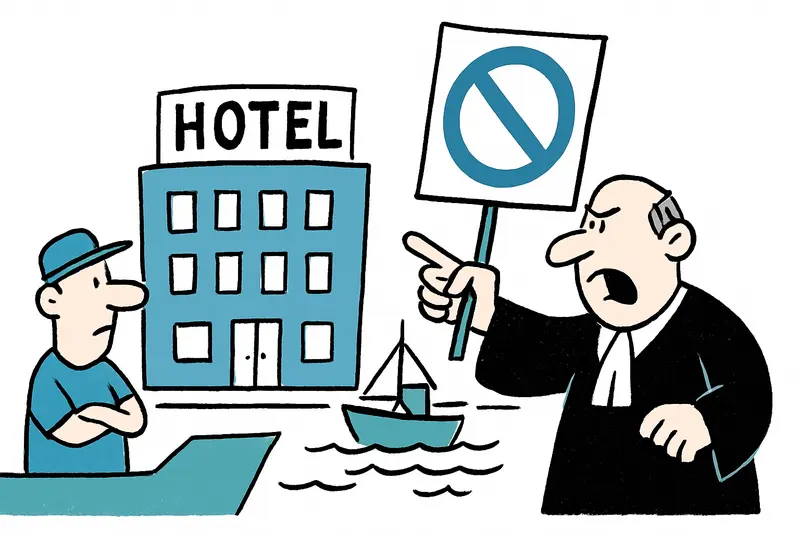
A court has ruled that a regular hotel may not operate in the harbour of Alcudia. Only accommodation for boat users is permitted. What does this mean for harbour operations, users and residents?
Alcudiamar in Alcudia harbour: Court blocks hotel operation
Key question: Who ensures that harbour rules don't have loopholes?
Early in the morning, when the fishermen on the Passeig Marítim sort their nets and seagulls cry above the quay walls, the harbour of Alcudia looks as it always has: boats, cafés, a bit of traffic, the light low over the water. In this setting, a court has now made clear that a regular hotel operation is not allowed in one place: according to the ruling, the Alcudiamar complex is not authorized as a hotel and may only offer rooms that are used directly by skippers and harbour visitors.
The ruling strikes a nerve. GOB, the environmental organisation, is demanding consequences and wants the rules to be enforced, not just written on paper. The operator counters that since April 2024 no classic hotel has been running there; overnight stays are exclusively for people who use the marina. Thus two interests collide: preserving the harbour function and the economic interests of an operator who apparently tries to use the space differently.
Critical analysis: The court decision is clear on the core question, but it remains unclear who will give lasting force to the requirements; similar issues have arisen in other cases such as Judges in Palma strengthen passenger rights — a win with open questions. Municipal administration, harbour authority, inspectors — these are all institutions that would need to monitor compliance. In practice, however, the capacity for ongoing checks is limited. Added to this is the fact that harbours are hybrid spaces; they thrive on a mix of uses, but not on a permanent conversion into tourist accommodation that alters the harbour's character.
In the public debate there is currently little concrete discussion about how such decisions should be implemented. There is talk about rights and claims, but hardly any about control mechanisms, staffing or clear responsibilities. The effects on employees, seasonal jobs and the local neighbourhood are also rarely weighed objectively: who looks after the people who suddenly have to work differently when an operation is reorganised?
Everyday scene: An old man stands on the quay with a plastic bag and watches a boat that is just docking. A waiter from the nearby café wipes tables, a yacht crew carries suitcases past. These everyday sights and routines explain why decisions at the harbour are not just legal formalities: they change the daily rhythm and the soundscape when suddenly more guests stay overnight than intended.
Concrete solutions, without long deliberation: First, the municipality must publish clear rules and designate a contact point where residents and harbour users can report irregularities. Second, the harbour authority should carry out regular spot checks, supplemented by a digital reporting obligation — who rents how many beds and under which permit? Third, sanctions that are economically dissuasive; they should be transparent and applied swiftly when regulations are violated. Fourth, a transition model for businesses that need to adapt their operations, including support offers for employees and clear deadlines for conversion measures.
Public information is also important: harbour operations are not just leisure, they are infrastructure. If people understand why certain uses are excluded, tensions will decrease. Authorities should also review whether existing harbour regulations need to be formulated more precisely so that future disputes leave less room for interpretation.
Conclusion: The court has drawn a line — that is a clear signal. But a verdict alone does not change everyday life; authorities have sometimes pursued contested land-use measures, for example in coverage on Expropriation of Alaró Castle: Who Benefits from the Project, and Who Pays the Bill?. Enforcement, transparency and small organisational interventions are needed so that the harbour of Alcudia remains a harbour and does not gradually lose its function. Otherwise one morning the local melody will change: fewer nets, more suitcases, and a quay that sounds different than before.
Frequently asked questions
What is the weather like in Mallorca in autumn?
Can you still swim in Mallorca in autumn?
What should I pack for Mallorca in autumn?
Is autumn a good time to visit Mallorca?
What is the weather usually like in Palma de Mallorca in autumn?
Is Sóller nice to visit in autumn?
Is Pollença good for walking in autumn?
What are the best activities in Mallorca when the weather cools down?
Similar News

When the Wallet Becomes a Danger: Attack in Peguera and Lessons for Mallorca
In Peguera, two women are said to have stolen the wallet from a 75-year-old German couple. When the victim intervened, t...
Plata stays Plata: Young people take over, Llonguets remain
A small bar on Carrer de l'Argenteria will continue: Tolo Serra hands the place over to young Mallorcans at the end of t...

Unnoticed in the Luggage Compartment: How a Boy Traveled More Than 100 Kilometers in a Team Bus
A minor traveled in the undercarriage of a team bus for more than 100 kilometers until his cries for help were heard. A ...

Cap Vermell Grand: Second Michelin Key – a Gift for the East
The Cap Vermell Grand in Capdepera has been awarded its second Michelin key. For the region this elevates the luxury off...

Eurowings lets four aircraft carry names – a friendly idea that also reaches Mallorca
Eurowings is launching a campaign: four Airbus A320s are to carry the first names of people who help others in everyday ...
More to explore
Discover more interesting content

Can Cap de Bou

Townhouse Lleo 72
