
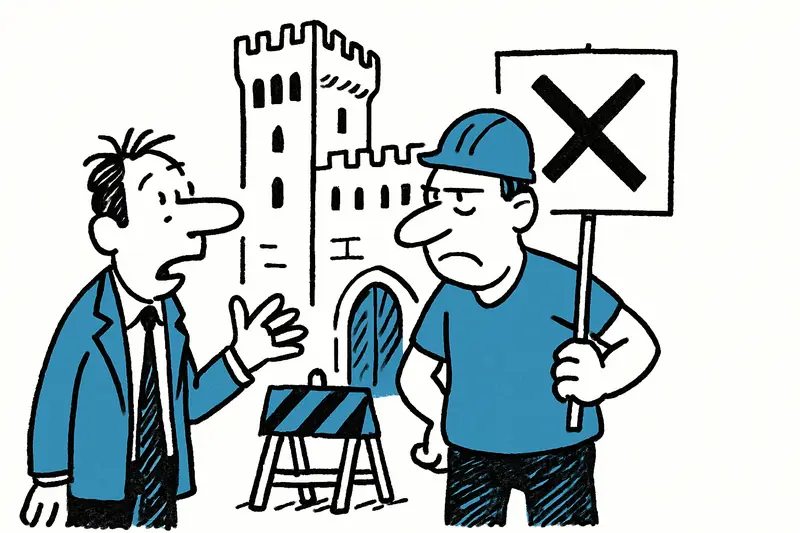
Almudaina temporarily closed: Modernization yes, but at what price?
Almudaina temporarily closed: Modernization yes, but at what price?
The Palacio Real de la Almudaina in Palma is closed from 12 January to 1 June 2026. €2.33 million from the recovery plan will be invested in new technology, an accessible entrance and a museum reorganization. A critical assessment.
Almudaina temporarily closed: Modernization yes, but at what price?
The historic Palacio Real de la Almudaina in Palma will close its gates for several months: from 12 January to 1 June 2026 the building is to be comprehensively redesigned. According to official statements, €2.33 million from the Spanish Recovery and Resilience Facility, i.e. funds with European participation, are available. Interventions are planned for lighting, the visitor center and the museal presentation; new audiovisual elements and rooms that have not previously been accessible to the public are to be opened.
Main question
Main question: Do the measures permanently improve access to the Almudaina — or will the result above all be modernization and marketing noise that conceals old substance and everyday proximity?
Critical analysis
The facts are compact: period, amount and target areas are specified. But some contradictions remain invisible if you only read the data. €2.33 million sounds like a lot of money, but for structural interventions on a building with Roman, Arab and medieval layers it is more ambitious than generous. Reconfigurations in the sense of a "museal reordering" leave questions open: How invasive will the structural interventions be? Who decides which rooms will be opened to visitors? Should the historic fabric be given priority, or will greater emphasis be placed on experiential elements? Similar debates appeared during planning for Palma plans a new exhibition center.
Anyone who sees the Almudaina on a typical morning — a view from Passeig Mallorca, the cathedral bells striking, street sweepers with brooms at the edge, delivery drivers looking for parking spaces in the side streets — will notice immediately: the palace is part of an urban fabric. Construction sites here are not isolated cultural projects; they have effects reaching into the cafés on Plaza de la Reina and the souvenir stalls at the Portal Mayor. Similar short-term bottlenecks were visible during the Palma Airport Module D closure.
What is missing from the public discourse
The previous announcements contain hardly any details on these points: a precise cost breakdown, time buffers for archaeological finds, a transparent list of the restorers involved, or concrete information on the sustainability of the measures. There are likewise no clear statements about how residents and small businesses in the vicinity are to be supported during the work. Accessible routes within the palace are also announced; it remains unclear how implementation will be carried out with regard to the conservation principle of "as little as necessary, as much as possible."
Everyday scene in Mallorca
Imagine it like this: It is a cool January morning, the construction machines on Calle del Mar start to work, seagulls circle, a delivery van beeps briefly, tourists with cameras still stroll along the Passeig de Born. The tense balance between urban space and monument is palpable everywhere. For the small souvenir stalls and bistros that depend on visitor flows, the closure means months with altered foot traffic — some will need alternative offers, others will rely on the summer months without palace visitors.
Concrete solutions
1. Transparent cost and decision structure: Publish a detailed budget and procurement procedures; who restores, who plans the museal reordering, which criteria apply to interventions.
2. Phased openings and temporary measures: Instead of a complete closure, phased restrictions could have been possible, combined with clearly communicated partial openings and temporary alternative offers nearby — for example small exhibitions in the Casa de la Cultura or mobile info points, as with the recently reopened Palma's Maritime Museum.
3. Archaeological safety reserve: Part of the budget should be held as a buffer for unforeseen excavations or conservation emergencies so that valuable finds are not sacrificed under time pressure.
4. Combine sustainability and conservation: For new lighting and technology, energy-saving systems (e.g. dimmable LED systems) are mandatory, but always installed so that historic surfaces are not affected.
5. Involve residents and businesses: Information events, discounts for local businesses and promotional campaigns guiding visitors to the surrounding area during the renovation would help alleviate the economic burden.
What can be gained — and what can be lost
There are clearly real opportunities if implemented correctly: a clear, easily accessible route, barrier-free paths and rooms that were previously hidden can bring history closer. On the other hand, the risk remains that interactive elements will overshadow the historic character, or that in haste conservation care will be sacrificed for quick visitor numbers.
The Almudaina is not an exhibition container, but a witness to many eras. Those who respect that will gain a public offering that appeals to locals and visitors alike. Those who only modernize the experience risk turning a historic ensemble into a showpiece.
My conclusion: Transparency, phased work and genuine coordination with conservation experts and the neighborhood would be the right ingredients to ensure that the announced modernization not only sounds good, but endures — for the island and its people.
Frequently asked questions
Why is the Almudaina in Palma closing temporarily?
When will the Almudaina in Palma be closed and when is it expected to reopen?
What will change at the Almudaina after the renovation?
How much money is being spent on the Almudaina project in Palma?
Will the Almudaina renovation affect businesses near Plaza de la Reina and the old town?
Is the Almudaina in Palma still worth visiting after the modernization?
What does the Almudaina closure mean for sightseeing in Palma?
What should visitors know before planning a trip to the Almudaina in Palma?
Similar News
Magaluf: Watchtower Alarm – Lifeguards Pull Unconscious Beachgoer from the Water
After a drama in the late afternoon, two lifeguards at Magaluf beach rescued an unconscious 44-year-old man. He was stab...
Turquoise in the City: How dangerous is the color play of the Sa Riera?
The Sa Riera in Palma suddenly turned turquoise — a pretty motif, but behind the effect lies a discharge of saline waste...

Jeckliner at Sunnesching: Cologne spirit sets sail from Palma
In September 2027 the Mein Schiff 2 briefly becomes a floating carnival stage: four days with Cologne bands, comedy and ...
Finally Home: Mike and Leyla Heiter Buy Villa with Sea View in Mallorca
The reality TV couple Mike and Leyla Heiter have bought a house in Mallorca with a roof terrace and sea view. An Instagr...

Arrest after series in Palma: Who protects apartments from repeat offenders?
The National Police arrested a man in Palma who investigators say may have broken into several apartments. In one incide...
More to explore
Discover more interesting content

Can Cap de Bou

Townhouse Lleo 72
