
Ancient Piece Brought to Light: Guardia Civil Recovers Roman Anchor Fragment off North Coast of Mallorca
Ancient Piece Brought to Light: Guardia Civil Recovers Roman Anchor Fragment off North Coast of Mallorca
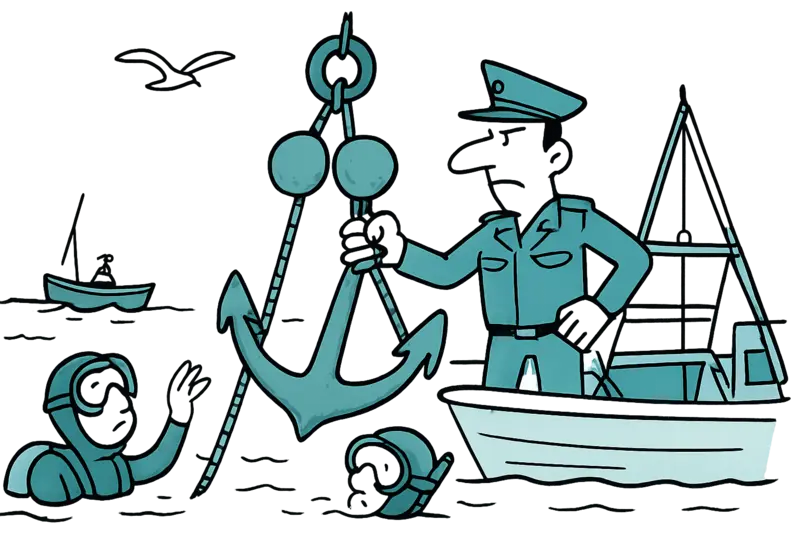
Divers from the Guardia Civil recovered a massive iron piece from Roman times off Mallorca's north coast. The roughly 350-kilogram anchor fragment lay only three meters deep and is thought to date from the 1st to 2nd century. The recovery now protects a piece of the island's history.
Ancient Piece Brought to Light: Guardia Civil Recovers Roman Anchor Fragment off North Coast of Mallorca
A lump of iron, a bridge to antiquity — and a morning by the sea
On Thursday morning, around 11 a.m., there was an unusual bustle at a still-confidential spot north of the island: seagulls cried over the blue, a fishing boat chugged by, and two divers prepared lifting aids on board. Instead of a modern wreck part, the unit for underwater activities of the Guardia Civil hauled up an iron fragment that experts date to the time of the Roman Empire — likely to the 1st to 2nd century.
The object thus falls into a special category: not a complete ship, but an approximately 1.20-meter-long piece with a propeller-like shape. It weighs an estimated 350 kilograms and was located only about three meters below the surface in coastal waters. Why this matters: such relics tell of trade routes, storms, navigation errors and the people who sailed off our coast, as with the Roman Wreck off Can Pastilla: Piecemeal Recovery Raises Questions for the Island.
The site had been known to the Guardia Civil for several years. During an inspection shortly before the recovery, officers noticed that someone had apparently tried to remove the iron piece from the water. Such attempts endanger not only the material itself but also the scientific value of the find. For that reason the responsible authorities decided to move the anchor fragment to a secure location; the precise destination was determined by an official from the island council, a recurring issue discussed in Can Pastilla: The Roman Wreck and the Question of Responsibility and Funding.
The lifting operation was carried out professionally: dive teams used balloons as buoyancy aids and gently brought the piece to the surface. Afterwards, the department responsible for cultural heritage took over the next steps so that researchers can examine the find and its protection is ensured.
If you walk along the harbors of Alcúdia or Pollença early in the morning, you rarely hear about such operations. Still, they are part of everyday life on a coast that has offered shipping, trade and refuge for millennia. The sounds of the recovery — ropes, the clatter of metal, the quiet radio — mixed with the usual bustle of the fishermen and the smell of salt water and diesel. That makes the story tangible: archaeology does not only take place in museums but sometimes also between buoys and fishing nets.
For Mallorca the find is an asset. Such discoveries strengthen awareness of the island's maritime heritage, provide starting points for scientific study and can later become visible in exhibitions or educational projects, as with Deeper Cistern, a Thousand Shards: What the New Finds at Alaró Castle Mean. They remind us that the Balearic Islands have long been part of trade and transport networks — and that every bay has its stories.
Outlook: the next steps are conservation and scientific work. Experts will document, clean and stabilize the find; further tests could yield conclusions on origin, use and the context of the shipwreck. There is also the opportunity to integrate the find into local educational programs: school classes, diving clubs and interested residents could learn about a piece of island history first-hand.
It is also a reminder of shared responsibility: relics in the sea belong to the collective heritage and should be protected. Those who walk the beach or dive encounter not only beautiful nature but sometimes also fragments from a distant time. That the Guardia Civil and the cultural heritage offices worked together is a sign that care is taken in Mallorca — for objects that tell more than just metal.
In the end remains the image of a morning on the coast: two divers, lifting balloons, a heavy piece of iron, and the slow ascent of the ancient into daylight. For some it is just a find; for others it is a new spark of curiosity about the stories that rest deep in the water.
Frequently asked questions
What does the Mallorca Roman anchor find tell us about ancient sea trade around the island?
How are underwater relics protected and studied in Mallorca after being recovered?
What exactly was found off Mallorca's north coast and why is it considered important?
Can visitors learn from these underwater finds in Mallorca?
Why is Mallorca's coastline tied to such discoveries and what do they say about the island’s role in ancient trade?
What steps follow the recovery of an underwater artifact in Mallorca?
What should you do if you spot a relic on Mallorca’s beaches or shoreline?
How does Mallorca balance tourism with protecting maritime heritage when discoveries arise?
Similar News

Who Benefits from the Half‑Hourly Flight on the Edge? Aena, Investments and the Island's Interests
Almost one billion euros is flowing into Son Sant Joan. The figures show the scale of investment and expected beneficiar...

Are the Balearic Islands the Southern Border of Europe? A Reality Check on Immigration
The Balearic Islands are again calling for EU aid after a sharp rise in arrivals by sea. Conflicting priorities between ...

"Expensive chaos" and many open questions: What clients can do when a lawyer suddenly stops responding
Several clients complain that a well-known German lawyer in Mallorca has been unreachable for months. Key question: What...
TV tip: 'The Last Problem' — Mallorca as the setting of a classic crime
A classic whodunit on Mallorca: A new miniseries set in spring 1959 brings storm, an isolated hotel and a dense web of s...
Nipping Sea Creatures: Why Bathers in Cala Major and Elsewhere Should Be Cautious
In Cala Major, bathers have reported being nipped by small fish. What is behind it, how can problems be avoided — and wh...
More to explore
Discover more interesting content

Can Cap de Bou

Townhouse Lleo 72
