
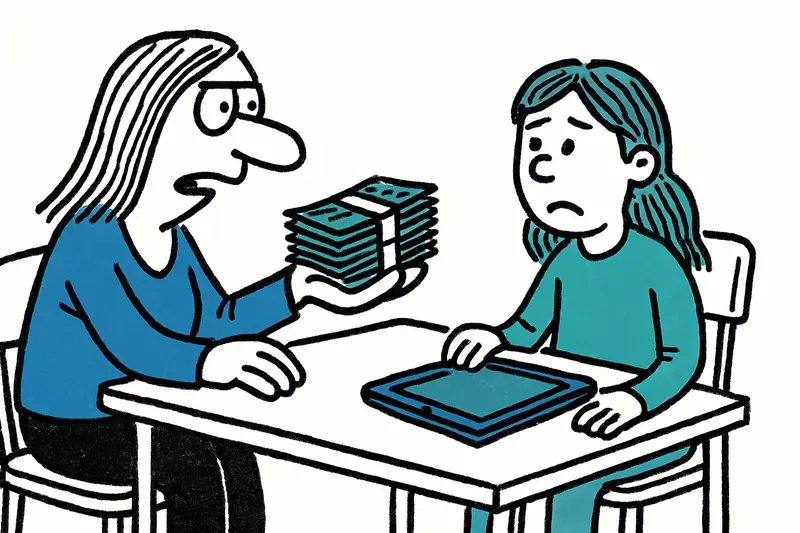
How much does Anne Wünsche really earn — and how safe is that for her daughter?
How much does Anne Wünsche really earn — and how safe is that for her daughter?
Influencer Anne Wünsche moved to Mallorca at the end of March and publicly cites large figures: around €300,000 per month via OnlyFans and BestFans, a private salary of €40,000. At the same time, her 12-year-old daughter's social media presence is criticized. A reality check from Mallorca.
How much does Anne Wünsche really earn — and how safe is that for her daughter?
A reality check between figures, protection and everyday life on the island
At the end of March, German-born influencer Anne Wünsche moved to Mallorca. Subsequently, figures about her income emerged: total revenues across two adult platforms are estimated at around €300,000 per month, her own private monthly salary is said to be €40,000, and she reported earning between €160,000 and €180,000 from OnlyFans alone. At the same time there is criticism of the online presence of her twelve-year-old daughter, whose account with almost 80,000 followers was recently inaccessible and which apparently generated lower four-figure income through affiliate links.
Key question: How responsible is it when large commercial interests, platform mechanics and a child come together in a personal environment? This question cannot be answered in a single sentence, but it should become more central in public debate.
Critical assessment of the numbers: At first glance, six-figure monthly revenues sound spectacular. Two important points put this into perspective. First: not all gross revenue stays with the content creator — in the present case "taxes and staff" are broadly cited as consuming a large share. Second: income generated via subscriptions and private platforms fluctuates greatly with content frequency, seasonality and platform policy. A suspended account or a change in terms can abruptly reduce income. Both factors are already on the table here: the main account with over a million followers was temporarily inaccessible, and platforms vary in how strictly they handle explicit content.
What is often missing in public discourse: the perspective of protecting minors vis-à-vis the economic benefit of their parents or caregivers. It is not only about moral outrage; it is about legal grey areas, age-appropriate education and economic entanglement that a child can hardly understand. Also rarely discussed is the question of residence and tax liability: a move to Mallorca changes legal conditions, but tax consequences depend on specific circumstances such as length of stay and corporate structure.
An everyday scene from Palma highlights the tension: late in the morning parents with strollers sit in front of a café on the Paseo Marítimo, waves lap, delivery scooters rattle by. Children play and listen to music while tablets and smartphones lie on the tables. As ordinary as this sight appears, the underlying economy is new: likes and clicks can be directly converted into euros today — and the question remains who pays the price if an account suddenly disappears or a clip causes legal trouble.
Concrete starting points for solutions can be derived from different levels. On the legal level: clearer rules for the commercial use of accounts that affect minors, including transparency obligations for affiliate links. Platforms should introduce mandatory age labels and visible notices about commercialization. At the state level: information offers for parents about digital income sources and tax responsibilities. At the local/institutional level in Mallorca, this could mean advisory centers for newcomers with digital business models offering help on tax issues and child and youth protection.
Practical steps that help immediately: 1) clear labeling of posts that contain commercial links; 2) consensual agreements that record which content may be published in a child's name; 3) emergency plans for account suspensions so that revenue losses do not automatically endanger the family's livelihood; 4) low-threshold information offers in communities, for example info evenings in cultural centers in Palma or Manacor, or community events like Fine dresses for a good cause: Duchess Diane establishes foundation in Felanitx.
Concise conclusion: The figures are impressive, but they must not distract from the fundamental question of how children are protected in digital business models. Transparency towards followers and authorities, combined knowledge about taxes and platform rules, and concrete protection mechanisms for minors belong together. On Mallorca's promenades one often hears discussions about influencer money — the island is an attractive place to live for digital incomes, as seen in Danni Büchner: Between Show and Protection – a New Summer in Mallorca. If we leave this trend without stricter rules and without education, the risk grows that the market, not the child, makes the decisions.
Frequently asked questions
What is the weather usually like in Mallorca in late spring?
Is it warm enough to swim in Mallorca in spring?
What should I pack for Mallorca in late spring?
When is the best time to visit Mallorca for mild weather?
What is Palma de Mallorca like to visit in spring?
Is Sóller a good place to go in spring in Mallorca?
What is Port de Pollença like outside the summer season?
Do you still need sun protection in Mallorca when it does not feel very hot?
Similar News
German tourist dies in Sa Calobra – a reality check for emergencies on Mallorca's beaches
A 40-year-old tourist died at the Torrent de Pareis. The emergency call, a doctor who happened to be present, a defibril...
Deadly Tractor Accident in Bunyola: What Needs to Be Done Now
In a work accident on an estate near Bunyola, a roughly 40-year-old man lost his life. His wife and a small child were o...
Head-first dive into the shallow part of Cala Fonoll: An accident and the unresolved question of responsibility
A young tourist dove into Cala Fonoll and was seriously injured. Key question: Why are clear warning signs missing at da...
Mistaken identity with fatal consequences: Brutal assault in S'Aranjassa — what's missing in the follow-up?
At S'Aranjassa a visitor to a finca was tied up, beaten and thrown out of a van. Three men have been arrested, including...
High heel slips, car accelerates: accident on Camí de Son Hugo
A woman lost a high-heeled shoe on the forecourt of the sports facility at Camí de Son Hugo. The car accelerated, mounte...
More to explore
Discover more interesting content

Can Cap de Bou

Townhouse Lleo 72
