
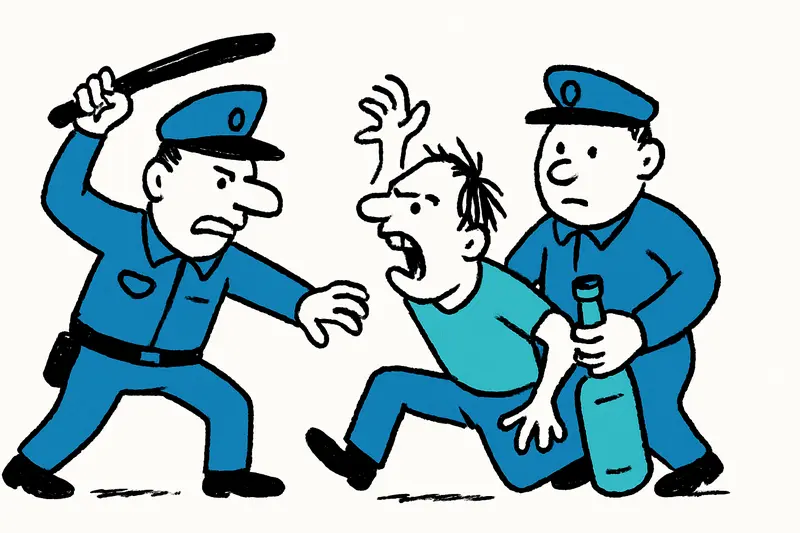
Nights in Arenal: When intoxication turns into violence — What is missing to end such escalations?
In the early morning hours a 26-year-old German tourist in Antoni Maria Alcover (Llucmajor/Arenal) lost control, attacked local police and had to be sedated and taken to Son Espases Hospital. A reality check: why repeated violence and drug use provoke nightly operations — and what we can do concretely.
Nights in Arenal: When intoxication turns into violence — What is missing to end such escalations?
Guiding question: Why do nightly outbreaks of violence in the Playa de Palma region repeatedly end so severely — and how can police, emergency services, hotels and the municipality cooperate better?
In the early hours of Sunday, around 3:30 a.m., an incident escalated on Antoni Maria Alcover in the center of Llucmajor (Arenal). A 26-year-old German tourist, who according to emergency services was under the influence of drugs, smashed market stalls and then attacked local police officers. Paramedics shortly afterwards requested that the handcuffs be removed in order to provide medical care. Despite tranquillisers, he ultimately had to be sedated with stronger medication and taken to Son Espases Hospital, where he is currently being held under the supervision of the local police. Two officers suffered injuries — a fractured finger and an elbow ailment — and are unfit for duty.
To cut to the chase: arrival on Saturday with a friend, partying in several venues, being found at night by residents, arrest with considerable force, medical treatment and hospital stay. So far, so concrete, as other reports show after an arrest in s'Arenal.
Critical analysis: We see several systemic weaknesses here that are often overlooked in public debate. First: the interface between police and emergency medical services does not work smoothly in acute intoxication cases. The paramedics' request to remove handcuffs for treatment is practical and medically plausible, but in practice it creates dangerous situations for responders. Second: there is a lack of age-specific and linguistically accessible prevention offers for young tourists, on site in hotels or drinking establishments. Similar violent escalations have occurred elsewhere, as in the Brawl at Playa de Palma, underlining the need for prevention. Third: the resources of local police in tourist centres are limited; colleagues rendered unfit for duty mean less presence on subsequent shifts — a vicious circle.
What is often missing in public discourse: data. There are hardly any easily accessible figures on nightly incidents involving drugs, times, affected locations and age groups that are evaluated locally and regularly. Without this data, every measure remains piecemeal. There is also too little discussion of how hotels and landlords can act preventively — from information duties at check-in to a clear course of action when guests behave conspicuously. And finally: the perspective of staff in bars and at stalls, who are often the first to be confronted, is missing. Blind spots in side streets and markets are highlighted by cases such as the supermarket robbery in s'Arenal.
An everyday scene you can see every summer in one form or another: Antoni Maria Alcover is only sparsely lit at this hour, the street-cleaning carts trundle by, folded market stalls lie at a corner, a taxi driver leans against his car smoking a cigarette. Music still drifts from an open hotel room, further back seagulls cry. Neighbours switch on lights and look out of windows. It is these transitional minutes between nightlife and morning in which irritability and exhaustion meet drug use — and a scuffle can become an incident with injuries, similar to the robbery at an ATM in Arenal that shocked residents.
Concrete approaches, not just Sunday speeches:
1) Joint protocols: Police and emergency medical services need binding procedures for dealing with heavily intoxicated persons (handcuff policy, accompaniment by medical staff, use of sedatives only according to clear criteria).
2) Night medical points: Short emergency units or night clinics in tourist centres could stabilise patients without burdening main hospitals.
3) Build a data base: Monthly analyses of nightly incidents, anonymised but locally differentiated, help targeted prevention measures.
4) Involve hotels and venues: Mandatory information at check-in, trained night managers in clubs, an easily reachable hotline for hotels to report acute cases.
5) Training for responders: De-escalation training, scenarios with sedated persons and mental stress prevention for officers so that injuries become rarer.
6) Education for guests: Multilingual campaigns at the airport, in hotels and via digital channels about the risks of mixing substances and available help on site.
A pointed conclusion: Such cases are not isolated offender phenomena, but the result of a porous safety and health net in the night economy. Concrete, locally coordinated measures are needed — not blanket debates about "tourism" or "bans". If police, emergency services, hotels and the municipality cooperate here, much of the escalation risk can be defused. Otherwise Antoni Maria Alcover will remain just another street corner where the siren will sound again at some point.
Frequently asked questions
What is the weather in Mallorca like in October?
Can you still swim in Mallorca in October?
Is October a good time to visit Mallorca?
What should I pack for Mallorca in October?
What is Palma de Mallorca like in October?
Is Sóller worth visiting in October?
What is the weather like in Alcúdia in October?
Can you do outdoor activities in Mallorca in October?
Similar News

Fewer Airlines, Fewer Destinations: What Palma's Winter Flight Schedule Means for Mallorca
Analysis shows: Winter at Son Sant Joan Airport will be quieter, with significantly fewer airlines and destinations. Who...
German tourist dies in Sa Calobra – a reality check for emergencies on Mallorca's beaches
A 40-year-old tourist died at the Torrent de Pareis. The emergency call, a doctor who happened to be present, a defibril...
Deadly Tractor Accident in Bunyola: What Needs to Be Done Now
In a work accident on an estate near Bunyola, a roughly 40-year-old man lost his life. His wife and a small child were o...
Head-first dive into the shallow part of Cala Fonoll: An accident and the unresolved question of responsibility
A young tourist dove into Cala Fonoll and was seriously injured. Key question: Why are clear warning signs missing at da...
Mistaken identity with fatal consequences: Brutal assault in S'Aranjassa — what's missing in the follow-up?
At S'Aranjassa a visitor to a finca was tied up, beaten and thrown out of a van. Three men have been arrested, including...
More to explore
Discover more interesting content

Can Cap de Bou

Townhouse Lleo 72
