
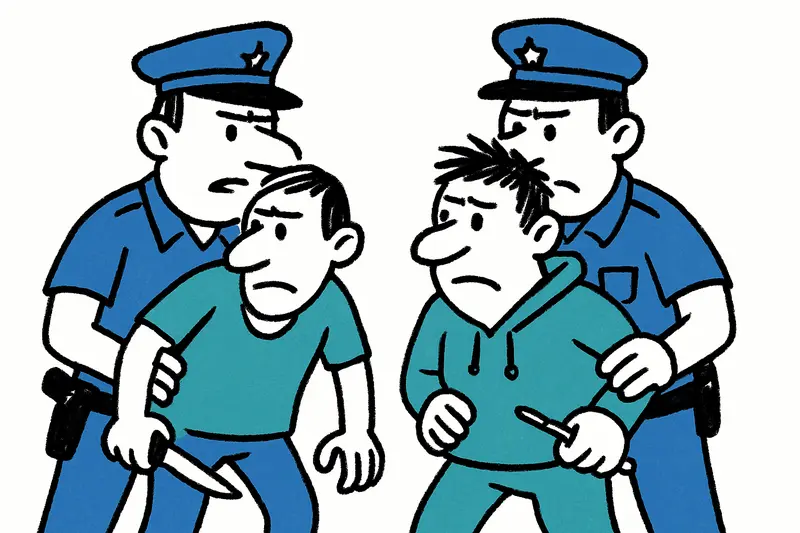
Arrests after threats at the city beach: Why an evening stroll must become safer again
Two young men were arrested after an attempted assault at Palma's city beach. The police's quick response prevented worse, but residents and tourists remain unsettled. What lies behind the violence — and which steps really help?
Arrests after threats at the city beach: Why an evening stroll must become safer again
It was one of those mild Sunday evenings on Palma's promenade: a light breeze, seagulls calling, occasional television sounds from the bars. Around 10:30 p.m. the calm was abruptly broken — agitated voices, the distant wail of a siren, a dog barking, people running. Two young men are said to have threatened several holidaymakers with a knife and a screwdriver to force money and valuables from them. Those affected managed to flee; witnesses alerted the police, who shortly afterwards detained two suspects in a side street. Related coverage includes Robbery at Can Pere Antoni: Why this incident reverberates — and what needs to happen now.
Key question: How safe is an evening walk?
The central question remains: Can you still move freely at the city beach in the evening? The swift arrests show that police presence has an effect — but safety is more than reaction time. Many residents are left with an uneasy feeling: “You used to stroll toward the harbor at ten without a second thought, now you think twice,” says a dog owner whose steps echo on the paving while the streetlights cast their warm glow.
Analytical view: Recognize patterns instead of only reacting
The National Police have taken over the investigation; initial indications link the detainees to three similar cases in recent months. One such case is detailed in Nighttime Attack on the Paseo Marítimo: How Safe Is Palma’s Party Mile Really?. That is a pattern that needs closer examination. Such crimes do not occur in a vacuum: short-term offender strategies, the night economy, alcohol and drug use, but also socio-economic factors — unemployment, lack of prospects among young people — often play a role. Little discussed is how the seasonal ebb and flow of tourism and nightlife intensifies spatial and social tensions.
Another often overlooked aspect: bright, busy promenades abruptly change into dark side streets and stairways with visual barriers and poor lighting. These “interfaces” between day and night life are coastal hotspots for petty crime.
Concrete measures: Improve safety smartly and sustainably
It is not enough to count headlines after every incident. Four pragmatic steps could help in the short and medium term:
1. Visible presence and targeted patrols: More police presence on the promenades at peak times, combined with foot patrols in the dark side streets. Visible officers not only provide protection, they also build trust with tourists and residents.
2. Lighting and spatial design: Optimised street lighting, attention to blind spots and clearer route guidance along the promenade. Good lighting increases visibility and reduces dark hiding places.
3. Technology and cooperation: Better analysis of camera footage, networking of surveillance data between the National Police, Guardia Urbana and the port authority. At the same time, data protection and the rule of law must be preserved — transparency is needed here to maintain trust.
4. Prevention instead of only repression: Mobile advisory centres, youth projects and closer cooperation with local NGOs can create prospects for young people. Preventive work takes time but pays off in the long run.
Underestimated opportunities: Learn from crime patterns
The arrests are also an opportunity: if investigators link the suspects to earlier incidents, hotspots, times and offender profiles can be identified. With this data, more precise deployment plans can be developed — more community policing and targeted social work in the affected neighborhoods. Another gain would be better information for tourists: clear guidance, safe routes and coordinated taxi stands can reduce uncertainty. Earlier reporting on enforcement and arrests can be found in Palma takes stock: Arrests made — is that enough to make beaches safer?.
What residents and visitors can do
Report observations — that is important now. Witnesses are asked to contact the police station in Palma. Small behavioural rules also help: walk in groups, choose well-lit routes, avoid displaying valuables openly and seek help immediately if in doubt. It may sound trivial, but small things significantly change the feeling of safety.
The police's quick response prevented worse — that is reassuring. At the same time, the city must not stop at damage control. Only a bundle of prevention, presence and social work will turn the temporary calm on the promenade into a lasting one.
For those affected the shock remains; for the neighbourhood it is a moment to reflect on how to make the promenade an evening place where people want to linger — not hurry past.
Frequently asked questions
Is it safe to walk along Palma beach promenade at night?
What should I do if I feel unsafe while walking in Palma at night?
What areas of Palma are more vulnerable to petty crime after dark?
What can residents and visitors do to stay safer on Palma’s seafront?
Why do police patrols matter on the Palma promenade?
Has Can Pere Antoni in Palma had safety problems recently?
Why does lighting matter so much on Palma’s promenade and side streets?
What is being done in Palma to prevent repeat incidents near the beach?
Similar News

Release after bloody attack in Palma: Why the court's decision raises questions
An 18-year-old who allegedly inflicted a serious neck injury on a man at Plaza Gomila using a wristwatch wrapped around ...
Kidnappings in Inca: Three young men forced into car trunks and abused in the forest – a reality check
In Inca, three 18-year-old men were forced into car trunks by masked assailants at the Plaça des Bestiar, taken to a for...
Spreading Massification: The Brake That Still Has Much Work to Do
Marga Prohens announces limits on volume tourism. The measures sound harsh — but are they enough to save everyday life, ...

Through the Keyhole onto the Party Yacht: How Daniela Katzenberger Is Planning Her 40th on Mallorca
Daniela Katzenberger turns 40 and wants to celebrate it on the island — likely with a boat, cake and her mother. A relax...
By Boat Instead of the Road: Palma's Water Bus — a Reality Check
The 'Bus Nàutic' launches in two stages — but questions remain over interim operations, fares and environmental requirem...
More to explore
Discover more interesting content

Can Cap de Bou

Townhouse Lleo 72
