
Balearic Islands Choose Voluntariness Over Blanket Ban: A Critical Look
The Balearic government rejects a uniform smoking ban on beaches and terraces and favors education and local solutions. Why this is not just pragmatism — and which alternatives are now necessary.
Balearic Islands choose voluntariness instead of a blanket ban — and do not solve all problems
The decision by the Balearic government — to reject a central smoking ban on beaches and terraces — appears pragmatic at first glance: no new fines, no additional stress for small venues — and instead education, prevention and voluntary non-smoking areas. Yet the region's approach also raises questions that often get lost in the loud summer flow between Passeig Marítimo and Cala Mayor: Can voluntariness be enough to reconcile health, environmental protection and tourism interests?
The central question
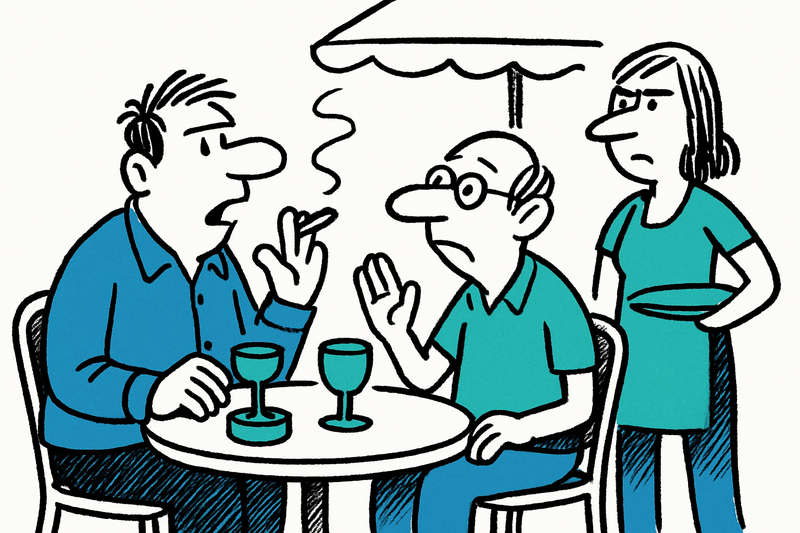
Who protects whom — and who enforces it? That is the real point of contention. On one side are the operators of cafés and beach bars who fear complex rules and want simple, practical regulations. On the other side are people who expect a bit of fresh air at the beach, children playing between loungers, and beach-cleaning teams who have to pick up cigarette butts every day. For now, the Balearic government relies on information and voluntariness. That is understandable, but it is not sufficient as a sole strategy.
What is often missing from the public debate
The discussion often runs between two poles: health protection versus economic consequences. Less attention is paid to how much wind direction and time of day change the impact of smoke. One day at Passeig Marítimo the Poniente blows so gently that cigarette smoke is hardly noticeable; the next day the Levante turns and an entire row of beachgoers breathes it in. The cost question is also rarely addressed properly: Who pays for additional controls, beach-cleaning crews or training for hospitality staff?
Concrete risks for the island
There are clear follow-up costs: cigarette butts are the most common form of beach litter, they harm marine life and cause microplastics in the sand. This matters for Mallorca's reputation as a family and nature destination. In addition, inconsistent practices cause annoyance among tourists: some feel patronized, others unprotected. The result can be complaints, social media backlash and, in the worst case, a lasting damaged image.
Why voluntariness still has a place
Voluntary non-smoking zones work surprisingly well where hosts actively communicate the offer and tourism businesses see an advantage in competition. Hotels or beach bars that position themselves as completely smoke-free use it as a quality feature. The Balearic government wants to focus on exactly that: subsidies, certifications and information campaigns instead of a nationwide smoking ban on beaches and terraces. That is smart — but not enough without accompanying measures.
Suggestions that could help both Madrid and the islands
A mix of rules and incentives would be realistic and practicable: pilot zones on heavily frequented beaches, seasonal bans during peak visitor periods, mandatory minimum distances between seating groups on terraces where smoking areas exist, and clear fines only for repeated or aggressively ignored violations. This should include support programs so that small venues can structurally separate smoke-free areas, and free support services for smoking cessation for hotel and catering staff.
There is also often a lack of a simple reporting and information system: an app or hotline through which beachgoers can report problems, linked to local police or municipal authorities, would professionalize complaint management — without every report immediately triggering a fine.
The pragmatic middle ground
Another idea: a voluntary "smoke-free" quality seal for hotels and venues, linked to visible communication during the booking process. The tourism industry benefits because guests increasingly care about health and environmental standards. For authorities this means fewer controls while still offering a noticeable range of smoke-free options.
What needs to happen now
In the coming weeks a round table will take place — with authorities, doctors, tourism experts and restaurateurs. This is the chance not only to exchange positions but to put together a clear pilot program: where do we test bans, where do we rely on voluntariness, and how do we measure success? Legal clarity is needed so that no patchwork of rules emerges on Mallorca in the autumn.
My impression: On a walk by the sea you can hear not only waves and seagulls, but sometimes the distant rustle of a cigarette pack. A bit of composure is good — but responsibility must not evaporate in the breeze. Mallorca needs practical rules and bold pilot projects to keep the island clean, healthy and welcoming.
Frequently asked questions
Is smoking on Mallorca beaches still allowed?
Why is Mallorca not introducing a blanket smoking ban on beaches and terraces?
Does voluntariness work well enough for smoke-free beaches in Mallorca?
Why do cigarette butts matter so much on Mallorca beaches?
Are some Mallorca beaches or beach bars more likely to become smoke-free?
How do wind and weather affect smoking on Mallorca beaches?
What could Mallorca do instead of a total smoking ban?
How could Mallorca improve smoke-free areas without making rules too strict?
Similar News

Maribel: Five Decades of Service – Housekeeper from Peguera Celebrated with a Special Honor
Over 50 years in the hotel business: María Isabel “Maribel” Molinos was honored in Palma at the Nit del Turisme by Unive...

Orange Alert over Parts of Mallorca: Are We Prepared?
Dark clouds and an announced wet spell have triggered an Orange alert in parts of Mallorca. A reality check: what's miss...

Sundair & Co.: Sale speculation and what it could mean for Mallorca
Rumors about a possible sale of the airlines Sundair and Fly Air 41, which belong to Schauinsland-Reisen — and whether b...
Anne Wünsche in Mallorca: A job offer with a catch — who fits the role of personal assistant?
Influencer Anne Wünsche has left Berlin and is urgently looking for a full-time personal assistant in Mallorca. Why the ...

Daily from New York: Palma Between Boom and Strain
United will increase the Newark–Palma route to daily flights in 2027 using Boeing aircraft (231 seats). What does the in...
More to explore
Discover more interesting content

Can Cap de Bou

Townhouse Lleo 72
