
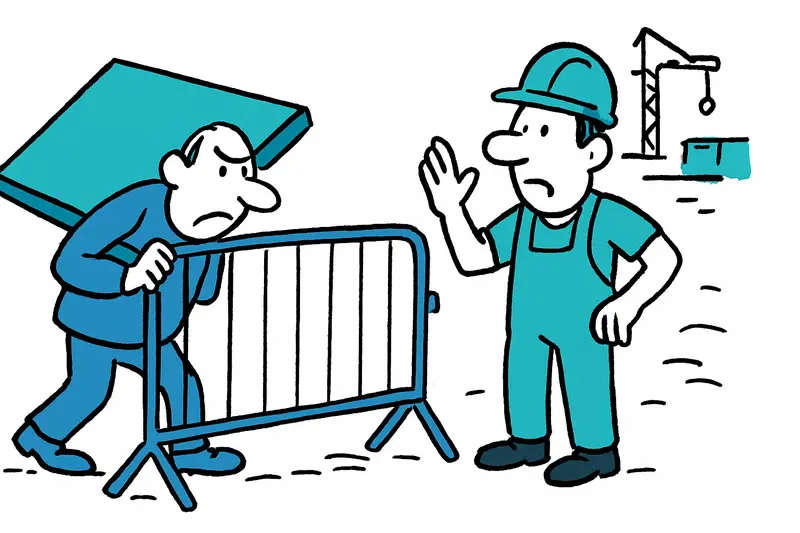
Ballermann Construction: When the Fences Will Finally Come Down — and What the City Is Hiding
The promenade at Playa de Palma will remain lined with construction fences for weeks. Who bears the burden — and how can the season be made more tolerable for residents and businesses? A reality check from the Playa.
Ballermann Construction: When the Fences Will Finally Come Down — and What the City Is Hiding
Key question: Is mid-May and underground work continuing until the end of June a sufficient plan — or will Palma's administration miss the chance to organize the season in a tolerable way?
The sun is clean in the sky, AEMET reports around 23ºC for Palma, and the Paseo is already in a spring mood. Still, on my walk I often stumble over barricades, knee-high posts and privacy screens: Maravillas Park is fenced on the sides, along the promenade there are site huts, signs and freshly piled earth. The Palma Beach hoteliers' association names mid-May as the date when the visible drainage work should be finished; underground work, they say, will continue until the end of June.
Those are facts you need to know. Anyone who expects the Playa to appear in its usual undisturbed party mode for the April openings of Bierkönig (April 16–19) or Mega-Park (April 23–26) will see a different picture: construction fences frame the area, a local example of the Construction Boom in the Balearic Islands: Opportunities, Noise and the Tricky Road Ahead. For many holidaymakers this may be an annoying sight. For residents, hoteliers and shopkeepers it can have tangible consequences — from restricted pedestrian flow to lost outdoor dining space.
What I miss is clear communication about consequences and compensation, a problem highlighted in When Palma's Trees Fall Silent: Felled Pines and Lost Trust. If underground work continues, that means noise at certain times, possible closure of entire access points and restrictions for emergency routes. Such details should not only be in an association paper but public, comprehensible and accompanied by responsible persons who answer questions.
Pushed to the extreme: anyone already lining up in April on the Schinken- and Bier street hears the rattling of construction machines in the background, smells bratwurst and diesel mixed together and often feels like they're standing in a construction site instead of a holiday district. That's the everyday experience of many shop owners whose tables are missing on sunny days because space is needed for construction vehicles.
The criticisms can be named concretely. First: missing detailed plans for residents and the gastronomy sector. Second: no transparent scheduling of noisy work. Third: unclear responsibilities for cleanliness and safety at the construction sections. Fourth: no short-term replacement solutions for parking and recreational spaces, such as the announced conversion of the dino mini-golf area, which is only due to be tackled on October 1.
So what to do? Concrete proposals that can be implemented immediately: 1) a weekly updated online plan with maps, closure times and responsible contacts; 2) a local point of contact (community liaison) on site who handles complaints within 48 hours; 3) restricting loud work to morning windows so evening operations in bars and restaurants remain possible; 4) temporary, mobile seating and privacy solutions so outdoor catering can operate despite the construction; 5) a hotline for emergencies and accessibility cases to ensure emergency routes are always kept clear.
One final point on perspective: the announced underground work until the end of June may be unobtrusive for tourism if it is truly low-noise and well-coordinated. Far more important, however, is how the city controls the images of the summer. A few weeks of bad photos can stick to the online image of an entire season. Transparent, honest communication and visible damage-control measures would therefore be wiser than soothing platitudes.
Conclusion: It is right to put the Playa de Palma's infrastructure in order. But planning is more than a date. Whoever names mid-May as the visible end and at the same time schedules underground work until the end of June must take responsibility for the meantime, be visible and reachable, and protect the people on site. Otherwise more memories of the season will be of fences than of the sea.
Frequently asked questions
When will the construction fences come down at Playa de Palma?
Will the Ballermann area be fully open for the April openings in Mallorca?
How will construction at Playa de Palma affect holidaymakers and beach bars in Mallorca?
Is it still possible to go out to bars and restaurants at Playa de Palma during the works?
What kind of information should Palma provide about construction near Playa de Palma?
What is the weather like in Palma in spring for walking along the Paseo?
Why are people in Mallorca worried about noise from underground construction at Playa de Palma?
What is happening with the old mini-golf area near Playa de Palma?
Similar News

Rental Car Theft in El Arenal: What This Incident Reveals About Our Gaps
A teenager steals a running rental car in El Arenal, flees on foot, climbs over walls and is caught by the Guardia Civil...

Red Rope in Palma's Library: What Helps Against Selfie Tourism — and What's Missing
Palma's city library cordoned off an area with a red rope to keep selfie tourism away from reading and working activitie...

Fort San Carlos: Museum, Harbor Dispute — and a Conflict That Demands Answers
The military museum at Fort San Carlos sits right on Palma's harbor, with unexpectedly quiet rooms filled with cannons a...

Old Town Under Pressure: When a Doorway Becomes a Sleeping and Shower Place
For months a woman has been living with a parasol, a clothes rack and personal belongings next to the social welfare off...

When Shopping Weighs Heavier: Mallorca Demands a Tax Pause on Food and Fuel
Rising prices are putting pressure on households and agriculture. The Balearic Islands are calling for temporary tax rel...
More to explore
Discover more interesting content

Can Cap de Bou

Townhouse Lleo 72
