
Blackout in the High Season: Who Pays the Price at Playa de Palma?
Blackout in the High Season: Who Pays the Price at Playa de Palma?
Several days of power outages at Playa de Palma hit restaurants, bars and guests. Who is responsible — and how can repetitions be prevented?
Blackout in the High Season: Who Pays the Price at Playa de Palma?
Key question: Why did the power supply collapse now at one of Mallorca's most important tourist stretches — and who ultimately has to bear the costs for the damages?
In the hot week in mid-July, when the promenade between Can Pastilla and Ballermann 6 was full of tables and sun-seekers, the lights went out on several evenings. Guests suddenly ate by candlelight, chefs had to stop fryers and pans, and provisional diesel generators hummed in the background. The heat lay over the coast like a blanket; on the terraces the clinking of glasses mixed with the distant roar of the surf and occasional horn blasts. Such scenes are not only annoying — they threaten livelihoods.
The facts are clear: In a section of Playa de Palma there were massive outages between July 17 and 19 and prior recurring voltage fluctuations. Hotels, gastronomy and retail reported damage, perishable goods were endangered, and POS systems failed. The local hotel and gastronomy associations are now reviewing legal steps and demanding transparency, as discussed in Playa de Palma at the Season Finale: Profits, Noise — and Who Pays the Bill?.
Critical analysis: A serial failure of the supply during the high season has multiple causes that must be distinguished. Technically, much points to overload combined with outdated or damaged infrastructure: transformers, medium-voltage lines, distribution boxes — all of this ages and needs capacity, especially during record temperatures and peak loads. Organizationally, planning gaps add to the problem: redundant feed lines, emergency power concepts for commercial districts and fast replacement mechanisms appear not to have been sufficient. Legally, the question remains whether the grid operator fulfilled its obligations and whether regulation and inspections by authorities are strict enough.
What has so far been underrepresented in the public discourse: First, the role of preventive maintenance and the impacts of climate change on infrastructure. Heat increases the risk of failures; therefore regular stress tests and replacement investments are not a luxury but an obligation. Second, there is a lack of a clear, publicly accessible damage registry: Which businesses lost how much, which insurances cover this, and how long does a standard compensation process take? Third, the social consequences are rarely discussed: for temporary staff in restaurants and seasonal workers, sudden closures mean direct income losses, a trend documented in When the Beach Stays Empty: How Mallorca's Sunbed Renters and Chiringuitos Are Fighting to Survive.
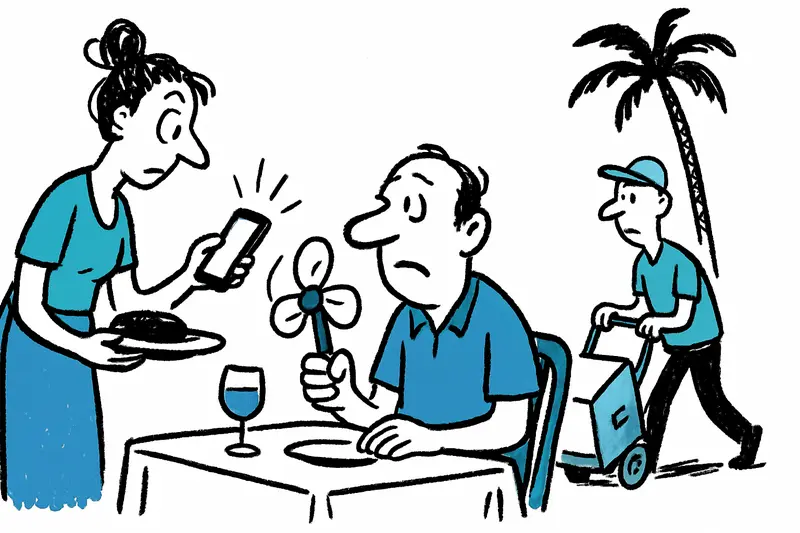
A scene from everyday life: On Saturday evening, when the second power failure occurred, I sat at one of the tables near Ballermann 6. A waitress with her hair tied up balanced plates in the light of a cellphone, an older guest desperately searched for his disposable fan, and two delivery workers pushed boxes of ice cream past that were already melting. The general mood swung between understanding and anger — very real, very close.
Concrete solutions: First, an immediate independent investigation of the incidents with publication of technical reports and timetables for remedies. Authorities should set clear deadlines for repairs and modernization. Second, build redundancy: additional feed-in points, more modern distribution systems, partial undergrounding or cable replacement where overhead lines are vulnerable. Third, short-term mandatory emergency plans for commercial districts: mandatory minimum cooling reserves for restaurants, subsidized mobile emergency power solutions for small businesses and coordinated distribution of generators by the municipality. Fourth, a fast compensation and reporting procedure: a digital platform where businesses can report damages with evidence, linked to a mediation body. Fifth, long-term: investments in smart grids and demand management, coupled with subsidy programs for climate-resilient infrastructure.
A pragmatic step would also be for the grid operator to issue daily situation reports in the coming weeks and for authorities to order regular inspections, a need highlighted by incidents such as the Power Outage and Storm: What the Incident at Palma Airport Really Reveals. Transparency is not goodwill, but trust — and that is quickly lost after such disruptions.
Conclusion: A power outage at Playa de Palma is more than a technical problem; it is an economic and social risk for a region that depends on tourism. Rapid restoration of supply is not enough. Clear answers, binding measures and fair compensation for those affected are needed. If only apologies remain after the candlelight, the risk is high that the next heatwave will switch off the lights again — and then it will not only be annoying, but existentially threatening.
Frequently asked questions
Why did the power outages hit Playa de Palma in mid-July, and who pays for the damages?
How does Mallorca's summer heat affect the electricity grid and outage risk?
What can Mallorca businesses do to prepare for power outages?
Is there a public damage registry for outages in Mallorca and how do claims work?
What long-term grid improvements could help Mallorca reduce future outages?
What should tourists in Mallorca do during a blackout?
How do power outages affect Mallorca's tourism economy and local workers?
What accountability measures are being considered after the Playa de Palma blackout?
Similar News
From the Reality Studio to the Pitch: Aleks Petrovic Makes Mallorca His Base
The former participant in numerous TV shows moves from Dubai to the island and launches a project with FC Germania Mallo...

When the Phone Falls Silent: Concern for Sarah Joelle in Mallorca — and What It Reveals
After days without a response, the TV personality's unreachability in Mallorca sparked concern. Shortly afterwards an al...

Ultraluxury on the Ground: Four Seasons Jet in Palma — a Reality Check for Formentor and the Island
A high-priced flight crosses Mallorca and its guests stay for days at the Formentor resort. What does the island get bes...
Death of a Witness and the Justice Backlog: Why the Kegel Brothers Trial Matters in Mallorca
A witness in the Playa de Palma fire case has died, and the trial against eight German holidaymakers has been delayed un...

Champagne Reception, Red Carpet and Mini Originals: The Pre-Nit del Art at Gallery Mensing
Almost 400 guests, champagne, pop-art feats by Tom Boston and a raffle for the Parkinson's foundation: Gallery Mensing t...
More to explore
Discover more interesting content

Can Cap de Bou

Townhouse Lleo 72
