
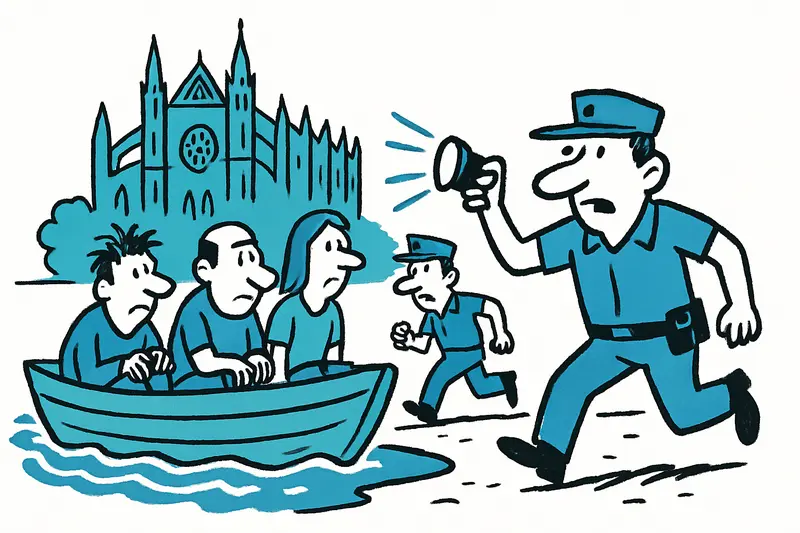
Boat at Can Pere Antoni: Why the landing in front of the cathedral is more than an isolated incident
Boat at Can Pere Antoni: Why the landing in front of the cathedral is more than an isolated incident
Shortly after two in the morning at an inner-city beach: A small migrant boat lands near Palma's cathedral. What does this say about the situation in the Balearics — and what is missing from the debate?
Boat at Can Pere Antoni: Why the landing in front of the cathedral is more than an isolated incident
A nighttime landing in Palma raises questions — not just for the coastguard
Key question: How is Palma preparing its beaches, authorities and residents for the increasingly visible landings of people seeking protection who arrive in small boats?
In the early hours, around 2:00 a.m., a small boat arrived at Can Pere Antoni, just a stone's throw from the cathedral. Four people were taken in by National Police and Guardia Civil officers and brought to the National Police headquarters. This is one of several landing points in recent days: authorities reported that nine boats reached the Balearics in a single Sunday, and in one week at least 52 people were registered in four boats.
Critical analysis: This scene is more than a solitary arrival at an unusual location. It shows that the routes by which people reach the Balearics are increasingly moving into urban proximity — and thus into view of tourists, residents and daytime activity; it echoes other incidents where coasts and small coves have come under pressure, such as When the Catamaran Came in Too Far: Banyalbufar and the Question of Who Shares Mallorca's Coasts. A landing in front of the cathedral is not just symbolic: it changes perceptions, shifts responsibility to local authorities and moves the challenge into places that are heavily frequented by tourists yet understaffed.
Security forces respond quickly, which is evident. But rapid interventions do not solve the structural questions: who takes on initial registration, medical first aid and legal screening when landings happen in the middle of the city? How can beaches be prevented from becoming temporary reception centers or residents and visitors from being unexpectedly turned into witnesses of humanitarian emergencies?
What is often missing from the public discourse is a sober confrontation with three levels simultaneously — prevention at sea, humane first reception on land, and long-term political responses. Prevention here does not mean isolation alone, but better information at sea, more capacity for maritime search and rescue, and clearer reporting chains between maritime surveillance and local services. First reception needs protected spaces, medical check-ups and fast, transparent identification processes. The political level concerns countries of origin and transit, legal migration routes and the question of how European responsibilities can be practically coordinated.
Everyday scene from Palma: the morning after, when the cathedral bells roll over the Passeig des Born, residents see fishing boats at the pier, joggers on the waterfront and the street cleaners who tidy the promenade. Tourists go to the café on the Rambla, the sun slowly climbs over the roofs, and the memory of the night landing hangs like a light dampness in the air. This mixture of normality and sudden humanitarian reality makes the situation particularly tangible here.
Concrete solutions that can be implemented locally: 1) A local alarm and coordination center for inner-city landings that networks police, Salvamento Marítimo and municipal services more quickly. 2) Temporary, dignified reception points near major beaches that do not immediately dominate the cityscape but allow for medical first aid and registration. 3) Information signs at beaches and ports with behavioral guidance for bathers and tourism providers so that bystanders are not drawn into dangerous situations or make panic-driven decisions. 4) Strengthened prevention cooperation with fishing and port communities (see Conflict in Banyalbufar's Cala: When Is Enough Boat Traffic Too Much?): inform and involve boat operators and ports early. 5) At the regional level: accelerated procedures for determining protection needs and better distribution between islands and the mainland to avoid local overloads.
What does not help: mere symbolic politics and spectacular patrol outings without accompanying infrastructure on land. Nor is it a solution to frame the debate only as a security issue; it remains a humanitarian and legal matter that, alongside security, concerns human rights and administrative capacity.
For Palma this means in practical terms: more staff in beach patrols, clearer points of contact in city administration, a routine for night landings and more transparency towards residents and visitors. The island government and the interior ministry must coordinate their capacities so that not every arrival becomes an improvised emergency with civilians as eyewitnesses.
Conclusion: The landing at Can Pere Antoni is a clear sign that migration is reaching island spaces where everyday life and tourism converge. Those who want to take the problem seriously must not only patrol the coast — organized procedures on land, clear information policies and binding agreements between rescue services, police and municipalities are needed. Otherwise the nocturnal scene will repeat itself: a boat, searchlights, voices on the promenade and the question of what the city will do next.
Frequently asked questions
When is the best time to visit Mallorca for warm weather and swimming?
What should I pack for a trip to Mallorca?
Is Mallorca a good destination for a beach holiday?
What is the weather like in Mallorca in spring?
Can you swim in Mallorca outside the summer months?
Is Palma de Mallorca worth visiting for a day?
What is Sóller like for visitors to Mallorca?
Is Alcúdia a good place for families in Mallorca?
Similar News

Eurowings lets four aircraft carry names – a friendly idea that also reaches Mallorca
Eurowings is launching a campaign: four Airbus A320s are to carry the first names of people who help others in everyday ...
From the Reality Studio to the Pitch: Aleks Petrovic Makes Mallorca His Base
The former participant in numerous TV shows moves from Dubai to the island and launches a project with FC Germania Mallo...

When the Phone Falls Silent: Concern for Sarah Joelle in Mallorca — and What It Reveals
After days without a response, the TV personality's unreachability in Mallorca sparked concern. Shortly afterwards an al...

Ultraluxury on the Ground: Four Seasons Jet in Palma — a Reality Check for Formentor and the Island
A high-priced flight crosses Mallorca and its guests stay for days at the Formentor resort. What does the island get bes...

Death of a Witness and the Justice Backlog: Why the Kegel Brothers Trial Matters in Mallorca
A witness in the Playa de Palma fire case has died, and the trial against eight German holidaymakers has been delayed un...
More to explore
Discover more interesting content

Can Cap de Bou

Townhouse Lleo 72
