
Brawl at the Airport: Who Is Responsible for the Escalation Among Transfer Drivers?
A dispute between two transfer drivers escalated on Saturday morning in the arrivals area of Son Sant Joan. One man was injured and a colleague arrested. What does this say about control and order at Palma's airport?
Brawl at the Airport: Who Is Responsible for the Escalation Among Transfer Drivers?
An incident on Saturday morning makes clear: conflicts at the pickup zone can quickly get out of control.
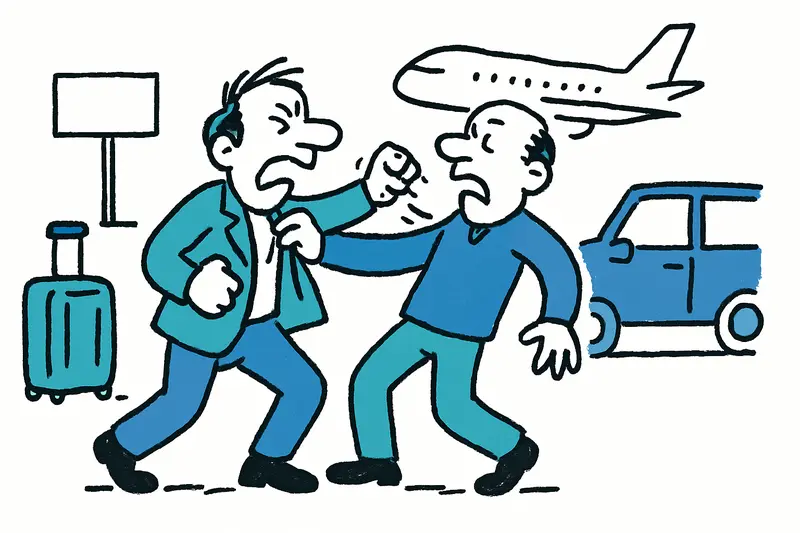
At the arrivals area of Son Sant Joan Airport, a busy Saturday morning was not only marked by the typical clatter of luggage trolleys but also by loud exchanges and finally physical violence. According to information available to the editorial team, two chauffeurs got into an argument while one of them was loading suitcases into the trunk of a minibus. The attacker approached the other man and delivered several blows — including to the head area, with the left ear particularly affected. The victim complained of dizziness and required medical assistance; a tooth and a dental brace were also damaged. Many arriving holidaymakers watched the scene, and the atmosphere in the arrivals hall was noticeably tense for several minutes.
During the altercation, the arrested man allegedly held a small metallic object in his hand, which the victim feared might be a wrench or even a knife. The National Police intervened: officers from the border control unit provisionally arrested a roughly 40‑year‑old Spanish national. He now faces proceedings for bodily harm, threats and serious coercion; the victim has filed a complaint. According to the injured person, there had already been previous conflicts between the parties over professional matters and the transport of passengers. (See related arrests at Son Sant Joan Airport.)
The scene is not just an isolated case of vigilante justice: in the eyes of arriving guests it reflects a problem that goes beyond personal aggression. Those who manage parking spaces, pickup lanes and customers at airports must expect competitive situations to arise — especially during peak times when buses, rental cars and transfer services compete for the same passengers.
Main question: How can airport operators, authorities and companies prevent professional conflicts from turning into violence — without further complicating operations and arrival procedures?
A sober examination reveals several weak points: a lack of clear assignment of pickup spots for private transfers, insufficient on-site checks of commercial operators, a lack of visible presence of order or security services at critical moments, and a culture in which drivers often confront one another directly and personally. Public discourse tends to speak of “chaotic conditions” at airports, such as strikes at Palma Airport, but rarely of the working reality of drivers who operate under time pressure and economic competition — or of the responsibility of the companies that send drivers out.
What is rarely mentioned: the voice of those affected, i.e., the drivers themselves, as well as the role of booking platforms and employers. Systemic questions are often ignored, such as how access rules, digital allocation of assignments and mediation mechanisms at airports are designed. And not least: what prevention duties do the operators of airport areas have?
A typical everyday scene: a coach unloads a group, a porter pushes luggage across the tiled floor, the cafeteria smells of fresh coffee, and small groups of waiting drivers form in front of the counters. In this mix a single spark is enough — a wrong word, a maneuvering mistake — and tempers flare. That is exactly where action is needed.
Concrete approaches to prevent future escalations could include: clearly and visibly marked zones for contract-bound transfer services; stricter access controls for private drivers during peak times; mandatory identification requirements and driver permits that can be checked on site; dedicated mediators or security personnel who intervene to de-escalate disputes; compulsory training for chauffeurs on conflict resolution and codes of conduct; digital dispatch systems that reduce double bookings and illegal pickups; and a transparent sanctioning policy by airport operators and the responsible authorities.
It is also important that travelers know whom to contact if they witness such incidents. Visible notices in the pickup area, a short hotline number or an app function would make it easier for passengers to report disruptive incidents without getting drawn into the situation themselves.
In the short term, increased police presence and better video surveillance would reduce the likelihood of such scenes. In the medium term, the island needs a coordinated strategy between the airport administration, private transfer operators, the trade supervisory authority and the police that clearly regulates operational rules, checks and sanctions. Without this, Palma’s reputation as a safe holiday destination is at risk — because arriving travelers should not associate their arrival with stress and violence.
Conclusion: The incident on Saturday was brutal and unnecessary, but it is also a warning sign. It is not just about two men who clashed. It is about structures, rules and responsibilities that must ensure that commercial interests do not turn into violence. If authorities, the airport and the industry do not act now, the next scene is only a matter of time — and it will not be understood by arriving guests.
Frequently asked questions
What happened at Son Sant Joan Airport that raised concerns about transfer-driver conflicts?
What steps can Mallorca airport operators take to prevent transfer-driver conflicts?
How should travelers respond if they witness a confrontation at Mallorca's airport pickup area?
Why are clearly marked pickup zones important at airports like Son Sant Joan?
Should drivers undergo conflict-resolution training for Mallorca transport services?
What role do booking platforms and employers play in preventing violence at Mallorca airport pickup zones?
What long-term coordination is recommended for Mallorca’s airport transfer ecosystem?
What immediate safety steps could Mallorca implement to deter future incidents?
Similar News
Collision in Palma: Why an E-scooter and a Patrol Car Ended Up on a Collision Course
At an intersection in Palma in early September a young e-scooter rider collided with a local police patrol car. No one w...
Warty on the Green: When a Cyborg Is Supposed to Learn Golf in Mallorca
A silver humanoid named Warty visits Son Gual – as advertising for Water D and as a guinea pig for golf lessons. A criti...
Balearics Consider Restrictions on Second-Home Purchases – a Reality Check
The regional government is examining whether purchases of second homes by non-residents can be restricted in future — bu...

Concert and Tasting at Sa Torre de Santa Eugenia: Music, Cuisine and Mallorcan History on September 18
An evening at a historic estate: chamber music, a tasting menu paired with wines from Macià Batle, and proceeds benefiti...

Carrer Cardenal Despuig: Where Residents Feel Abandoned in the Evenings
Residents of Carrer Cardenal Despuig in Palma complain about beggars, drug use and nighttime altercations. A reality che...
More to explore
Discover more interesting content

Boat Tour with BBQ along Es Trenc Beach

Private transfer from Mallorca Airport (PMI) to Pollensa
