
Breast Cancer at 34 – How Sarah Pipkin Began a New Life Through Art in Mallorca
Breast Cancer at 34 – How Sarah Pipkin Began a New Life Through Art in Mallorca
Diagnosed with breast cancer at 34, followed by chemotherapy, a mastectomy and a life in gray. On Mallorca, artist Sarah Pipkin reclaimed color — in her life and on canvas. In May she plans a charity event featuring 20 paintings.
Breast Cancer at 34 – How Sarah Pipkin Began a New Life Through Art in Mallorca
From a phase of gray to an explosion of color: images, movement and community as remedies
It is a bright morning in Santa Ponça. On the balcony of the apartment in Calvià, canvases lie glowing from the warmth. Birds are chirping, somewhere a moped starts its engine — the island atmosphere is unmistakable. This is where 34-year-old artist Sarah Pipkin lives and works. Not long ago her everyday life looked very different: in May 2023 she received a breast cancer diagnosis during a routine check. What followed were many doctor appointments, chemical treatments and finally a mastectomy. She has undergone three operations.
This experience changed Pipkin’s work. Previously, black-and-white and gray tones dominated her painting. During therapy she produced self-portraits, often only partially complete, without eyes, without hair — visual notes of an identity in the process of being lost. When chemo ended in September, a slow, arduous climb back to life began. Hair grew back, the body recovered; her soul found stability through movement, small rituals and the people who supported her: her partner, her parents and her two older brothers.
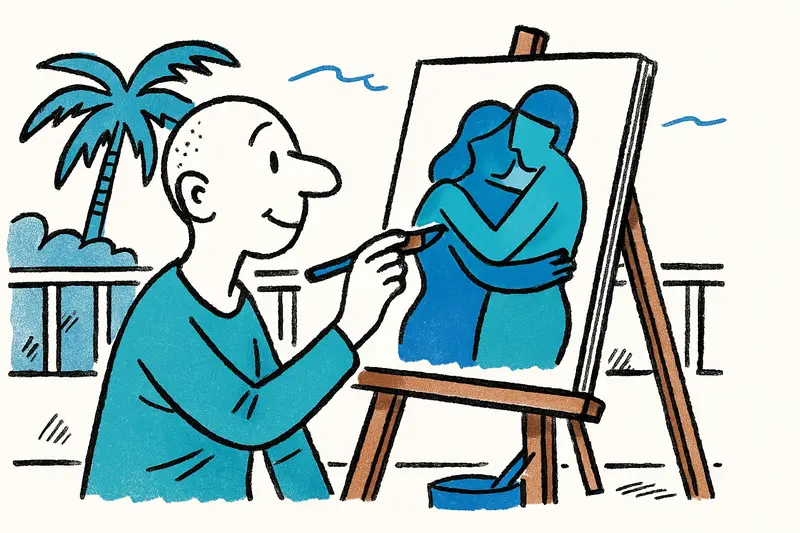
Today her paintings show couples, touching encounters, sensual figures in vibrant colors. Pipkin works with acrylic, palette knife and spray. The often life-size figures fill the space; they are close, forgiving, full of sensuality. "I wanted to be feminine again," she says. Not only as an artist, but in life. Her boyfriend, who accompanied her, helped her look ahead — small outings, shared meals, the feeling of being desired. At the same time she radically changed her routine: morning runs in the park, green tea with honey, no alcohol, no cigarettes, no sugar. Medical advice: 145 minutes of intense exercise per week. Yoga alone was not enough.
Professionally something shifted as well. She previously worked as a project manager in tourism after studying finance and economics at the University of London. Now she works from home in accounting for a tourism company in Mallorca, a quieter role that echoes other stories of new beginnings such as From the Conference Room to the AI Canvas: How an Ex-PR Woman Starts Anew in Mallorca. The tasks are quieter and more flexible; the body can take priority again. She has been back at work for about ten months — with new priorities.
Out of what she experienced came a concrete project: a series of 20 paintings that Pipkin plans to sell in May. About half of the proceeds will go to organizations active in the fight against breast cancer. The idea feels like a repayment — to those who helped and to the island community that often makes the difference in difficult times, as other residents putting down new roots show in stories like At the Finca near Llucmajor: How Talia Is Putting Down New Roots in Mallorca.
What this story also shows is that healing is not an endpoint, but a process. Pipkin goes for comprehensive check-ups every six months. Fear remains a companion, but it no longer determines everything. Instead, gratitude and empathy grow. The artist says she laughs more and dares more again. That radiates onto her surroundings — friends, neighbors at Parc de la Mar, walkers along the coast of Calvià.
For Mallorca this means more than a single success story. Culturally, an artist like her contributes to the island's diversity: she speaks about illness without pathos, about corporeality without eroticization, about solidarity without kitsch. The upcoming charity event can raise awareness, mobilize donations and strengthen local networks. Those sitting in small cafés at the harbor or strolling along Passeig Mallorca may soon encounter a painting and its story more often.
Lessons? There are several. Medical care is important, but so are closeness, movement, finding one's identity again and the ability to express oneself; cases like this raise questions about how Mallorca can better help. Pipkin’s path is an invitation: allow color in, share good things and don't wait until everything is perfect. On Mallorca, between the rustle of pines and the sea air, paintings are created that are not only beautiful but can also heal.
In May people will be able to see and buy her works. For many it will then be more than an art purchase, but a piece of lived hope — tangible, local and unpretentious.
Frequently asked questions
How can art help during breast cancer recovery in Mallorca?
What is life like in Santa Ponça for an artist?
Can exercise really make a difference during cancer recovery?
What kind of art did Sarah Pipkin start making after breast cancer?
Where can people see Sarah Pipkin’s paintings in Mallorca?
Why do some breast cancer survivors talk about body image changes?
What role does community play in recovery in Mallorca?
What is the connection between Mallorca and Sarah Pipkin’s new life?
Similar News
The Maricarmen Case: Why an Eviction Is Forcing Spain's Housing Debate
Images of an 87-year-old woman on a stretcher have sparked a debate in Spain that also runs deep in Mallorca. Who protec...
Parking dispute in Els Hostalets: When a gap leads to violence
A parking dispute on Calle Aragón escalated into a mass brawl at night. Why do trivial conflicts here turn bloody so qui...
Bodycams in Palma: More clarity needed so surveillance doesn't become the norm
Palma's local police equip UII officers with Axon Body 4 cameras. Useful for evidence collection — but specific rules on...
When the Bread Door Closes: Why Maria de la Salut Lost Its Last Bakery
The only bakery in Maria de la Salut, a sales outlet of Forn de ca'n Joan Terès from Palma, has permanently closed. What...
Ancient Piece Brought to Light: Guardia Civil Recovers Roman Anchor Fragment off North Coast of Mallorca
Divers from the Guardia Civil recovered a massive iron piece from Roman times off Mallorca's north coast. The roughly 35...
More to explore
Discover more interesting content

Can Cap de Bou

Townhouse Lleo 72
