
Burning Car at Sant Joan: Who Protects Us When the Road Becomes the Danger?
Burning Car at Sant Joan: Who Protects Us When the Road Becomes the Danger?
A car slips into a dried-out field and catches fire. A woman pulls the driver out; both are injured. Why is luck not enough as a rescue — and what needs to change?
Burning Car at Sant Joan: Who Protects Us When the Road Becomes the Danger?
Key Question
Why can a traffic accident in Mallorca so quickly turn into a wildland fire and cause severe burns to people — and what is missing so that in the future pure luck does not again decide between life and death?
Summary of the Incident
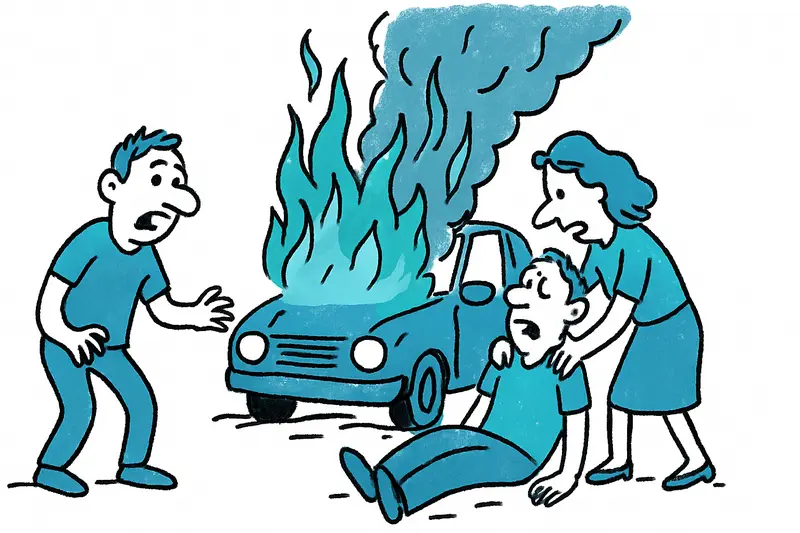
In the morning on the Camí de Can Calders near Sant Joan, a vehicle apparently left the road, slid down a low embankment and came to rest in a dried-out field. For reasons not yet clarified, the car caught fire. A man who was inside the vehicle suffered severe burns over large areas of his body and was initially taken to Son Espases; a transfer to the specialist clinic Vall d'Hebron is planned. A woman who happened to pass by pulled the trapped person out of the burning vehicle and thus probably saved his life. She herself suffered burns and was taken to Manacor. The flames spread to surrounding fields and destroyed about 1,000 square meters of vegetation. Firefighters from Manacor were eventually able to extinguish the blaze, echoing other incidents such as the field fire near Manacor. The Guardia Civil, the Sant Joan local police, civil protection, IBANAT and a SAMU 061 rescue team were on site; the traffic police are investigating the course of events.
Critical Analysis
The facts speak clearly: dry vegetation plus hot vehicle parts are an accelerant for fire. If a car leaves the road and comes to rest on flammable growth during a period of severe drought, often the residual heat from the engine or exhaust is enough to start a fire. Added to this is that on narrow country roads, tools and escape routes are scarce — this makes self-rescue more difficult and increases the risk for first responders.
What Is Missing from the Public Debate
The dramatic heroism of the woman is being discussed — rightly so. But two things are missing: first, an honest debate about how good our rural access roads and vegetation management really are; second, concrete information for drivers on how to behave if a vehicle ends up in dry terrain. Lots of publicity, but few topics like preventive measures, mandatory vegetation maintenance along roadways, or the availability of simple firefighting equipment in cars. This echoes episodes like the Fire on the Paseo Marítimo, which also exposed questions about infrastructure and prevention.
Everyday Scene from Mallorca
Anyone who drives along the Camí de Can Calders in the morning knows the cicadas' chirring, the light dust on the road and the smell of Sunday olives behind the dry stone walls. In late summer the island is often dust-dry; a passing tractor, a faulty exhaust, an unintended parking move are enough and suddenly smoke hangs in the air, sirens approach, and residents stand with wet sheets at gate entrances because of the lack of firefighting resources, similar to scenes reported after the Flames on Camí del Far.
Concrete Solutions
1. Organize vegetation management consistently: municipalities and landowners must have coordination plans to remove dry grass along country roads during dry periods. 2. Visible signs and emergency information at rural roads: signs with instructions, emergency numbers and GPS coordinates reduce search times. 3. Small fire extinguishers as recommended basic equipment: a compact extinguisher in the car is not a luxury but sensible for driving on unpaved tracks. 4. First-aid and fire-fighting workshops in communities: anyone who has learned how to pull a person out of a danger zone without endangering themselves can save lives, as shown by incidents like the fire next to the sports field in Inca. 5. Better equipment and rapid access for fire and rescue services in rural areas, including clear access routes for large emergency vehicles.
Who Pays, Who Does It?
These proposals mean effort and money: regular mowing, signs, training, additional equipment for emergency crews. Responsibility lies with the administration, but also with landowners and road users. Prevention is cheaper than dealing with consequences — medically, ecologically and financially.
Concise Conclusion
That a stranger on the roadside reaches into the flames says much about humanity, but nothing about systemic strength. Lucky coincidences must not be a makeshift substitute for missing infrastructure. If Mallorca's summers continue to be so dry, we must ensure that roads and fields do not become fire traps — with clear rules, practical aids and better local preparedness.
Frequently asked questions
How can dry vegetation and hot car parts ignite a fire on Mallorca’s rural roads?
What safety steps can drivers take on Mallorca’s rural roads to reduce fire risk?
What lessons should Mallorca communities focus on to prevent car-initiated wildfires?
How do Mallorca’s weather patterns influence fire risk in rural areas?
What should I do if my car ends up in dry terrain near Sant Joan on Mallorca?
Which organisations respond to rural fires on Mallorca?
Is carrying a small fire extinguisher in a car a practical idea for Mallorca?
What everyday steps can Mallorca residents take to reduce fire risk on roads and fields?
Similar News

Up to €9,000 Fine in Inca: Why Wet Wipes Can Blow Up the Sewers — and What We Should Really Do
The municipality of Inca warns of blockages caused by wet wipes — fines of €300 to €9,000 are possible. A reality check:...

World Cup Trophy in Palma: Two Days Up Close
The World Cup trophy is coming to Palma at the end of October: two days on display at City Hall, and on 31 October photo...

End of October: Can you still swim in the sea in Mallorca?
The late-autumn sun still warms the air and the sea has retained its summer heat—many people don't pack away their swimw...
Years of abuse in Costa de la Calma – Neighbor calls Guardia Civil
In a villa in Costa de la Calma a neighbor alerted the Guardia Civil: a 19-year-old woman reported years of violence by ...

Schauinsland Takes Over Management of the Morito in Cala Millor – a Reality Check
From March 2027 the German tour operator Schauinsland will manage the Morito hotel in Cala Millor. The Batle Erikson fam...
More to explore
Discover more interesting content

Can Cap de Bou

Townhouse Lleo 72
