
Butane Price Hike: Who Pays the Bill in Mallorca?
Butane Price Hike: Who Pays the Bill in Mallorca?
State-set bombona prices are rising again — consumers in Mallorca feel higher costs for cooking and heating. A reality check with concrete solutions.
Butane Price Hike: Who Pays the Bill in Mallorca?
Key question: Who bears the additional costs when the state's maximum price for the bombona rises — and what real leeway do households in Mallorca actually have?
Summary of the facts
The General Directorate for Energy Policy has re-established the official retail price for the butane cylinder (bombona): €16.35. The adjustment is based mainly on higher transport costs (more than +16%), increased raw material prices (around +3%) and a slightly stronger euro against the dollar. The mechanism calls for a reassessment every two months on the third Tuesday; deviations above five percent are offset in subsequent adjustments.
Critical analysis
At first glance this reads like a technical arithmetic exercise. For the home kitchen, however, it is a tangible bill: households not connected to the natural gas network — which includes many rural neighborhoods and some urban districts on Mallorca — use bombonas for cooking and heating. If transport costs carry so much weight, one has to ask how much of this increase is market-driven and how much is due to inefficient logistics, infrequent delivery schedules, or a lack of competitive pressure.
While the state mechanism is transparent in terms of review frequency, it is not fully transparent in the detail: How are transport costs composed regionally? How do local retailers and delivery services react? On Mallorca, additional costs arise from island transport and seasonal peaks — factors often invisible in the national framework.
What is missing from the public debate
There is little discussion about how much leeway private households have to avoid price increases, a topic also examined in Rising Cost of Living in Mallorca: Who Pays the Price?.
An honest debate about social hardship is lacking: pensioners with low incomes, small restaurants in the shoulder seasons, and finca landlords — for them the extra costs add up quickly, a situation also highlighted in Why Food Is Noticeably More Expensive in Mallorca — and What We Can Do About It.
Everyday scene from Palma
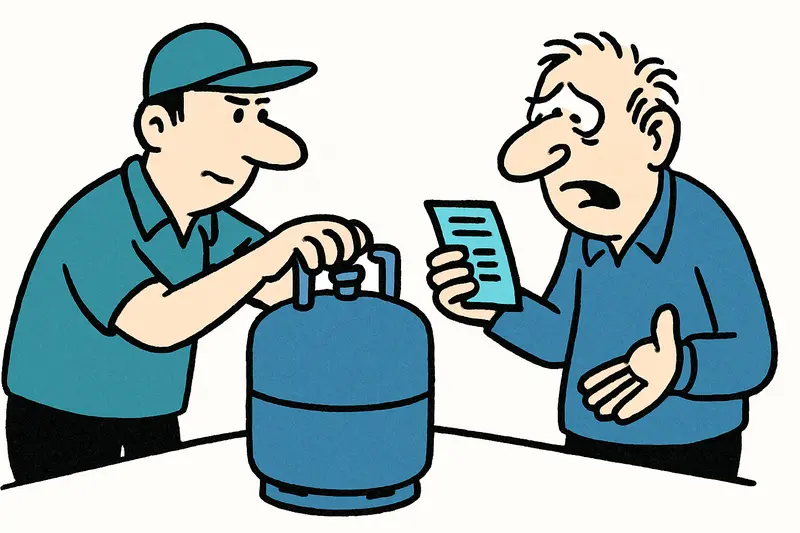
Early in the morning in front of Mercat de l'Olivar, a delivery van is queuing, the tail lift clacks, and an older couple pushes an orange cylinder into their trunk. The alley smells of freshly brewed café con leche, and the seller at the small kiosk next door calculates quickly: "If the price rises further, I have to consider replacing gas with electric grills." Such everyday situations show: these are not just euros on paper, but decisions about comfort and quality of life.
Concrete solutions
- Create local purchasing cooperatives for bombonas: neighborhood alliances of households, small restaurants and landlords could negotiate larger delivery volumes and reduce transport costs, a measure similar to recent short-term relief discussed in Cheaper Gas Bottles in Mallorca: Short-term Relief — But Is It Enough?.
- Expand targeted municipal support: instead of general subsidies, municipalities and the island authority could offer one-off vouchers for low-income households or transport subsidies for remote locations.
- Promote repair and replacement funds: when switching to lighter, refillable or safer containers, regional programs should absorb initial additional costs; recycling premiums for old steel cylinders would be sensible.
- Energy advice and efficiency programmes: costs for better insulation, efficient cooking appliances or switching to heat pumps can often be supported by public funds — local information campaigns could advise households directly.
- Transparency in the price-formation mechanism: the responsible General Directorate could publish a regional breakdown so that island-specific costs become visible and contestable.
Conclusion
The recent increase in bombona prices is more than a bureaucratic number in the official gazette. It affects people in their kitchens, small shops and guesthouses. The solution must happen on two levels: short-term practical, local measures to ease the burden; and long-term investments in alternatives and greater transparency of price components. Otherwise the bombona will remain not just a technical product, but a constant source of dispute at the kitchen table — and many Mallorcans cannot afford that right now.
Frequently asked questions
Why has the butane cylinder price gone up in Mallorca?
How often is the butane price reviewed in Spain and Mallorca?
Who in Mallorca is most affected by higher butane prices?
Can households in Mallorca do anything to reduce bombona costs?
Why do butane deliveries cost more on Mallorca than on the mainland?
What does the butane price increase mean for small restaurants in Mallorca?
Are there public support options for low-income households in Mallorca buying butane?
Why is the butane price debate important for everyday life in Mallorca?
Similar News

"Expensive chaos" and many open questions: What clients can do when a lawyer suddenly stops responding
Several clients complain that a well-known German lawyer in Mallorca has been unreachable for months. Key question: What...

TV tip: 'The Last Problem' — Mallorca as the setting of a classic crime
A classic whodunit on Mallorca: A new miniseries set in spring 1959 brings storm, an isolated hotel and a dense web of s...

Nipping Sea Creatures: Why Bathers in Cala Major and Elsewhere Should Be Cautious
In Cala Major, bathers have reported being nipped by small fish. What is behind it, how can problems be avoided — and wh...
Forced eviction in Santa Catalina: When a 65-year-old slept in her car and showered on the beach — a question of responsibility
The story of Pilar López from Santa Catalina represents a problem affecting many Mallorcans: How can an island with a bo...
New traffic rules from October 1: What Mallorca visitors and locals need to know
From October 1, 2026, Spain will implement far-reaching changes to traffic regulations. Important for Mallorca: greater ...
More to explore
Discover more interesting content

Can Cap de Bou

Townhouse Lleo 72
