
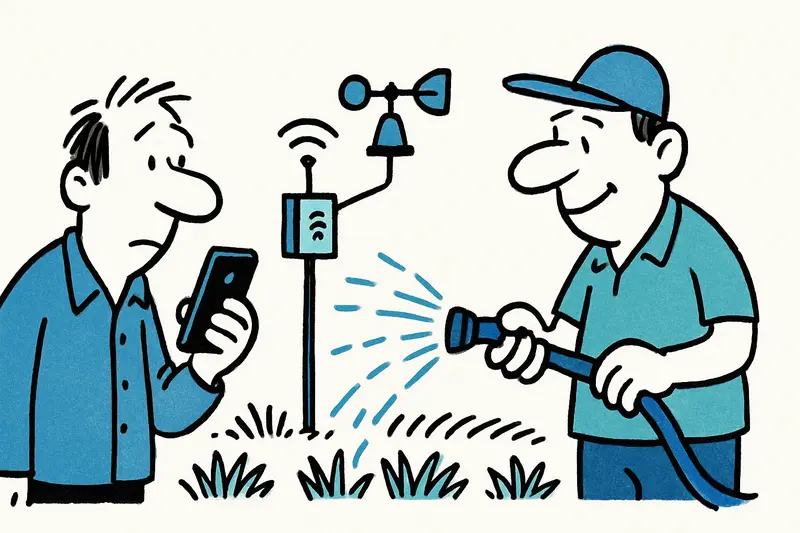
Cala Millor tests smart irrigation – is that enough to save water?
Cala Millor tests smart irrigation – is that enough to save water?
In Cala Millor the municipality and hoteliers are launching a sensor project for parks and gardens. Well-intentioned — but the real question remains: does technology actually change on-the-ground practice?
Cala Millor tests smart irrigation – is that enough to save water?
Key question: Can a sensor network and a weather station really reduce consumption without fundamentally changing on-site maintenance?
On the Passeig de la Mar, right next to the library, you hear the usual morning sounds: the clink of coffee cups, snippets of conversation in several languages, seagulls circling above the bows of the small excursion boats. Amid these everyday moments the first test installations for a new irrigation system are already running, which Sant Llorenç and Son Servera are launching together with the local hotel association. Moisture sensors, solenoid valves and water meters are intended to decide in future whether and when lawns, roundels and street trees are watered — in addition to a weather station that will record rainfall, a development detailed in Mallorca Becomes a Water-Weather Station: Can Probes Really Tame the Drought?.
The idea is obvious: less watering at the hottest time of day, automatic shutdown during rainfall and a more accurate view of actual consumption. The project is financed by a grant from the Consell under the RESCO programme for sustainable tourism — a signal that the resource water has become a priority in this coastal area, as reported in Real-time for Mallorca's Water — a Step, But Is It Enough?. The existence of a reclaimed water network is also an advantage: technically it can reduce the burden on drinking water.
But technology alone does not solve the problems. Viewed critically, there are several weak points: first, operating and maintenance costs often remain unclear. Sensors need calibration, valves wear out, and the electronics are sensitive to salty sea air. Second: who decides which areas have priority? Public green strips compete with hotel gardens, playgrounds and traffic islands. Third, transparency is still lacking: how will consumption data be processed, who has access, and will saving targets be communicated openly?
In public discourse technology is often overvalued: smart watering as a panacea. What is less discussed are questions about the long-term culture of maintenance. Local gardeners and landscaping companies, who work daily with shovel and hose, must be involved in the transition — not only as implementers but as designers of new irrigation plans. Equally important is training: plant knowledge determines whether Mediterranean species can survive at all with less water.
An everyday scenario: on a hot afternoon you see a hotel gardener on the Avinguda des Pins manually checking whether a dripper is clogged; a few metres away automatic sprinklers are spraying over the pavement even though a short shower has just passed. Such contradictions show that new technology and old habits can run in parallel — with waste as a consequence.
Concrete approaches that go beyond installing sensors could be implemented quickly: first, an open dashboard with anonymised consumption data accessible to municipalities, hotels and citizens — so goals become measurable. Second, regular maintenance contracts and a local service centre for components to minimise failures. Third, pilot zones with clear indicators (litres per square metre, plant condition) before the system is rolled out area-wide.
Further measures: prioritising irrigation areas according to ecological and social importance, switching to standardized drip irrigation instead of sprinklers at critical spots, promoting rainwater storage and greywater systems in hotels, and examining whether pumps and controllers can be powered by photovoltaics. A leak-detection programme coupled to the meters would also make unplanned losses visible early.
Politically, residents must also be included on the agenda: information evenings in Son Servera or an information stand at the weekly market in Cala Millor could teach simple behavioural rules — for example shifting watering times to the evening or choosing heat-tolerant plant species. Small behaviour changes multiply the effect of technical systems.
In conclusion: investing in sensors and weather data is a good step — but not a self-runner. Without transparent figures, reliable maintenance, the involvement of the people who water every day, and complementary measures like rainwater storage, the project remains a technical experiment with uncertain benefit. If Cala Millor really wants the coast to become greener and more water-efficient, several knobs must be turned: installing technology is only the beginning.
Frequently asked questions
When is the best time to visit Mallorca for comfortable weather?
Can you swim in Mallorca in spring or autumn?
What should I pack for a trip to Mallorca in the shoulder season?
Is Mallorca still warm in October?
What is Palma de Mallorca like for a short city break?
Is Sóller a good place to visit in Mallorca?
What is Alcúdia known for in Mallorca?
How many days do you need in Mallorca for a first trip?
Similar News

When the Wallet Becomes a Danger: Attack in Peguera and Lessons for Mallorca
In Peguera, two women are said to have stolen the wallet from a 75-year-old German couple. When the victim intervened, t...
Plata stays Plata: Young people take over, Llonguets remain
A small bar on Carrer de l'Argenteria will continue: Tolo Serra hands the place over to young Mallorcans at the end of t...

Unnoticed in the Luggage Compartment: How a Boy Traveled More Than 100 Kilometers in a Team Bus
A minor traveled in the undercarriage of a team bus for more than 100 kilometers until his cries for help were heard. A ...

Cap Vermell Grand: Second Michelin Key – a Gift for the East
The Cap Vermell Grand in Capdepera has been awarded its second Michelin key. For the region this elevates the luxury off...
Eurowings lets four aircraft carry names – a friendly idea that also reaches Mallorca
Eurowings is launching a campaign: four Airbus A320s are to carry the first names of people who help others in everyday ...
More to explore
Discover more interesting content

Can Cap de Bou

Townhouse Lleo 72
