
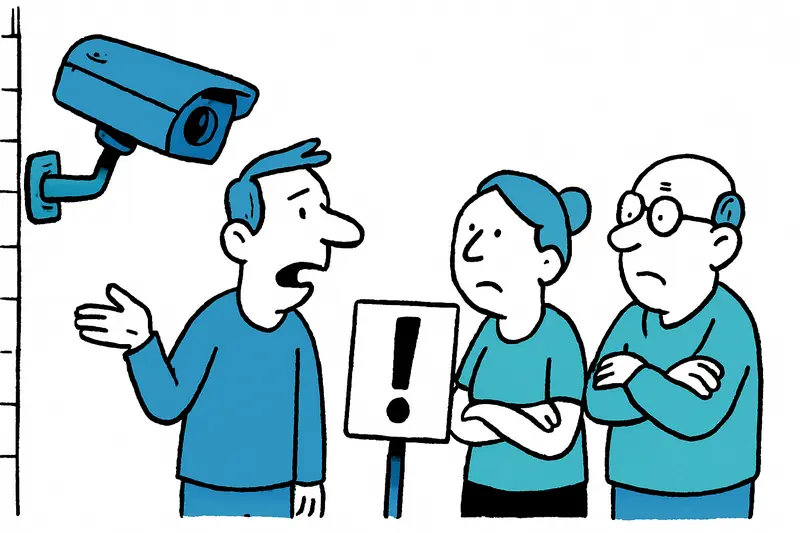
When the camera itself becomes the problem: Data protection, heritage protection and the consequences
When the camera itself becomes the problem: Data protection, heritage protection and the consequences
Video recordings are meant to show perpetrators — but they could be legally unusable. Key question: Do investigators lose evidence because private surveillance was installed unlawfully?
When the camera itself becomes the problem: Data protection, heritage protection and the consequences
Key question
Key question: Do investigators lose valuable evidence because a private surveillance camera captures more public space than permitted — thereby undermining the investigation of vandalism in Mallorca?
Background
On the night around May 31/June 1, several real estate offices in Santa Maria del Camí were apparently defaced with paint; locks were rendered unusable with adhesive and windows were smashed. The Guardia Civil published images that are said to show several people; two women were arrested and a man is still being sought. At the same time, the recording from a real estate office's surveillance camera is now at the center of attention because, according to legal assessment, it apparently filmed significantly more than the immediate entrance area, an issue that echoes other local controversies such as Hidden Cameras North of Palma: Trial, Distrust and the Question of Our Protection.
Critical analysis
The simple logic: private cameras in this country are generally only allowed to monitor the immediate business or house entrance. Anything that shows public streets, pedestrian crossings or opposite house entrances ventures onto thin ice under data protection law. A legal expert report specialized in data protection criticizes exactly that: the camera is said to have captured two pedestrian crossings and entrance doors on the other side of the street. A previous highest-court ruling from another region already made clear that such recordings can be inadmissible; at that time a bank's footage was discarded as evidence because it captured too much public space, a problem that also featured in the case discussed in Secret Recordings in Palma: Verdict, Questions and What Matters Now for Those Affected.
What this means in practice
If a court deems the recording unusable, investigators are left without one of their strongest pieces of evidence. This has consequences: alleged perpetrators may not be convicted due to lack of reliable video evidence; victims remain without compensation; and investigative work appears amateurish to those affected. Even more awkward: the municipality apparently only learned about the cameras on the façade through the published images and now demands installation documentation within ten days. On a heritage-listed building, in addition to the usual building permit, approval from the heritage protection commission would also be required — according to the administration.
What is missing in the public debate
The debate often runs between two poles: protection of the public versus security for business owners. What is missing is a pragmatic review of the procedures: Who legally authorized the images for release and when? Is there a court order permitting publication? Was the chain of evidence preservation documented? Has the data protection authority already opened investigations against the system operator? All these questions remain unspoken in many conversations, even though they can decide the outcome of proceedings.
A small everyday scene
If you stroll down the Carrer Major of Santa Maria del Camí on a hot afternoon, you hear the church bells, smell pa amb oli from a bar and see older neighbours sitting on benches. Right there, at the classic street corner with a view of the town hall and the plane trees, yellow evidence notices from investigators are now posted and a small group loudly debates cameras on historic façades. The mistrust is palpable: are such recordings protection — or an intrusion into the privacy of the people who live here?
Concrete solutions
1. Immediate evidence protection: The municipality should review the technical documentation and demand a forensic documentation of existing recordings so the chain and integrity of the evidence remain traceable. 2. Data protection review by the AEPD (Spanish Data Protection Authority): It must clarify whether the system is lawful and whether personal data were processed unlawfully. 3. Transparency obligation in investigations: Police and public prosecutor's office should disclose the legal basis on which recordings were published. 4. Technical adjustments: Cameras must be oriented and, if necessary, covered so that only the immediate entrance is captured; motion detectors and fixed retention periods reduce misuse. 5. Municipal dialogue: City and business associations should jointly create legal alternatives, for example increased presence on critical nights and lawful protest areas instead of escalation, a conversation that runs alongside broader municipal measures such as Palma steps up: More cameras, drones and the big question of privacy.
Pointed conclusion
The irony is harsh: the very recordings that could help clarify vandalism might prove legally inadmissible. This endangers not only prosecution but also people's trust in authorities and businesses. Those who want security must organize it in a legally sound way — and be doubly careful in places with heritage status. Otherwise the bitter lesson remains: good images are useless if built on shaky legal ground.
Frequently asked questions
Are private surveillance cameras allowed to monitor public spaces beyond the entrance in Mallorca?
What happens if surveillance footage is deemed inadmissible in a Mallorca vandalism case?
What practical steps should Mallorca authorities take to protect privacy while using cameras on buildings?
What happened in Santa Maria del Camí regarding surveillance on a heritage-listed building?
Why is heritage protection a concern when using cameras on historic façades in Mallorca towns?
What questions should residents and reporters ask about released surveillance footage in Mallorca?
How can surveillance systems be adjusted to reduce privacy concerns while aiding investigations in Mallorca?
What can communities in Mallorca do to improve safety without compromising privacy on historic streets?
Similar News

Towel on It, Chair Gone? How Hotels Can Regulate Reservations of Sun Loungers
After a deadly dispute in Greece, the question has resurfaced in Mallorca: Are hotels allowed to ban or sanction the pra...

Illetas: Police Officer and Two Lifeguards Rescue Two Female Tourists from the Sea
Late on Friday afternoon emergency responders entered the water off the coast of Illetas: a local police officer and two...

Inca: Severely injured female dog found in garbage bags in a container – who has seen anything?
In Inca, a severely injured female dog was discovered wrapped in two garbage bags inside a container on Avenida Rei Jaum...

Pre-Nit de l’Art in Palma: Champagne, Spray Can and Studio Flash in the Old Town
Red carpets, a photographers' stand and live performance: the Pre‑Nit de l’Art filled Galerie Mensing with around 400 gu...
Failed before the first flight: How Fischer Air's plans for Palma were ground down
Announced routes, repeated postponements and now apparent insolvency: Why the Fischer Air project for Mallorca is not me...
More to explore
Discover more interesting content

Can Cap de Bou

Townhouse Lleo 72
