
Card payments on Palma's city buses – relief or nuisance?
Card payments on Palma's city buses – relief or nuisance?
EMT is rolling out card readers in Palma's buses: about 134 vehicles already equipped, group discount rules — but also the end of ten‑ride tickets. What travelers and locals need to know now.
Card payments on Palma's city buses – relief or nuisance?
What exactly is new, who benefits — and where trouble still looms
At the bus terminal on the Plaça d’Espanya on a mild January morning the beeper can be heard: a card is held to a new reader, a brief green light, and the passenger boards. This is the future EMT is aiming for: contactless payment on board instead of coin struggles at the entrance. According to the operator, the devices are already installed in about half the fleet (around 134 buses) and active on all airport routes; the retrofit is to be completed by the end of March 2026. Cash will remain an option for the time being — but some familiar ticket types will disappear, a shift discussed in Tarjeta Única in Mallorca: Relief with Pitfalls.
Key question: Does the change actually make riding the bus in Mallorca easier — or will familiar, inexpensive options for visitors be quietly phased out?
Critical analysis: The benefits are obvious. Paying by card means no more searching for coins; visitors coming straight from the airport into the city in particular save time and nerves. The new system also brings price reductions: the first card‑paying passenger receives a 40% discount, and travel companions up to 60% (groups of up to six people). Such discounts can be financially significant for families or small groups.
At the same time a familiar product disappears: ten‑ride tickets, single city‑line fares and special tickets for airport or port connections will cease to be valid on the cutoff date, a topic also explored in EMT Plans Single-Ticket Increase: Who Will Pay the Bill in Palma?. Remaining trips on ten‑ride tickets can still be refunded without an appointment at the customer service office until 31 July 2026 — that is correct and important, but it does not automatically close the gap: for those arriving on short notice or people without a bank card, the question remains whether the new charges and procedures are fair.
What is missing from the public debate: there is a lot of talk about technology and discount rates, but little about everyday situations. Older passengers, occasional users without a contactless card, people without a smartphone, or those using foreign card types — how will they be assisted in future? The refund deadline for unused ten‑ride tickets is clear, but the practical handling at the customer service office in Palma can take a long time on busy days. And: how will communication at stops, in tourist information centers, hotels or at the airport be improved so confusion doesn't arise in the first place?
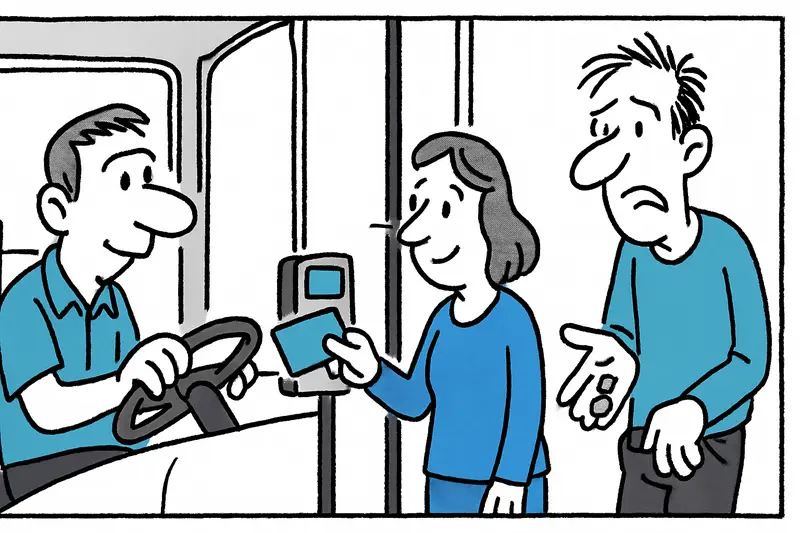
Everyday scene: A bus on the Avinguda de Jaume III stops. From the driver's cabin the soft whistle of the door mechanism sounds; nearby two tourists are speaking German, one desperately fishes coins from her bag while the other smiles and holds up her card — the validator beeps, the light turns green. Next to them a pensioner searches for his ten‑ride ticket in an envelope wallet and looks uncertain. These small moments aren't found in a press release, but they decide whether the change is perceived as a service or an obstacle.
Concrete solutions: First, short, clear signs in several languages at each stop and on board that show the new discounts and the card payment procedure. Second, mobile info teams at key hubs during the first weeks (airport, intermodal station, Plaça d’Espanya) to help with the transition and assist with refund questions. Third, a digital alternative to the old ten‑ride ticket: a QR‑based multi‑ride product that is price‑comparable and can be easily loaded by card, an approach related to proposals for a unified travel product such as One card for all of Mallorca: From October less paper clutter in your wallet. Fourth, transparent information about which card types are accepted so that visitors from abroad are not faced with closed payment options. And fifth, the option to offer refund services at multiple locations or to temporarily extend refund periods if demand is high, a concern raised in One Ticket for Everything: Can Mallorca's New Fare Really Simplify Everyday Life?.
Why this matters: Switching to modern payment systems can benefit Palma — faster boarding and alighting, less cash handling, a fairer distribution of staff resources. But if the transition is not inclusive, it creates frustration at stops, queues at the customer service office and uncertainty among tourists. A transport system lives on trust: those who can rely on routes and prices use the bus more often — that should be the goal.
Pointed conclusion: Card payment is progress, but not a given. EMT has installed the technology in many buses and entices riders with hefty discounts. That is not enough if simple, affordable products like the ten‑ride ticket are removed without replacement and affected passengers find no low‑threshold alternative. A bit more service at major hubs, clear information and a genuine digital multi‑ride option would turn a technical innovation into a real gain for Palma.
Frequently asked questions
Can you pay by card on Palma buses now?
Do Palma bus tickets get cheaper when you pay by card?
What bus tickets in Palma will no longer be valid?
Can I still get a refund for unused Palma bus rides?
Is card payment on Palma buses useful for airport transfers?
What should tourists know before using Palma city buses with a bank card?
Will older passengers in Palma have problems with the new bus payment system?
When will card payment be available on all Palma EMT buses?
Similar News

Mistaken identity with fatal consequences: Brutal assault in S'Aranjassa — what's missing in the follow-up?
At S'Aranjassa a visitor to a finca was tied up, beaten and thrown out of a van. Three men have been arrested, including...
High heel slips, car accelerates: accident on Camí de Son Hugo
A woman lost a high-heeled shoe on the forecourt of the sports facility at Camí de Son Hugo. The car accelerated, mounte...

Phone Scam: How Two Hotel Employees at Playa de Palma Lost Thousands of Euros
One morning in September, two reception employees at Playa de Palma were pressured by alleged alarm-company staff — in t...
When the Wallet Becomes a Danger: Attack in Peguera and Lessons for Mallorca
In Peguera, two women are said to have stolen the wallet from a 75-year-old German couple. When the victim intervened, t...
Plata stays Plata: Young people take over, Llonguets remain
A small bar on Carrer de l'Argenteria will continue: Tolo Serra hands the place over to young Mallorcans at the end of t...
More to explore
Discover more interesting content

Can Cap de Bou

Townhouse Lleo 72
