
When the Catamaran Came in Too Far: Banyalbufar and the Question of Who Shares Mallorca's Coasts
Midday calm in Cala Banyalbufar, then a catamaran — too close, too large, too loud. The incident highlights how small coves are coming under pressure. Who protects them, who enforces rules, and what solutions are there?
A loud midday in a small cove
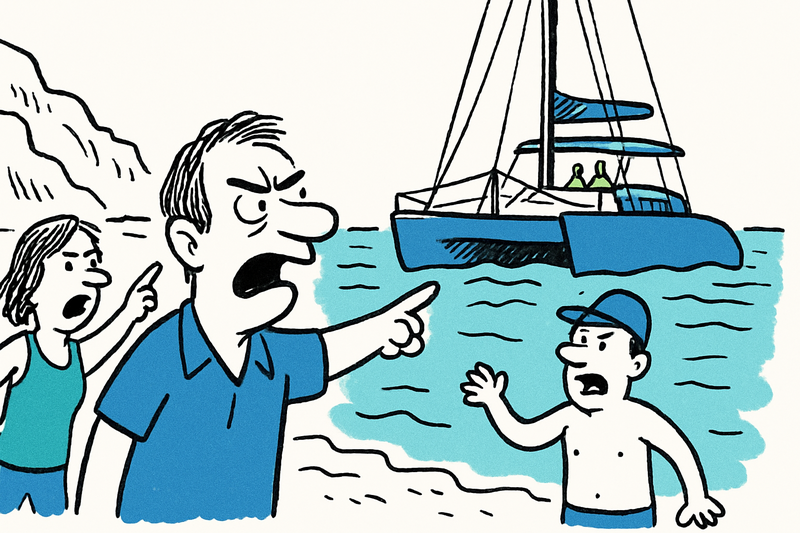
It was shortly after 1:30 pm, the sun beat down on the terrace rocks above Cala Banyalbufar, the air smelled of salt and pine resin. Families, long-time residents, children with paddling pools – and suddenly a massive catamaran that pushed far into the turquoise, otherwise so manageable cove. A few shouts, a loud 'fuera', the splashing of spray, then a collective frown: this is what it looks like when a public space is felt to be taken over, as reported in Conflict in Banyalbufar's Cala: When Is Enough Boat Traffic Too Much?.
More than an annoying maneuver
That the ship neither moored nor dropped anchor seems at first glance a stroke of luck. On a second look, however, it becomes clear why the mood changed: the proximity curtailed the sense of safety and quiet, divers and snorkelers felt disturbed, and older visitors saw their familiar spot suddenly as a tourist stage. The reaction of the beachgoers – loud complaints, noting the boat number, a few phone calls to the coast guard – was less an outburst of anger than the spontaneous defense of a place that belongs to many as part of the island's identity.
The real guiding question
The scene raises a central question: who owns the space along Mallorca's coasts – if not legally, then in practice? Is it the boat operator's right to bring his tour product as close as possible to the photo spots? Or is it the right of locals and regulars to keep their peace and the integrity of small calas? Behind this simple question lie regulatory gaps, economic incentives and a growing fault line between mass tourism and everyday life.
Aspects that are rarely discussed loudly
First: the economic logic of the charter industry. The closer and more spectacular the stop, the better the photos, the more satisfied the customer, the more profitable the tour, a dynamic examined in Between Waves and Berth: Mallorca's Problem with 'Floating Holiday Rentals'. Second: the practical weakness in enforcement. Rules on distances and protected areas exist, but monitoring is often sporadic – too few patrols, no permanent presence in all the small coves. Third: the information available to skippers. Many captains do not know the fine-meshed restrictions around seagrass meadows (Posidonia oceanica), private access paths or local temporary bans. Related coverage documents how small, license-free motorboats cause noise and damage in coves across Mallorca, as in Drunk Boats, Battered Bays: When Private Boat Rentals Put Mallorca's Coasts at Risk.
Concrete solutions — without promising the blue sky
From the observation in Banyalbufar pragmatic steps can be derived that work in the short term and also push for longer-term rethinking:
1. Better presence and clear sanctions: More regular patrols to deter, coupled with immediate fines when distances are not respected. Visible enforcement pays off — people then feel taken seriously.
2. Geofencing and digital maps: Virtual exclusion zones for large excursion vessels, maintained by the coastal authority. Many modern sport and charter boats are GPS-equipped; technological solutions could make unclear boundaries visible.
3. Size and distance restrictions: Small, sensitive calas are not suitable targets for catamarans with a hundred guests. A simple regulation: maximum allowed boat sizes and minimum distance to the shoreline.
4. Education and liability: Mandatory briefings for charter skippers about sensitive natural areas and sanctions for violations. Insurance conditions could define breaches of protection rules as triggers for liability.
5. Local participation and reporting apps: An easy-to-use reporting platform through which regulars and residents can submit boat numbers and incidents. This improves the data available to authorities and creates transparency.
An opportunity in the unrest
The anger in the cove was not an isolated annoyance but a symptomatic moment. It shows: small places are indicators of larger problems. If we allow such spots to lose their intimacy bit by bit, we also lose an important piece of Mallorca's identity. At the same time, the incident offers the chance for a pragmatic shift: more technology, clearer rules and above all more dialogue between the coastal authority, the municipality, charter operators and residents.
Finally: responsibility instead of reflex
The reaction of the people that midday was simple and human: they protected what mattered to them. In the long run, however, shouting is not enough. If we want coves like Banyalbufar to keep the little sound of the waves, the chirping of crickets on the rocks and the relaxed splashing of snorkelers in the future, we need binding measures. A catamaran can back up a metre — or we can ensure it never approaches such places in the first place.
Frequently asked questions
Why do catamarans sometimes cause conflict in Mallorca’s small coves?
What should you do if a boat comes too close to swimmers in Mallorca?
Are there rules about how close boats can go to Mallorca’s coast?
When is the best time to visit Cala Banyalbufar in Mallorca?
Is Cala Banyalbufar in Mallorca suitable for snorkelling?
Why is Posidonia important around Mallorca’s coves?
How can Mallorca improve control of boat traffic in small coves?
Why do residents in Banyalbufar react strongly to boats near the cove?
Similar News

Release after bloody attack in Palma: Why the court's decision raises questions
An 18-year-old who allegedly inflicted a serious neck injury on a man at Plaza Gomila using a wristwatch wrapped around ...
Kidnappings in Inca: Three young men forced into car trunks and abused in the forest – a reality check
In Inca, three 18-year-old men were forced into car trunks by masked assailants at the Plaça des Bestiar, taken to a for...
Spreading Massification: The Brake That Still Has Much Work to Do
Marga Prohens announces limits on volume tourism. The measures sound harsh — but are they enough to save everyday life, ...

Through the Keyhole onto the Party Yacht: How Daniela Katzenberger Is Planning Her 40th on Mallorca
Daniela Katzenberger turns 40 and wants to celebrate it on the island — likely with a boat, cake and her mother. A relax...
By Boat Instead of the Road: Palma's Water Bus — a Reality Check
The 'Bus Nàutic' launches in two stages — but questions remain over interim operations, fares and environmental requirem...
More to explore
Discover more interesting content

Can Cap de Bou

Townhouse Lleo 72
