
Chaos Over the Bay: Seniors Experience Risky Flight — Landings Aborted, Diverted to Ibiza
A flight from Lübeck to Mallorca had to abort two landing attempts and divert to Ibiza. How well are passengers, especially seniors, protected in such scenarios?
Chaos Over the Bay: Seniors Experience Risky Flight — Landings Aborted, Diverted to Ibiza
Key question: Was enough done to ensure the safety and care of passengers during strong gusts?
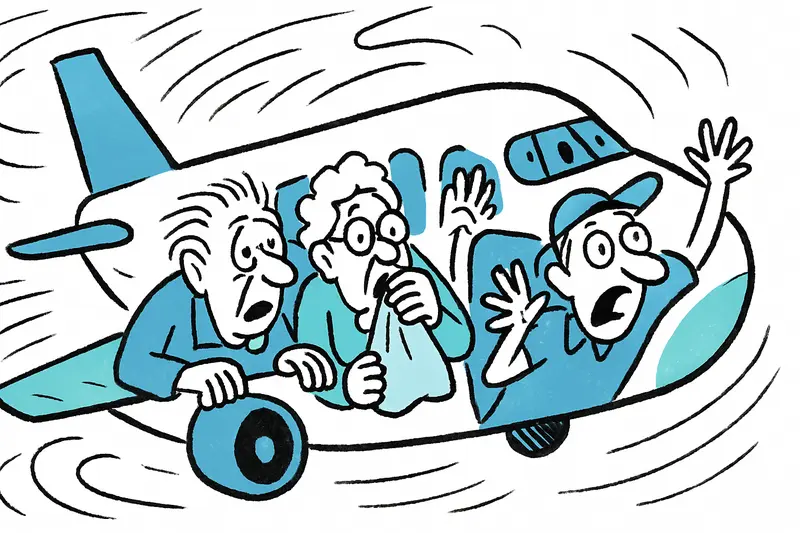
Late in the morning, when the palms along the Passeig Mallorca creaked against the wind and the coffee in the airport café trembled in thick drops on the window, a Ryanair flight from Lübeck did not land in Palma but in Ibiza — after two aborted approaches. The result: frightened, in part very elderly travelers, people vomiting on board and an unplanned onward journey that still has to be organized.
In short: The crew aborted the first approach, handed out air sickness bags, several passengers felt sick and vomited. The second attempt also failed; the aircraft entered a holding pattern and was then instructed to divert to Ibiza, where passengers described the landing as very hard. No injuries were reported, but eyewitnesses said there was a medical incident in the rear of the aircraft that apparently required the attention of the pilot and co‑pilot; this echoes issues described in When Mental Health Crises Disrupt Air Travel: Lessons for Mallorca After the Nuremberg Incident.
Critical analysis: The situation shows that technical decisions and human care are closely linked. Aborting a landing in stormy conditions is the correct, standardized option — incidents of abrupt aborts have previously caused panic, see Aborted Takeoff in Basel: Panic on Board – and What It Means for Mallorca Travelers. The question remains whether older passengers were sufficiently prepared and cared for. Air sickness bags are a short-term measure against nausea; they do not replace clear communication, basic medical equipment, or a quick solution for travelers who depend on assistance after a diversion.
What is missing in public debate: Three points are rarely discussed. First, the particular vulnerability of senior groups during weather-related flight disruptions. Many retirees travel in groups, with medications and scheduled transfers — and are often left alone during diversions. Second, the airline's duty to organize passengers during a diversion: Who immediately takes care of transport, accommodation and basic medical care? Past diversions show varying responses, as in Delayed Mallorca–Berlin Flight: Landing in Hanover, Continued by Bus. Third, transparency about the medical incident on board: Was it only nausea or a serious emergency? Citizens expect airports and airlines to communicate clearly and quickly here.
A scene from everyday life in Mallorca: On the forecourt of the airport, near the bus stop to the center, relatives sit waiting to pick up their loved ones. You see the small, rickety roll suitcases, the jackets braced against the wind, hear the distant wail of airport vehicles. In such moments abstract news becomes everyday life: the arriving seniors who instead of their usual transfer take nervous phone calls, the smell of coffee at the information desk, the tired hope for a quick solution — it is real and close.
Concrete solutions: 1) Airlines should designate mandatory assistance for flights that carry particularly many older passengers — easily identifiable, with a contact number for someone responsible in case of diversion. 2) Standardized information chains: As soon as a flight is diverted, clear information must be sent by SMS/email to all affected (pickup location, contact person, medical support). 3) Airports should keep a rapid liaison team ready at alternate landing sites: an airline representative, a paramedic and ground staff to organize transfers. 4) Expand crew training for turbulence management and patient care; an anti-nausea kit and basic first-aid on board should be standard. 5) Tour operators and senior groups themselves: prepare emergency plans in advance, keep medications readily accessible and designate responsible persons.
What should be done immediately: In the short term the affected airline could set up an information hotline, coordinate onward travel for the affected guests and liaise with tour operators/transfer services in Ibiza and Palma to ensure the seniors get back to Mallorca safely and with as little stress as possible. In the long term we need better coordination between weather warnings, flight planning and passenger care.
Punchy conclusion: Pilots' safety decisions are correct and life-saving; but the logistics afterwards must not stop at the terminal. Those who arrive in Mallorca — or cannot arrive — should not be left alone. A hard landing may have been technically uneventful, but humanly it was a stress test. We need clearer rules for care and quick assistance, especially when travelers are older.
One final note for anyone flying in the coming days: watch the weather updates, inform your companions about medications and emergency contacts, and ask your airline before departure how diversions are handled. On Mallorca you may then hear only the sea at the beach again — not the nervous clatter of roll suitcases on the airport forecourt.
Frequently asked questions
What happens if a flight to Mallorca cannot land because of strong winds?
Are diverted Mallorca flights usually rebooked the same day?
What should older passengers keep in mind when flying to Mallorca in bad weather?
How do airlines care for passengers after a diverted flight to Mallorca?
Is it normal for a pilot to abort a landing in Palma during gusty weather?
What should I pack for a flight to Mallorca when the weather looks unstable?
What is the best way to get from Ibiza to Mallorca after a diverted flight?
Where do passengers usually wait for transfers near Palma Airport?
Similar News
Fewer Airlines, Fewer Destinations: What Palma's Winter Flight Schedule Means for Mallorca
Analysis shows: Winter at Son Sant Joan Airport will be quieter, with significantly fewer airlines and destinations. Who...
German tourist dies in Sa Calobra – a reality check for emergencies on Mallorca's beaches
A 40-year-old tourist died at the Torrent de Pareis. The emergency call, a doctor who happened to be present, a defibril...
Deadly Tractor Accident in Bunyola: What Needs to Be Done Now
In a work accident on an estate near Bunyola, a roughly 40-year-old man lost his life. His wife and a small child were o...
Head-first dive into the shallow part of Cala Fonoll: An accident and the unresolved question of responsibility
A young tourist dove into Cala Fonoll and was seriously injured. Key question: Why are clear warning signs missing at da...
Mistaken identity with fatal consequences: Brutal assault in S'Aranjassa — what's missing in the follow-up?
At S'Aranjassa a visitor to a finca was tied up, beaten and thrown out of a van. Three men have been arrested, including...
More to explore
Discover more interesting content

Can Cap de Bou

Townhouse Lleo 72
