
Children Clear Up: Colorful Parade in s'Arenal Makes Litter Visible and Wakes Neighbours
In s'Arenal children and environmental groups sent a clear signal against litter: with decorated pedal wagons, drums and full nets they marched from Megapark to the Torrent dels Jueus and collected trash on the beach. An example worth copying.
Children Clear Up: Colorful Parade in s'Arenal Makes Litter Visible and Wakes Neighbours
With pedal wagons, batucada and full nets: a local initiative turns a party mile into a place of learning
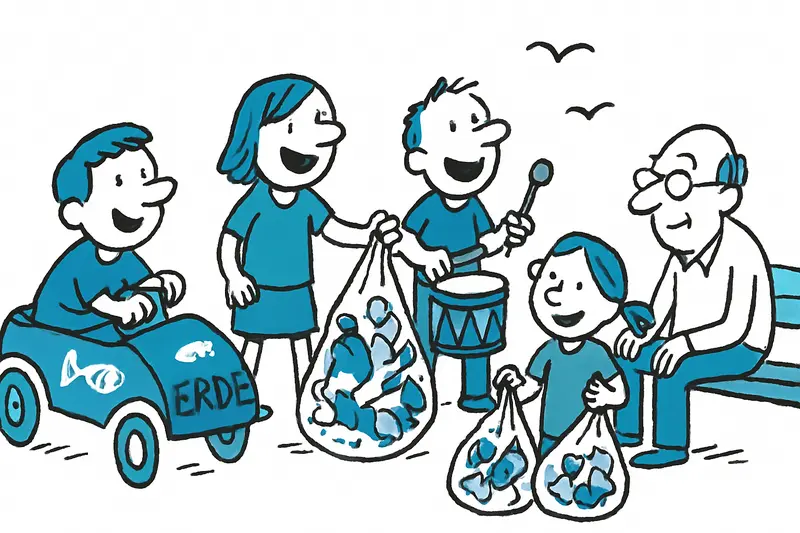
On Saturday morning, when the promenade still smelled of salt and street sweepers, brightly painted pedal wagons suddenly rolled down the avenue from Megapark toward the sea. From the speakers of the first wagons came a rumbling, joyful batucada that drew passersby: children, parents, volunteers – a parade that wanted to be more than a picture for social media feeds.
The event was organized by the non-profit group Ondo Terra; participating were also the platforms Kids4nature, Mallorca neta i sana, Amics de la Terra, Protemar and the German school Eurocampus. The route ended at the dried-up streambed of the Torrent dels Jueus, the border between Palma and Llucmajor, and continued to the beach at Playa de Palma. There symbolism turned into action: children bent down, picked up cigarette butts, plastic bottles and packaging, and filled large nets that had already been displayed along the parade.
Appearance mattered: two of the pedal wagons bore the roles “Land” and “Sea”, decorated with handmade fish and paper flowers. The nets with attached rubbish looked like memorials, but friendly ones – so that tourists, hoteliers and locals stopped to ask questions. That the parade took place near World Cleanup Day and at the same time referenced Universal Children’s Day gave the action extra weight.
What worked well on a small scale is, in my observation on Mallorca, a rare but welcome moment: instead of wagging fingers there was practical hands-on work. Children learned not only to see litter, but also why it remains in certain places – whether due to missing bins, carelessly discarded cigarettes or the everyday tourism that produces packaging.
The scene on the beach was understated: cries of seagulls, the sound of the surf, voices in several languages. Some older residents on benches nodded approvingly, other tourists took photos. The action sparked conversation, more than many appeals before. That is the point: visibility creates awareness – and children are the most credible ambassadors.
Why this matters for Mallorca is easy to explain. Clean beaches are not only postcard scenery; they are habitat for marine life and part of everyday life for local residents. If younger generations learn how much work goes into a tidy coastline, behavior can permanently shift – into the bin instead of onto the sand, into sorting instead of into a single trash can.
If anyone thinks such an action changes nothing on a larger scale, they should know: small rituals anchor habits. Schools, neighbourhoods or beach bars could regularly adopt similar actions. Cooperation with hotels, landlords and event organizers would be a pragmatic next step: more information on arrival day, clearer signage on promenades and additional collection points.
What s'Arenal showed above all was community. Parents, students and local environmental groups did more than push wagons; they started conversations. The batucada was more than noise; it was an invitation. And the children, tired but proud at the end as they presented their full nets, turned a party mile into a place of learning for a moment.
A brief outlook: such actions can be repeated and scaled up. Two or three Saturdays a year, several starting points along Playa de Palma, a school project that documents waste volumes – all this costs little and yields much. Above all, it creates a culture in which litter is no longer seen as "over there" but as a problem to be solved together.
Late in the morning, as the sun rose higher and traffic increased, helpers handed out giveaways – litter pickers, small pocket ashtrays, information sheets. Such small tools keep the memory fresh: once someone has learned how to keep their beach clean, they are more likely to do it again. And if the next generation behaves with this kind of ease, the often-mocked "Ballermann" can become a place where consideration is as natural as sangria.
Perhaps the most important conclusion of this parade is this: no grand plan, no government act, but a movement growing from the ground up. An island that listens more and more to what its children do – that's an image that pleases and is worth imitating.
Frequently asked questions
What was the goal of the colorful parade in s'Arenal and what did the kids do?
How can communities involve children in beach cleanup efforts in Mallorca?
When is the best time to visit Mallorca for outdoor activities like beach cleanups?
How do events like the s'Arenal parade help wildlife and beaches in Mallorca?
What might a family experience if they visit Playa de Palma near s'Arenal during an environmental event?
What role did pedal wagons and batucada play in the s'Arenal parade?
Are there ongoing efforts in Mallorca to keep beaches clean through schools and local groups?
How can locals and visitors participate in keeping Mallorca beaches clean?
Similar News

Between Drama and a Season Decider: What the Dismissal of Thorsten Legat Means for Germania Mallorca
A coaching change, loud accusations and an interim coach under pressure: how a scandal is disrupting FC Germania Mallorc...
Ownership change at Playa de Muro: Return on investment or short-term flip?
The four-star hotel at Playa de Muro has changed hands again. What does the quick resale reveal about Mallorca's hotel l...

Riot night in Palma: a reality check before Halloween
Checks, arrests, boarded shop windows: Palma faced a tense Halloween night. How can the city prevent costumes from becom...

Train accident near Toledo: A Mallorcan woman dead — Who bears responsibility?
After the collision of two high-speed trains near Urda the worst fear is confirmed: a 26-year-old woman from Inca has di...
Bronze Age at Ballermann? Excavations at Es Velar and Son Sunyer Yield Surprising Clues
Not far from the noisy promenade, archaeologists have uncovered traces from the Bronze Age. What this means for Mallorca...
More to explore
Discover more interesting content

Can Cap de Bou

Townhouse Lleo 72
