
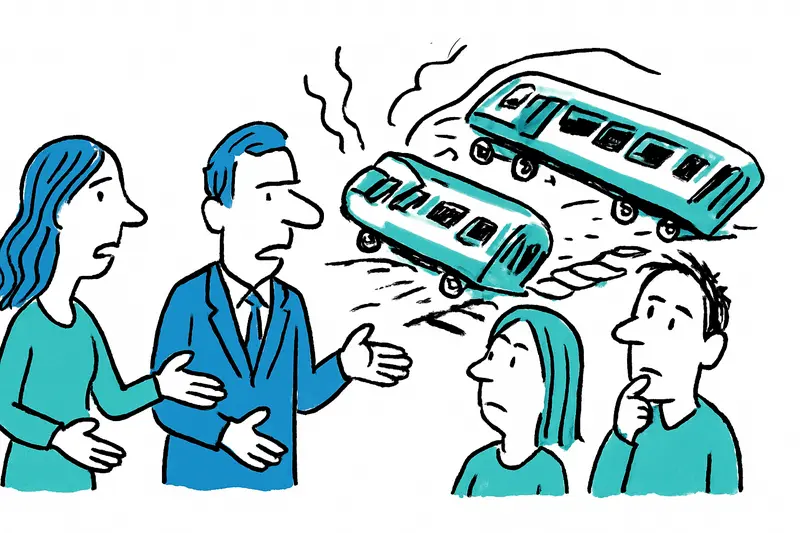
Train accident near Toledo: A Mallorcan woman dead — Who bears responsibility?
Train accident near Toledo: A Mallorcan woman dead — Who bears responsibility?
After the collision of two high-speed trains near Urda the worst fear is confirmed: a 26-year-old woman from Inca has died. Which technical and organisational failures led to the catastrophe?
Train accident near Toledo: A Mallorcan woman dead — Who bears responsibility?
Guiding question: How could a chain of disruptions, decisions and missing safety measures escalate so far that people lost their lives?
The news landed here in Mallorca like a blow: a 26-year-old woman from Inca, who lived in Madrid, is no longer at the kitchen table — she was killed in the train accident near Urda. Family and friends held out hope for days, DNA samples were submitted, relatives traveled to Toledo, a father searched hospital corridors for answers. These are facts: concise, harsh and painful.
The technical key data are now public: two high-speed trains — a state-owned AVE and a private Iryo — collided with an estimated relative speed between 160 and 200 km/h. Part of the safety technology (LZB) failed; operations had to be switched to the so-called lateral signal block procedure (BSL). This increased the dependence on human decisions between train crews and the operations center of network operator Adif.
In short: automation failed, communication became more important. But at precisely this point, as investigation results from AITAT suggest, safety barriers did not work as intended. Cars derailed, toppled down an embankment, and a bent section of rail pierced a carriage — the extent of the destruction painfully exposes the weak spots. The data recording devices of both trains have been secured; the Guardia Civil is taking custody.
What I miss as an editor and as someone who often listens to commuter trains between Palma and the harbour in many accounts is a clear picture of lines of responsibility, as happened in Head-on Crash near Manacor: Two Dead, Questions Remain.
Technical faults can happen. What matters is how organisations react: who had the concrete responsibility for the instruction to resume travel at 'normal speed'? Why was there no automatic protection that would brake the trains automatically under certain parameters? And why does an employee of the operations centre apparently refuse to testify — is this a right to refuse, or does it protect responsibilities that should be clarified publicly?
Public debate often lacks the perspective of long-term maintenance of infrastructure. On Mallorca you see it in small things: potholes that wait months to be repaired, signals that are only replaced after complaints. That is not the same as a national high-speed network, but it shows a pattern: maintenance is budgeted but not always prioritised, a theme highlighted after Fatal accident in Alcúdia: Who is responsible — and what needs to change?.
Likewise, clear, publicly accessible protocols about how and when to switch to emergency procedures are often missing — who decides under which conditions speed may be increased again?
An everyday scene that stays with me: on Passeig Mallorca, when taxi drivers take their last customers to the hotels, they hear the distant rattle of trains over the bridges. Technology that carries us daily remains invisible until it fails. Families from Inca arrived at Toledo hospital in recent days — completely alienated from the routines of everyday life, suddenly part of a bureaucracy of DNA comparisons and identification protocols. Such images show how close the consequences of technical defects are to our small, familiar living worlds, as seen after Serious Accident Near Porto Cristo: When a Holiday Day Becomes a Test of Emergency Response.
Concrete approaches can be named without waiting for the final findings of the investigation:
1) Strengthen redundant technical safety: Systems like LZB need independent backups that do not rely solely on human communication in case of failure. Automatic speed limits when switching to BSL must become mandatory.
2) Transparent error reports and maintenance records: Infrastructure maintenance and fault data should be accessible and auditable. External audits at regular intervals could uncover patterns before something severe happens.
3) Clear, binding decision paths: Protocols must precisely define who in the operations centre may give which instructions and in which cases the final release requires a second-instance approval.
4) Protection for witness statements and whistleblowers: Employees who report technical deficiencies or questionable orders need legal protection and incentives so that investigations receive complete information.
5) Family-friendly crisis communication: Relatives must be informed earlier and more reliably; psychosocial support on site must not be a luxury — hospitals and authorities should cooperate here.
This list is not a panacea. It is a first, concrete outline of what authorities, operators and politicians must now examine. The investigations by AITAT and the criminal inquiries by the Guardia Civil will provide essential details, and follow-up reporting like Who Was Really at the Wheel? A Reality Check on Alcohol, Responsibility and Investigations will help public scrutiny.
Punchy conclusion: technology can fail, people can too. What matters is how a system anticipates and intercepts errors. If signals fail and people can make wrong decisions because of missing or unclear protocols, then that is a system-level failure — and we must not accept it with silent dismay. For the family in Inca, for the 26-year-old whose name was mentioned here, this is a bitter certainty. For all of us it must be a call: make things safer, make them transparent, clarify responsibilities — before the next crack in the system costs lives.
Frequently asked questions
What lessons from the Toledo train crash could change how Mallorca handles transport safety?
Why are automatic safeguards and independent backups important in rail safety, and how does that apply to Mallorca?
How can Mallorca improve transparency of maintenance records for public transport?
Who should decide when to resume normal speed after an incident, and how should that be documented?
What protections exist for workers who report safety concerns, and why are they important?
How can crisis communication with families be improved during transport accidents in Mallorca?
What practical steps can Mallorca residents take to understand and monitor transport safety improvements?
How do rail accident investigations typically unfold, and what outcomes matter?
Similar News
Bronze Age at Ballermann? Excavations at Es Velar and Son Sunyer Yield Surprising Clues
Not far from the noisy promenade, archaeologists have uncovered traces from the Bronze Age. What this means for Mallorca...
Motorworld Inn in Palma: A Critical Look at the Setting, Kitchen and Customers
A Lamborghini above the bar, schnitzel days and high wine prices: What makes Motorworld Inn special — and where the conc...
Wrong-way driver on the Ma-15: What this early head-on crash reveals about our roads
On the Palma–Manacor motorway, a seven-seat minivan driving the wrong way collided head-on with a delivery van. Two peop...
Reality, Trauma and Responsibility: Danni Büchner in a Villa on Rhodes – How Far Can Television Go?
Danni Büchner, who lives on Mallorca, is taking part in a new TV format that brings nine women together for twelve days ...
A Rescue That Kills: What the Death of a Holidaymaker on Menorca Reveals
While trying to save her granddaughter, a 69-year-old British woman lost her life on Menorca's north coast. A critical l...
More to explore
Discover more interesting content

Can Cap de Bou

Townhouse Lleo 72
