
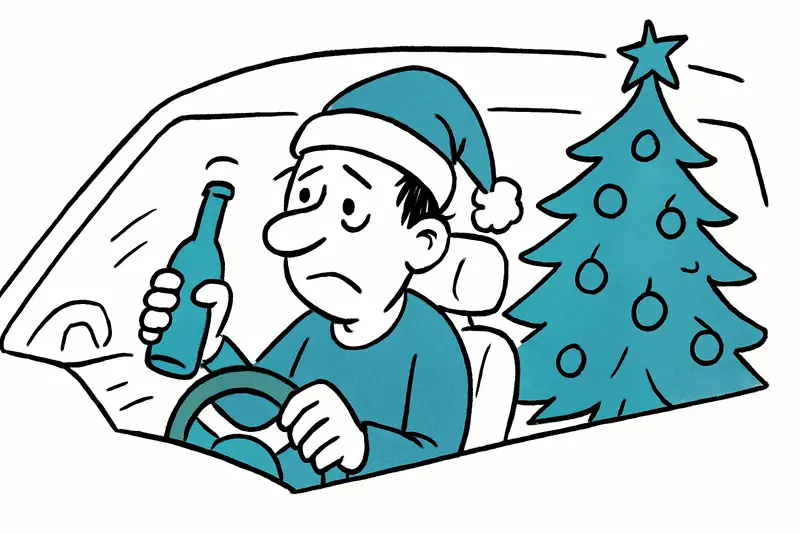
Christmas at the Wheel: Why So Many on the Balearic Islands Keep Driving After Drinking
Christmas at the Wheel: Why So Many on the Balearic Islands Keep Driving After Drinking
A survey shows: on the Balearic Islands nearly 25 percent say they drive after drinking at Christmas. Key question: why is the risk downplayed — and what needs to happen locally?
Christmas at the Wheel: Why So Many on the Balearic Islands Keep Driving After Drinking
Key question: Why does a large part of the population on the Balearic Islands accept driving after drinking as a normal consequence of celebrations — and how do politics, employers and everyday life react?
A recent survey by Fundación Línea Directa points to a worrying trend: on the Balearic Islands 24.5 percent of respondents say they drive after consuming alcohol at Christmas. The figure for Spain as a whole is 19 percent. Further figures from the factsheet: 45 percent of those who drink do so after company Christmas dinners, and 57 percent of those affected do not see their behaviour as dangerous. The traffic authority DGT carried out 5.6 million alcohol checks last year; 1.2 percent of these were positive.
These numbers sound sober, but imagine a December Sunday night in Palma: fairy lights on Passeig del Born, glasses clinking in bars, and on the street the quiet hum of patrol cars moving toward the Ma-20. At a checkpoint that residents have known for years, as documented in Sparks on the Autopista: 14 Kilometres Without Tires – Suspected Alcohol Use Shakes Commuters, taxis line up one after another — some drivers roll down their windows, others appear unconcerned, and incidents such as Eivissa on alert: Five taxi drivers stopped under the influence of alcohol or drugs underline problems with relying solely on taxis. It is precisely these everyday scenes that explain why statistical values become normal: for many the Christmas meal is work, tradition and social obligation at once; the journey home by car feels almost automatic.
Critical analysis: several factors come together on the Balearic Islands, as discussed in Distraction at the Wheel: Why the Balearic Islands Suffer More — and What Steps Are Needed Now. First: social habits. Company parties are common and are seen as part of corporate culture; the responsibility not to drive afterwards often rests solely with the individual. Second: infrastructure and mobility options. Reliable alternatives to the car are missing in the evenings and at night in many places, especially in outlying towns and outside the high season. Third: perception and education. That 57 percent do not see the danger suggests that prevention messages are not getting through or are dismissed as a nuisance. Fourth: enforcement. 5.6 million checks sound like a lot — but a positive rate of 1.2 percent can indicate both effectiveness and selectivity of the controls; random samples are not enough when behaviour patterns are systemic.
What is often missing in the public discourse is the linking of levels of responsibility: employers, local administration, hospitality businesses and the community must act at the same time. It is not enough to announce more checks or increase fines if the ways home remain impractical and expensive. Nor does it help to rely solely on criminal enforcement if a large part of the population does not even recognise the problem, as investigations in Alcúdia: Who Was Really at the Wheel? A Reality Check on Alcohol, Responsibility and Investigations indicate.
Concrete, locally implementable proposals: 1) Employer obligations for company parties: employers should organise guaranteed return options, such as shuttle buses or taxi vouchers, especially for December events. 2) Mobile, visible checks at critical points such as access roads to Palma (Ma-20) and main routes in towns like Inca or Manacor during festive times, combined with on-site communication work. 3) Subsidised night bus lines on December weekends or a cooperation model between the island council and taxi companies for fixed return fares after midnight. 4) Training for the hospitality sector and caterers: courses on how to serve alcohol responsibly and ensure guests get home safely. 5) Transparency initiative: more detailed, easily accessible accident and control statistics for the islands so citizens and communities can better understand local risks.
Practical measures can have quick effects: a shuttle after a company party, a taxi voucher in the invitation or a clearly visible police checkpoint at the exit of a nightlife street change decisions immediately. Politics and administration should also improve the data situation and communicate specifically: when people on the islands understand how many accidents or injuries are linked to alcohol, the trivialisation begins to crumble.
Concise conclusion: those who toast at Christmas must not automatically get behind the wheel. On the Balearic Islands this is not only an individual problem but an interplay of habit, infrastructure and a lack of collective responsibility. If town halls, employers and the hospitality industry finally plan together, many risky trips can be avoided. Short term, a reliable return offer helps; long term, clearer data and a culture that does not trivialise driving after drinking are needed.
Frequently asked questions
Is it common to drive after drinking at Christmas in Mallorca?
Why do people in Mallorca still think it is safe to drive after drinking?
What can employers in Mallorca do to prevent drink-driving after Christmas dinners?
Are there enough night-time transport options in Mallorca during the festive season?
What is the DGT doing about alcohol-related driving in Mallorca and Spain?
Where are police checkpoints often placed in Mallorca during festive nights?
What should I do if I have had alcohol at a Christmas dinner in Mallorca?
Why is drink-driving in Mallorca seen as more than an individual problem?
Similar News
Near-miss on Lanzarote: Landing Ryanair Jet and Iberia Takeoff — what really went wrong
On Lanzarote there was a dangerous incident: A Ryanair flight (FR5910) from Dublin landed on runway 03 while an Iberia E...
Eurowings introduces new Premium Business seats on Mallorca routes
From December 1, selected Eurowings flights to Palma and other destinations will feature eight particularly generous sea...
Car on MA-13 near Inca in flames – a safety check for the island
A vehicle caught fire on the MA-13 towards Alcúdia on Tuesday afternoon. The driver was uninjured, the car was destroyed...
Real Estate in Mallorca: Fewer Buyers, Higher Prices — What's Behind It?
Sales on Mallorca are falling, yet prices continue to climb. Why fewer transactions do not equal relief — and what shoul...
Just Bought — Already Trouble: Water Damage in the Heiters' Villa and What Owners in Mallorca Should Know Now
A newly purchased sea-view property — and within days a water damage. What risks lurk in new properties in Mallorca, and...
More to explore
Discover more interesting content

Can Cap de Bou

Townhouse Lleo 72
