
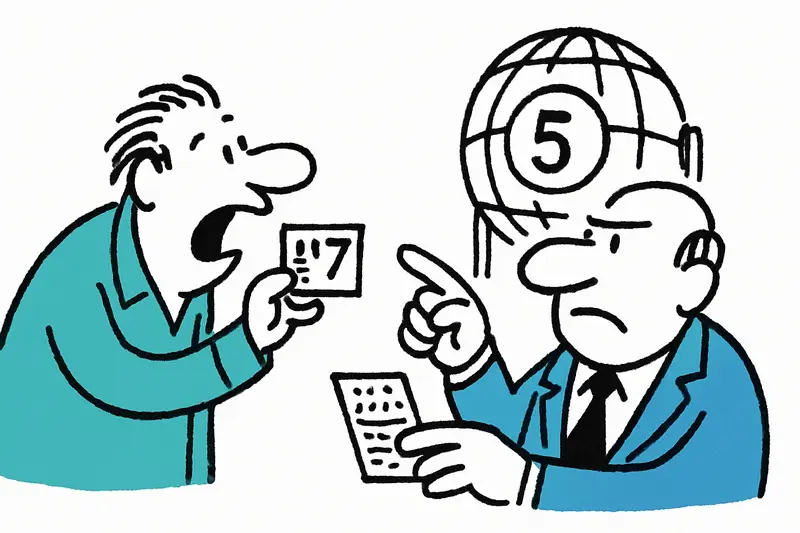
Christmas Lottery: What the final digits really mean — and what they don't
Christmas Lottery: What the final digits really mean — and what they don't
Shortly before Monday's drawing of 'El Gordo': a look at the final digits, their frequencies, and whether past patterns carry weight in a purely random draw.
Christmas Lottery: What the final digits really mean — and what they don't
Guiding question: Does it make sense to base your choice of ticket on historical final-digit frequencies?
On a windy afternoon on Passeig Mallorca you hear vendors calling, cafés on the Plaça Major smell of coffee, and everywhere people are debating whether their lucky number will come up this time. Monday is drawing day for the Spanish Christmas lottery "El Gordo" — many hope, some plan strategically with numbers that have won more often in the past. The bare facts from historical counts look like this: considering single-digit final digits, 5 leads with 32 wins; 4 and 6 follow with 27 each; 3 and 7 appear 22 times each; 0 and 8 have 24 hits each; while 1 only eight times, 2 thirteen times and 9 sixteen times.
For two-digit endings certain combinations stand out: the ending 85 was drawn seven times (first occurrence 1841, most recently 2005), 57 six times (between 1820 and 1932) and 75 five times (1825–1962). On the other hand, in the long history of the lottery there has never been a Gordo with the following endings: 09, 10, 21, 25, 31, 34, 41, 42, 43, 51, 54, 59, 67, 78 and 82. And as a small orientation note: the Gordo of 2024 carried the number 72,480.
Even for three-digit endings you can find clusters: 297, 457 and 515 each appeared three times as the ending of a décimo (one-tenth of a full ticket). A number of other three-digit endings occurred twice, including 085, 094, 400, 640, 381, 856, 892, 590, 466, 365, 704, 600, 758, 884 and 076.
Sounds exciting — but here comes the critical view: the drawing of the Christmas lottery is a random process, and mathematically every final digit has the same chance to come up. Historical clusters are mostly random hits over long time spans. If you overhear an open-air debate on the Playa de Palma you often hear sentences like "5 always wins!" — which is understandable, because people look for patterns even where pure randomness rules.
What is often missing in public discussion is a placement in statistical expectations and the role of small sample sizes. Some of the mentioned clusters come from very long periods with changed lottery modes, numbers of series and administrative practices. Perception is also biased — winning macros are remembered, long runs of blanks are forgotten.
Concrete suggestions for those who still want to participate more deliberately or more relaxed: first, only play with money you can spare; the lottery is entertainment, not an investment. Second, join a group (peña or syndicate) — that reduces the cost per person and increases the chance to at least share smaller prizes. Third, get information locally: buying tickets at official administration offices in Palma — Palma: Christmas lottery ticket purchases are picking up — or at local kiosks ensures you have real "décimos." And if you are traveling from Germany or live there: Germans with a bank account in Spain can participate — but check the formalities beforehand (see Why Germans are not simply allowed to play the Christmas lottery "El Gordo" online) so that any prize payout is handled correctly.
Is something important missing from the debate? Yes: the responsibility of vendors and a clear notice about gambling addiction risks. When street stalls in Felanitx or the market on Avinguda Antoni Maura verge on upheaval, the line between social ticket purchases and problematic gambling behavior is quickly crossed. Authorities and lottery sellers should display visible notices about budget limits and help services.
Conclusion: Historical final-digit lists are a nice plausibility argument when chatting with friends in Palma, but no guarantee. If you take part, do it consciously — share tickets, set a limit and enjoy the ritual. The bells ring, the numbers are sung, and in the end there's often enough luck left that you at least have a good story to tell.
Frequently asked questions
Does the final digit of an El Gordo ticket in Mallorca affect your chances of winning?
Which final digits have appeared most often in the Christmas Lottery?
Is it smarter to choose a Christmas Lottery number with a rare ending?
What is the safest way to buy Christmas Lottery tickets in Palma?
Why do people in Mallorca still choose lottery numbers by final digits?
How should you think about past Christmas Lottery results in Mallorca?
Is it worth joining a Christmas Lottery syndicate in Mallorca?
What should you keep in mind before playing El Gordo as a resident or visitor in Mallorca?
Similar News
Injured captain, big plans: Germania Mallorca before the away match in Consell
The newly founded FC Germania Mallorca travels to Consell on Saturday. Captain Bastian Müller is out injured, but coach ...
Palma, Palma de Mallorca, Palma‑Mallorca: What is it really about?
The debate over the city's name is more than grammar: it concerns identity, law and branding policy. A sober reality che...
Warning to Bathers: Nipping Fish in Cala Major and Other Coves — a Reality Check
In Cala Major and several beaches around Mallorca, bathers report painful “nips”. Who are the animals, why are they gett...
Rental Car Theft in El Arenal: What This Incident Reveals About Our Gaps
A teenager steals a running rental car in El Arenal, flees on foot, climbs over walls and is caught by the Guardia Civil...
Red Rope in Palma's Library: What Helps Against Selfie Tourism — and What's Missing
Palma's city library cordoned off an area with a red rope to keep selfie tourism away from reading and working activitie...
More to explore
Discover more interesting content

Can Cap de Bou

Townhouse Lleo 72
