
Smuggling in the secured area: How a gang exploited the duty-free zone at the airport
Smuggling in the secured area: How a gang exploited the duty-free zone at the airport
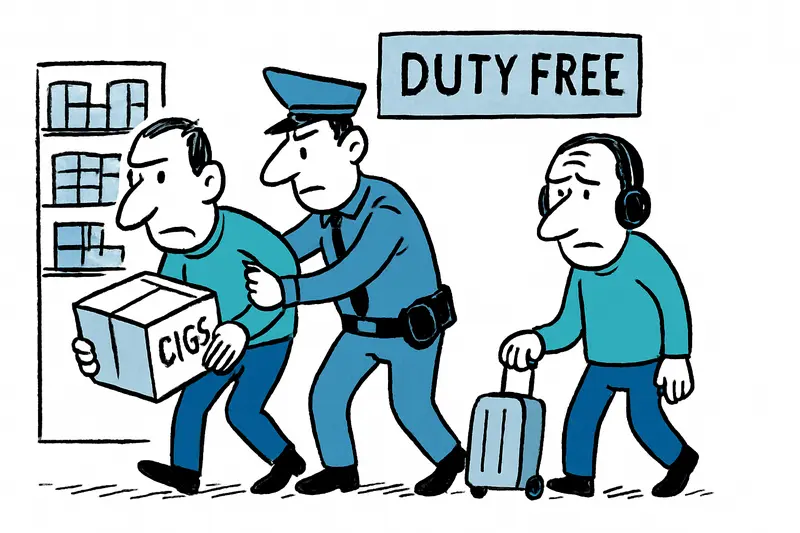
Two further arrests at Son Sant Joan airport: the Guardia Civil stopped a group that used cheap flight tickets to access the departure area and is suspected of specializing in stealing cartons of cigarettes.
Smuggling in the secured area: How a gang exploited the duty-free zone at the airport
On Sunday afternoon, amid a tangle of announcements and rolling suitcases, the Guardia Civil struck again: Arrests at Palma Airport: Two employees detained after alleged thefts. Investigators believe they were part of a group that deliberately stole cartons of cigarettes from shops in the departure area. Other suspects from the same network had already been detained previously.
Key question
How can a public transport hub like Palma airport become so vulnerable that organized thieves can systematically exploit it?
The sequence described in the investigation files and eyewitness reports is simple and at the same time infuriatingly effective: the suspects bought cheap flight tickets to legally enter the restricted departure zone. On site they worked in teams: one watched staff and customers, others disposed of goods in inconspicuous places or hid them in hand luggage. Headphones served as a means of communication to pass signals without attracting attention.
An officer from the tax and border protection unit, who was privately in the terminal, recognised two men — aged 34 and 38 — who were already the subject of ongoing investigations. He reported his sighting to the on-duty patrols. They acted and arrested the two on suspicion of repeated shoplifting and membership in a criminal organisation.
Critical analysis
The gang’s pattern reveals systemic weaknesses: first, buying a ticket currently grants almost unrestricted access to the security zone once formalities are completed. Second, there are areas behind sales counters and between duty-free shelves that are poorly visible. Third, cooperation between shop operators, airport security services and police forces remains sporadic and reactive instead of preventive.
Accomplices exploit social distance — headphones, hurried travellers, rolling trolleys — as camouflage. For shop detectives it is an old trick: distract, create space, collect later. In a busy airport with continuous security checks, this tactic is further aided by the high density of movement. This concern was raised previously in Thefts at the Airport: Two Employees Detained – How Secure Is Son Sant Joan?.
What is missing from public discourse
Conversations in cafés on Passeig Mallorca and with airport employees reveal that the economic incentives are rarely discussed: cigarettes are easy to transport, in demand internationally and legally resellable in many places. The burden on shop staff is also little addressed — not only morally but economically: recurring losses drive up security costs and prices.
The question of how airlines, ticket platforms and airport operators can work together is also too rarely present, as highlighted in Checkpoint Son Sant Joan: When unpaid fines can stop a holiday. Low-cost flights are a benefit for travellers; for criminals they can serve as access. This needs to be discussed openly and factually — without service panic, but with clear vision.
Everyday scene from Mallorca
Imagine the departure hall: the smell of coffee mixes with the salty breeze that sometimes reaches the terminal. A father pulls his son past with a rolling suitcase, an elderly lady reads the departures board, and in the background a bus on Via Roma rumbles by. It is precisely in this routine that the scenes described hide — unnoticed, because everyone’s eyes are on their own journey.
Concrete solutions
- Increase visibility: add camera angles and create clear sightlines in shops. Shelves and hiding spots should be designed so that staff have a better overview. - Relieve staff: training for sales staff on observation techniques and safe interventions, plus simple reporting channels to police and security. - Control access: consider whether additional checks for certain tickets make sense (e.g. larger random bag checks on frequently used low-cost connections) without restricting freedom to travel. - Strengthen cooperation: regular situation meetings between airport management, shop operators, private security services and the Guardia Civil, complemented by undercover checks. - Product management: manufacturers and retailers could make packaging harder to transport or better marked, reducing the appeal for resale.
Conclusion
The recent arrests do not automatically end a series of crimes. They do show, however, that the presence of well-trained officers, even off duty, helps. In the long term, more than police operations are needed — concrete, coordinated measures between all parties at the airport. Son Sant Joan is the gateway to the island; it must remain open and safe, and not become a playground for organised petty crime.
Frequently asked questions
How can airports in Mallorca reduce theft in duty-free areas?
What signs indicate a risk of theft in a busy Mallorca airport departure hall?
What happened at Son Sant Joan and what does it reveal about security in Mallorca airports?
How can Mallorca airport operators and shop staff work better together to prevent theft?
What practical steps can travelers take to protect their purchases in Mallorca's departures?
Are there airport security practices like random bag checks that could help deter theft in Mallorca?
How does organized petty crime at Mallorca airports affect travelers and costs?
What does everyday life at Palma's airport look like, and how can travelers stay safe while moving through it?
Similar News

Brawl at Palma Airport: When Competition Turns to Violence
In the arrivals area of Son Sant Joan a dispute between transfer service drivers escalated. One man was arrested, the vi...

77-year-old missing in Llucmajor: Why such cases on the island must not become routine
A 77-year-old German is missing in Llucmajor. SOS Desaparecidos is searching for Reiner Schnell. A critical assessment: ...
Ham Street, Sunglasses, Cocaine: When Sales Tricks Become Dangerous
A vendor at Playa de Palma offered a pair of sunglasses — and apparently hid a small packet of cocaine. The central ques...
Dancing Instead of Complaining: The Viral Duty‑Free Artist and the Payment Gap at Palma Airport
An actor dances through the duty‑free area in Palma, goes viral — and speaks of unpaid bills. Who is responsible, and wh...

"As a diver I felt helpless": Many dead sea urchins off Calvià — what this means for the sea
At one spot off Calvià a diver found hundreds of dead sea urchins. It is clear these animals are important for the seabe...
More to explore
Discover more interesting content

Boat Tour with BBQ along Es Trenc Beach

Private transfer from Mallorca Airport (PMI) to Pollensa
