
Cut into the Shade: Why Palma's Wall Trees Fell Despite Protests
Cut into the Shade: Why Palma's Wall Trees Fell Despite Protests
Just after seven on a cool December morning the city felled 18 “elephant trees” along the old city wall after a court lifted an injunction. Residents protested. The question remains: would a more transparent process have removed the roots of the conflict?
Cut into the Shade: Why Palma's Wall Trees Fell Despite Protests
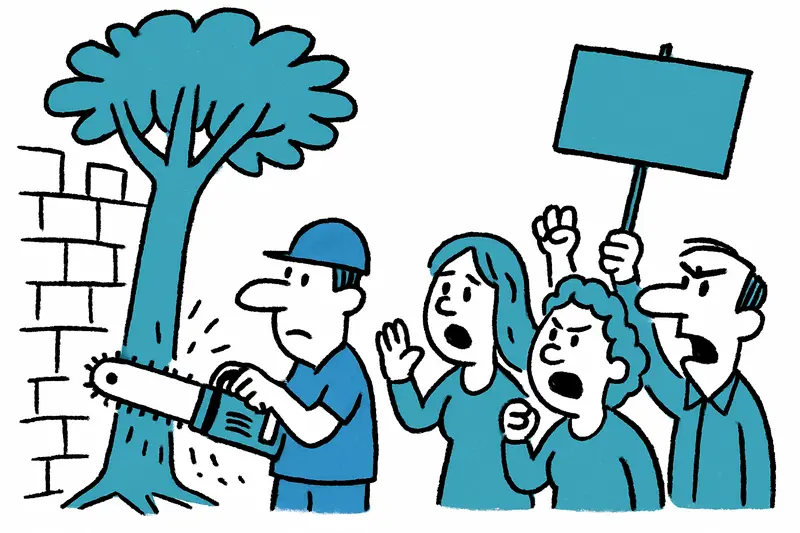
Just after seven on a cool December morning the chainsaw began to sing. Right as people took their first coffee on the steps of Plaça Llorenç Villalonga, residents, many of them opposing planned tree felling, watched city technicians saw down 18 so-called “elephant trees” on the remains of the city wall. The court had previously lifted an injunction and thus legally cleared the way for the measure. The mood: uncertainty, anger, grief — and the question everyone is asking now: was this truly unavoidable?
Key question
Was the felling operation an unavoidable safety measure or was there a lack of transparency and alternative actions that could at least have mitigated the loss?
Critical analysis
The court based its decision on technical reports from the municipal parks and gardens department, which stated that the trees were in poor condition, showed several diseases, and had no prospect of recovery. That is factual as far as it goes. What is missing, however, is an independent public verification of the findings: which tests were carried out, which specific diseases were diagnosed, and which restoration attempts were made? Instead of answers, the morning brought fences, trucks and the crunching sounds of falling branches.
In strong winds or heavy rain, weakened trees can indeed pose a danger. That is a valid point in favor of the city. Yet the timeframe — injunction lifted, chainsaws 48 hours later — gives the impression that the administrative action was executed faster than a credible dialogue could have taken place. For many residents this raises the question whether purely technical criteria were sufficient or whether political priorities played a role.
What is missing from the public debate
Three things are missing: verified second opinions, publicly accessible diagnostic reports and a long-term, clearly communicated plan for managing the city's tree stock. If the city reports that trees have “no future prospects,” it must also show which alternatives were considered — from pruning and crown securing to transplantation, where feasible. Equally missing is a map or registry documenting the extent and age of the trees. Without such data, the decision remains opaque to many citizens.
Everyday scene from Palma
On Plaça Llorenç Villalonga, where residents had previously blocked the planned felling of 17 ombu trees, older women stood with shopping bags, a café owner closed the door as the dust cloud approached. Children watched from the school, a cat jumped off the fountain edge, a delivery van parked halfway down Carrer de la Marina. The protesters did not sing; they held up photos of branches, spoke in low voices, some cried. For a moment the sound of the chainsaws was louder than the traffic on Passeig del Born.
Concrete proposals
1) Immediate publication of the reports and sample results as well as the findings of external arborists. 2) Introduction of an independent expert review process for contested fellings, funded by the city but staffed with independent specialists. 3) Expansion of a digital tree cadastre: age, condition, history of maintenance measures. 4) Trial of emergency measures prior to felling — crown securing, cabling, radical pruning — where appropriate. 5) Creation of a municipal fund for replacement plantings and temporary sun protection (e.g. shade canopies) in particularly affected squares. 6) Involvement of the neighbourhood: “tree sponsorships” and regular, publicly accessible maintenance reports.
Pithy conclusion
People's safety has priority; that is undisputed. But safety must not become a pretext for carrying out contentious urban interventions without understandable transparency. Whoever fells trees in Palma cuts not only wood but public quality of life. The city should now do more than cut and put up stakes; it must show how it will better mediate the conflict between preservation and safety in future. Otherwise cleared shady spots and alienated neighbourhoods will remain.
Frequently asked questions
Why were the wall trees cut down in Palma?
Are tree removals in Palma always a safety issue?
What should a city publish before cutting healthy-looking trees in Mallorca?
Was there any alternative to felling the trees in Palma?
Why did residents protest the tree felling at Plaça Llorenç Villalonga?
What happened at Plaça Llorenç Villalonga during the tree felling in Palma?
Does Palma have a public tree register or cadastre for its street trees?
What can Palma do after removing street trees to improve shade in the city?
Similar News
Who Benefits from the Half‑Hourly Flight on the Edge? Aena, Investments and the Island's Interests
Almost one billion euros is flowing into Son Sant Joan. The figures show the scale of investment and expected beneficiar...
Are the Balearic Islands the Southern Border of Europe? A Reality Check on Immigration
The Balearic Islands are again calling for EU aid after a sharp rise in arrivals by sea. Conflicting priorities between ...

"Expensive chaos" and many open questions: What clients can do when a lawyer suddenly stops responding
Several clients complain that a well-known German lawyer in Mallorca has been unreachable for months. Key question: What...
TV tip: 'The Last Problem' — Mallorca as the setting of a classic crime
A classic whodunit on Mallorca: A new miniseries set in spring 1959 brings storm, an isolated hotel and a dense web of s...
Nipping Sea Creatures: Why Bathers in Cala Major and Elsewhere Should Be Cautious
In Cala Major, bathers have reported being nipped by small fish. What is behind it, how can problems be avoided — and wh...
More to explore
Discover more interesting content

Can Cap de Bou

Townhouse Lleo 72
