
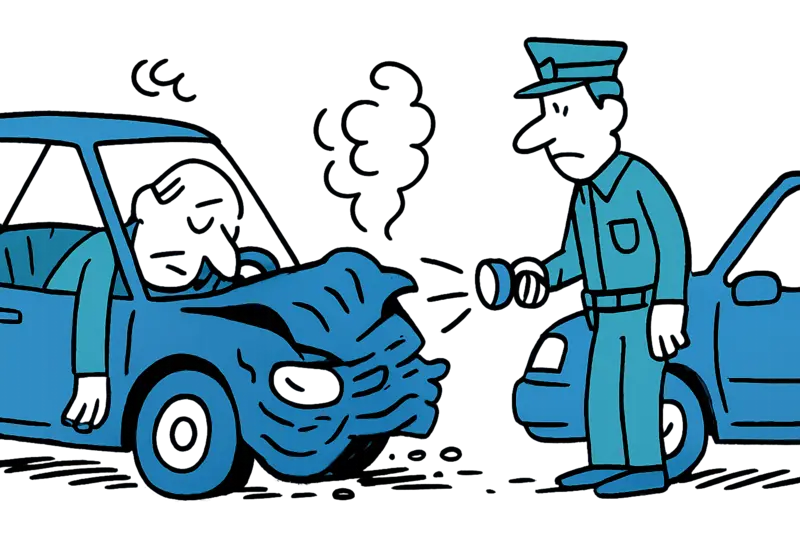
Fatal accident near Son Llàtzer: When a medical episode at the wheel turns the road into a danger
In a collision near the roundabout at Son Llàtzer hospital, an approximately 80-year-old car driver died. The suspicion of a medical episode raises questions about the driving fitness of older road users.
Fatal accident near Son Llàtzer: When a medical episode at the wheel turns the road into a danger
An evening accident in Palma raises questions about age checks, technology and responsibility
On Tuesday evening, around 7 p.m., a serious traffic accident occurred near the roundabout at Son Llàtzer hospital in Palma. A Nissan apparently first entered the roundabout in the wrong direction and then continued on an access road of the so-called second ring road against the permitted direction of travel. On the opposite lane the vehicle collided with several cars. The driver, an approximately 80-year-old Spanish national, died at the scene; several other people reportedly sustained only minor injuries.
Key question: How can we prevent a possible medical emergency at the wheel from becoming a deadly danger to others?
Critical analysis: Narrow roads and heavy traffic are common on Mallorca, especially around junctions like the roundabout at Son Llàtzer. When a vehicle changes sides of the road or drives against the flow, the consequences are often immediate and severe — similar patterns appear in other crashes, such as After head-on crash in Palma: Fleeing and many questions – 31-year-old dies. Several vulnerabilities converge here: an individual driver's physical condition, whether sufficient technical aids in the vehicle are active, and the infrastructure that could detect or mitigate such wrong-way maneuvers. The fact that signs of a medical episode are mentioned as a possible cause is important — but it must not remain speculative. Who else is still driving? What medical checks exist? And how quickly are they implemented?
What is missing in the public debate: Discussions often focus on assigning blame and sensational headlines, as with Fatal accident in Alcúdia: Who is responsible — and what needs to change?. Less attention is paid to preventive details: the practical enforceability of mandatory health checks from a certain age, the status of retrofitting requirements for autonomous emergency braking in older vehicles, or whether traffic planners can structurally reduce dangerous access points around hospitals and large junctions. Rarely discussed is the role of family doctors and relatives, who might notice early warning signs — and the legal hurdles when relatives raise concerns.
Everyday scene from Palma: In the evening you can hear the steady hum of passing cars on Passeig Mallorca, the streetlights casting long shadows. In front of the small corner supermarket, neighbors discuss the traffic jam at the hospital. An ambulance wails and cuts off conversations; the Guardia Civil shines lights on the asphalt and directs traffic. Care and danger sit so close together, says the woman at the bakery who sees the same old man with his dog every morning — and the silent question remains: When do you notice that someone is no longer safe to drive?
Concrete solutions: First: age-related but flexible fitness-to-drive assessments. Instead of rigid limits, a tiered system could be considered — medical certificates, simple driving tests or simulator sessions for people beyond a certain age. Second: promote technology. Many modern cars offer emergency braking assistants, lane-keeping warnings or systems that could detect wrong-way driving. Support programs or tax incentives to retrofit older vehicles would be a realistic step. Third: infrastructure checks at critical points. More visible markings, additional physical barriers or signs at access roads could catch wrong maneuvers — measures that might have mitigated incidents like Fatal Head-on Collision in Son Banya — More Than Just an Accident?. Fourth: raise awareness in medical practice. Family doctors who see older patients regularly should be better equipped to evaluate driving fitness and know formal reporting options in case of doubt, without stigmatizing the patient. Finally: support for those affected. Giving up driving requires alternatives — better evening public transport, neighborhood driving services or municipal offers that secure mobility without endangering people.
Legal and practical considerations: Measures must be clearly regulated to avoid arbitrary application. At the same time, transparency in handling medical data, protection against discrimination and practical contact points for relatives are needed. A pilot project at municipal level would be a good test: mandatory health checks coupled with advisory and mobility offers would show which approaches really work, as highlighted in other local investigations such as Fatal accident near Son Castelló: Three passengers come forward — where are the gaps in responsibility?.
Punchy conclusion: The fatal accident near Son Llàtzer is more than a sad headline. It is a wake-up call: traffic and health policy intersect directly here. As society ages, appeals are not enough. We must build systems that protect people without needlessly curbing freedom — and calmly clarify which steps are feasible in the short term and which require larger reforms.
Archive image: Guardia Civil at an operation (archive).
Frequently asked questions
When is the best time to visit Mallorca for good weather and beaches?
Are there family-friendly beaches in Mallorca?
What should I pack for a trip to Mallorca in summer?
How can I get around Mallorca without renting a car?
What are some top natural or cultural highlights to visit in Mallorca?
Is it safe to swim off Mallorca’s beaches?
Do seasonal winds affect Mallorca’s beaches and water activities?
What are some etiquette tips for visitors in Mallorca?
Similar News
Higher VAT for holiday rentals: What it really means for Mallorca from December
The Spanish government will reintroduce a 10% VAT on certain holiday rentals from 1 December 2026. Which landlords are a...
Can I travel to Palma without an ID? When a holiday falls apart just before departure
At Erfurt-Weimar airport two German travelers tried to travel to Mallorca without valid IDs. What travelers should know ...
Between Lamborghinis and Remembrance: A Reality Check on the Unity Celebration in Mallorca
Consul Angelika Saake celebrated the Day of German Unity at the Motorworld. An elegant reception — but the choice of ven...

"I voted for you" — A cry for help in parliament and what Mallorca lacks
An evicted woman seeks out Marga Prohens in the Balearic Parliament. The incident reveals more than political stage rhet...
A New Start for Copper: The Hound Who Needs Exercise
Copper lived on a boat for seven years and appears apathetic at the SOS Animal shelter. The active hound needs a home wi...
More to explore
Discover more interesting content

Can Cap de Bou

Townhouse Lleo 72
