
Does Palma still need the 100‑milliliter rule? Two decades of liquid bans and waiting for a real easing
Son Sant Joan has modern scanners, yet the 100‑milliliter limit remains. A critical stocktake: why technical modernization does not automatically lead to more allowance for liquids — and how Palma could take the next step.
Does Palma still need the 100‑milliliter rule? Two decades of liquid bans and waiting for a real easing
Between automated gates and mini bottles: what the 100‑ml limit still means in Mallorca today
Early in the morning, when the train from Inca runs along Passeig Mallorca and the first cortados are poured at the airport, some travellers are already standing in front of security with a giggling plastic bag: the obligatory collection of 100‑milliliter bottles. Two decades after the restriction was introduced, a simple question has become entrenched for many locals: is this still up to date, or is Palma stuck in the old ritual of tiny bottles?
Main question: Why doesn't Son Sant Joan fully use its technical equipment to replace the 100‑milliliter rule — and what would need to happen for that to change?
The fact is: Son Sant Joan has an automated control system with modern EDS‑CB scanners and a large number of security gates. The hardware now allows hand luggage to be checked in much more detail without passengers having to fish out every shampoo bottle separately. Officially, however, the 100‑milliliter limit still applies. Other airports in Europe have already found local ways to allow larger quantities; examples include airports in London, Milan and Vienna, which have tested and partly authorised corresponding scan systems.
So why the reluctance? The short answer is: regulation, liability issues and gradual validation. Technology alone does not change legal requirements. A Europe‑wide adjustment requires testing, official approvals and coordinated safety standards. Operators and authorities also do not want to act hastily, because errors in flight and passenger security quickly have large consequences — and that breeds caution.
What is missing from the public debate: The discussion often focuses only on comfort versus safety. Two larger aspects fall by the wayside. First: the role of regional airport operators. Son Sant Joan is part of a national network and decisions are not made on Mallorca alone. Second: sustainability. The 100‑ml rule has encouraged the spread of single‑portion plastic — small shampoo bottles, single‑use containers, mini soaps. Anyone standing at the coffee bar in the terminal can see the amount of packaging in the bins: an ecological footprint that is often overlooked.
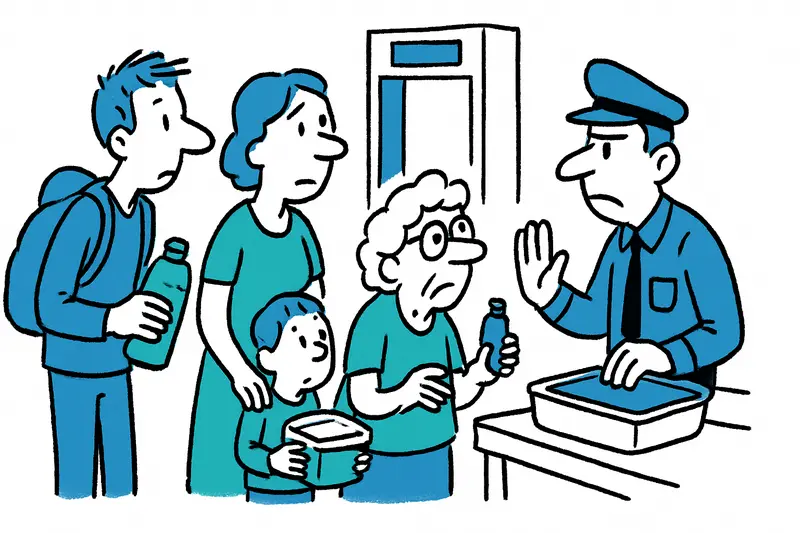
A typical scene makes this clear: a family with a toddler stands in line, baby food in a Tupperware box, a grandmother argues with the checkpoint staff about a 150‑milliliter sunscreen, and next to them a young backpacker is pouring liquids from a large bottle into travel containers. The public‑address announcement urges calm, staff manage the queue, baggage conveyors whirr — a small theatre of rules, habit and improvisation.
Critical analysis: there are three bottlenecks delaying any easing. First, the approval of new scanning procedures at EU level and the question of which test profiles are considered sufficient. Second, on‑site organisation: equipment is only part of the solution; training, procedures and liability agreements between the operator, airport security services and national authorities are decisive. Third, communication with travellers — without clear guidance, frustration and improvisation remain the norm.
Concrete approaches for Palma:
- Start a pilot programme: In coordination with the competent national authorities, Son Sant Joan could run a time‑limited pilot project testing relaxed volume limits at certain gates or times. That would provide concrete stress‑test data for the authorities.
- Increase transparency: Travellers need clear, easily accessible information about which scanner types are in use, how samples are checked and what happens in case of a problem. A simple FAQ on the airport website and prominent signage in the terminal would help.
- Staff and liability: The operator should clarify liability arrangements with insurers and national security authorities and at the same time finance more intensive training for security personnel so that technical innovations can actually be used.
- Promote sustainability: Parallel to relaxations, airports should support refill stations for hygiene products and launch partnerships with manufacturers that offer refillable formats. This can avoid a side effect — more single‑use plastic.
- Coordination at EU level: A binding timetable and standardized test protocols would reduce uncertainty. Spain could play a more active role in this process so that regional airports are not left waiting in the loop.
What this would mean concretely for travellers in Mallorca: less time spent transferring liquids, less stress at security and the possibility to bring familiar care products in larger formats. For local service providers and travellers with special needs (medications, baby food) it would be a noticeable relief.
Punchy conclusion: The technology is available, the habits and regulations are not. Son Sant Joan does not operate in a legal vacuum — legal steps and coordinated tests are necessary. Anyone looking around in the morning queue will quickly notice: the 100‑milliliter rule is less a technical problem than an organisational and political one. If Mallorca wants to play a leading role here, it needs the courage for concrete pilots, clear communication and the willingness to plan for ecological consequences at the same time. Then next time a plane arrives from the north, the plastic bag might stay in the pocket — and not only because travellers have become better organised.
Frequently asked questions
Is the 100‑milliliter limit still enforced at Palma’s Son Sant Joan Airport?
What would need to happen to allow larger quantities of liquids at security in Palma?
How could Palma improve traveler experience at security with the current technology?
What sustainability concerns are linked to the 100‑ml rule in Mallorca?
Could Palma run a pilot program to test relaxed limits, and what would be learned?
How does the 100‑ml rule affect families traveling from Mallorca, especially with babies or medications?
What kind of information should Palma provide to help travelers during security checks?
How does the 100‑ml rule relate to Mallorca's broader sustainability and tourism goals?
Similar News
Smoke over Avenida Argentina: High-rise fire raises unanswered safety questions
On Saturday afternoon an apartment on Avenida Argentina in Palma caught fire. A building was evacuated and a neighbor su...
When Farewells on Mallorca Run a Little Differently: Between Urn Chaos and Sea Singalongs
All Saints' Day on the island brings more than candles and flowers: stories of swapped urns, cremated scarves and sea bu...
Up for a Scare: Why Mallorca Enjoys a Little Fright
Pumpkins on the windowsill, children's voices on the Passeig Marítim and a warm autumn evening — Halloween on the island...
Wrong-way driving on the Ma-15: Head-on crash at Xorrigo and the questions that remain
In the early morning hours, a seven-seater vehicle traveling in the opposite direction collided with a delivery van at t...
When a Backpack Loudspeaker Becomes a Stress Test: Season's End at Ballermann and Loud Disregard
At the end of the tourist season, groups played extremely loud music through the streets in the Playa de Palma area. Res...
More to explore
Discover more interesting content

Can Cap de Bou

Townhouse Lleo 72
