
Dream Pool or Drought? Why Pools on Mallorca Become a Problem
Dream Pool or Drought? Why Pools on Mallorca Become a Problem
Pools are seen as a must-have here. But between construction costs, water scarcity and gradual evaporation, a lot is at stake. A reality check with practical solutions.
Dream pool or drought? Why pools on Mallorca become a problem
Guiding question: Who pays the price on the island for private luxury that is increasingly revealing itself as a public burden? This is also a concern for tourism, as discussed in Water scarcity in Mallorca: Why hotels must now take responsibility.
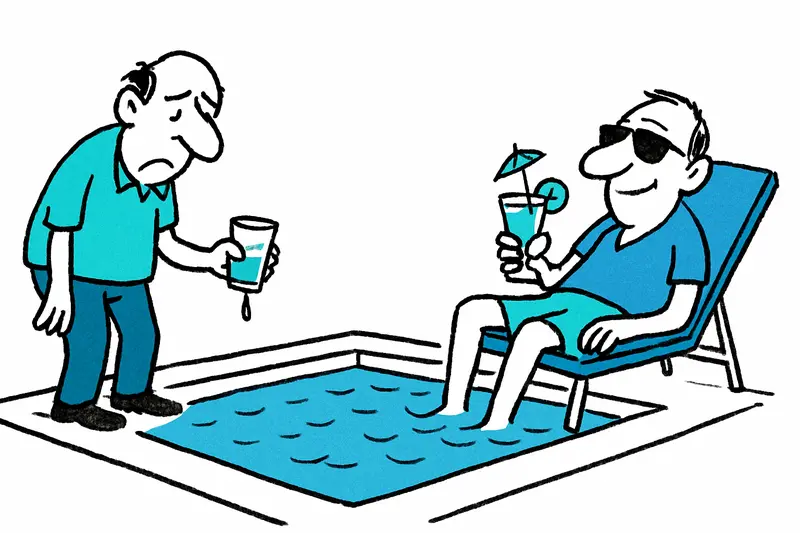
The idea of having your own swimming pool is now part of the package for many homebuyers on Mallorca: plot, terrace, pool. But behind the picture of blue water and cool drinks lies a complex calculation. A typical concrete pool in standard size – 8 x 4 metres – holds about 48 cubic metres. A one-time complete fill currently costs only around 100 to 150 euros. Sounds cheap? That's misleading. Construction costs for a concrete pool are roughly between 18,000 and 30,000 euros, plus annual operating costs of about 650 to 1,100 euros.
These figures also explain why so many pools appear here: in the Balearics there is statistically one pool for every 14 inhabitants. If you add up all pools – including estimates for illegal installations – there are almost 100,000 pools, a trend linked to broader supply issues outlined in When the Tap Runs Scarcer: Mallorca Between a Tourism Boom and a Dwindling Water Source. And the number is growing: almost 4,000 new pools were added in 2023 and 2024 alone, and over 6,000 since 2015. Places like Calvià, Llucmajor, Santa Eulàlia, Palma and especially Marratxí with its more than 4,400 pools show how strongly settlement and building policies affect water consumption.
The ecosystem reacts: experts estimate that all the pools on the islands together evaporate between seven and eight cubic hectometres of water annually – that is millions of cubic metres, more than a large reservoir would hold, as detailed in Why Mallorca's reservoirs remain empty despite rain — a reality check. Pools account for around six percent of total water consumption; that corresponds to the annual demand of roughly 50,000 households or 150,000 people. In a summer with water restrictions this picture is particularly bitter, as shown in Water Emergency in Valldemossa: When the Wells Whisper.
What is often missing from the public debate is the perspective of everyday practice. Imagine a hot July afternoon in Palma: the air shimmers over the Passeig, cicadas chirp in the narrow streets, rubble clinks on building sites. On many properties automatic sprinklers run at midday, neighbours pour water into small pools to compensate for evaporation. No one likes to turn off the sprinkler when the reason for the garden was already decided at the time of buying the house.
Critical analysis: This is not just individual consumer behaviour, but a system of building preferences, tax incentives, lack of control and missing alternatives. The economic incentive for pool builders and the expectations of property buyers drive the growth. Authorities often have trouble detecting illegal installations and imposing adequate sanctions. And water suppliers stand between their supply mandate and political pressure.
What is missing in the public discourse? Three points: first, binding rules for the construction and retrofitting of pools. Second, practical incentives for water-saving technology in existing pools. Third, an honest view of collective consequences – not just the individual owner.
Concrete solutions
- Mandatory pool covers or tarpaulins for private pools during the hottest months: evaporation is reduced significantly. - Subsidies for rainwater harvesting and cisterns in new buildings, with clear requirements to avoid connection to drinking water networks. - Bonuses or tax reductions for conversion to saltwater or recirculation systems with lower fresh water demand. - Stricter permitting procedures: new building projects should assess the water footprint of the entire development. - Municipal community pools in residential areas as an alternative to hundreds of individual pools. - Consistent sanctions and mandatory retrofitting for illegal pools.
Such a mix of regulation, technology and neighbourhood solutions would both curb the building frenzy and lower the everyday water bill for everyone.
Conclusion: A private pool remains a status symbol – but on an island with limited water resources this symbol will soon become a political question. Those who want to live permanently in Mallorca must learn to balance privileges with communal responsibility. That is uncomfortable, but feasible. In the square, next to the café, people are already discussing it. The challenge is not whether we dream less, but how we dream without drying out the island.
Frequently asked questions
When is Mallorca's weather most pleasant for outdoor activities?
What should I pack for a Mallorca beach trip?
Is spring a good time to swim in Mallorca's sea?
What are the best beaches in Mallorca for families?
What’s the best way to explore Palma de Mallorca in a day?
What can you see in Sóller and Port de Sóller?
What hiking options are popular in Mallorca?
Is it easy to travel between towns in Mallorca by public transport?
Similar News

When the Wallet Becomes a Danger: Attack in Peguera and Lessons for Mallorca
In Peguera, two women are said to have stolen the wallet from a 75-year-old German couple. When the victim intervened, t...
Plata stays Plata: Young people take over, Llonguets remain
A small bar on Carrer de l'Argenteria will continue: Tolo Serra hands the place over to young Mallorcans at the end of t...

Unnoticed in the Luggage Compartment: How a Boy Traveled More Than 100 Kilometers in a Team Bus
A minor traveled in the undercarriage of a team bus for more than 100 kilometers until his cries for help were heard. A ...

Cap Vermell Grand: Second Michelin Key – a Gift for the East
The Cap Vermell Grand in Capdepera has been awarded its second Michelin key. For the region this elevates the luxury off...
Eurowings lets four aircraft carry names – a friendly idea that also reaches Mallorca
Eurowings is launching a campaign: four Airbus A320s are to carry the first names of people who help others in everyday ...
More to explore
Discover more interesting content

Can Cap de Bou

Townhouse Lleo 72
