
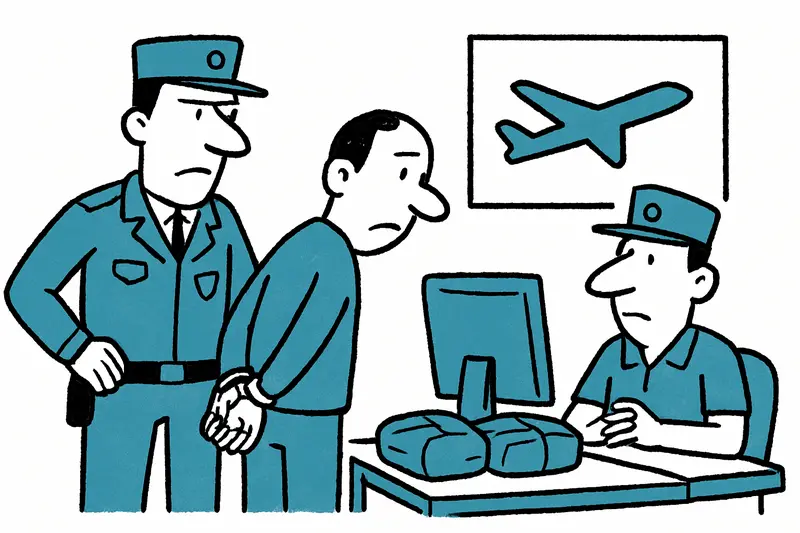
Drugs at Palma Airport: Six Arrests — what does this say about security?
Drugs at Palma Airport: Six Arrests — what does this say about security?
On 25 December 2025 the Guardia Civil arrested six people; package checks yielded 18.5 kg of hashish and 12.5 kg of marijuana. Investigations took place on Mallorca and Menorca. An assessment with a critical eye: where are prevention and controls?
Drugs at Palma Airport: Six Arrests — what does this say about security?
Key question: Are checks at the airport and postal outlets sufficient — or does too much smuggled goods slip through because authorities and technology are not keeping up?
On 25 December 2025 the Guardia Civil reported a major blow against alleged drug trafficking: six people were arrested, three were remanded in custody. Investigators seized a total of 18.5 kilograms of hashish and 12.5 kilograms of marijuana; the orders are said to have been arranged via social networks. The operations took place at several locations on Mallorca and also on Menorca, and similar operations have included inspections on ferries such as Drug discovery on a ferry from Barcelona: Three arrests in Palma and the questions that remain. Those are the facts. What does this mean for everyday life on the island?
If you walk along Terminal A in Palma on a quiet morning you hear the roll of suitcase wheels and the hum of the air-conditioning, see taxi drivers waiting for customers and tourists asking for directions to their gate. Between these routine scenes things happen that few associate with the noise of the departure boards: parcel deliveries (see Hashish Package in Palma: When Delivery Workers Become Investigators), private shipments, small transactions arranged via messenger channels. It is apparently in these in-between spaces that the opportunists of the drug trade operate.
Critical analysis: What works — and what doesn't?
A bust like this shows that investigators are working successfully: checking parcels, investigative work across multiple islands, arrests on site. At the same time the operation reveals structural weaknesses. First: using social networks as an ordering platform makes the trade harder to catch. Networks are dynamic; chats are deleted, accounts are switched. Second: parcel logistics — from private couriers to international postal shipments — offers many nodes that are not all checked equally strictly. Third: the distribution of the investigations across different islands shows how mobile the structures are and how quickly goods can be moved from one place to another, as in Raid on Mallorca: Network of Drug Trafficking and Money Laundering Shakes Palma and Surroundings.
From a police perspective the challenge is therefore: to be visible without crippling normal traffic. Checks at the airport are necessary, as indicated by Aena's Palma de Mallorca airport information, but they must not be the only line of defense. Otherwise the airport becomes just a visible part of a large, far-reaching system.
What is missing from the public discourse
Public debate often focuses on arrests and the quantity of drugs seized, such as the case of 171 pills found during a traffic stop: Traffic stop in Palma: 171 pills, two arrests – how safe are our streets?. Important questions usually remain underexposed: How do the packages enter the shipping chains? What role do local courier services or holiday flats play as transshipment points? Who benefits from the local demand? And not least: how much effort is put into prevention instead of just repression?
Equally rarely discussed is the social dimension: young people who live or work on Mallorca can quickly become dependent when small deals bring them short-term cash. Simply reporting the "arrests" does not reflect this problem.
Concrete solutions
1) Better cooperation between authorities and parcel service providers: targeted spot checks, information exchange about suspicious senders and recipients, sensible prioritization instead of full-scale inspection.
2) Digital education and community reporting: users of social networks must know that platforms and authorities can cooperate. Programs that create secure reporting channels for suspicious offers are needed.
3) Stronger presence at transshipment points: weekly markets, parcel shops and certain residential areas on Mallorca need visible prevention services and low-threshold contact points.
4) Social prevention: more counseling and job opportunities for young people so that short-term temptations become less attractive.
A practical example from Palma
Imagine the Carrer de la Pau: a bakery, a small travel agency, a parcel shop. There a young courier briefly speaks with the shopkeeper, looks for an address — and is gone again in five minutes. For residents such encounters are inconspicuous. For investigators these are exactly the moments that need to be pieced together.
Conclusion: The arrests on 25 December 2025 are a success for investigative work. At the same time they indicate that criminal structures are adapting to the digital and logistical reality. Those who rely only on arrests overlook the thin links in everyday life that enable these structures. Better-networked authorities, closer cooperation with parcel services and more local prevention could be more effective in the long term than individual headlines.
Frequently asked questions
How safe is Palma Airport when it comes to drug smuggling?
Do airport checks in Mallorca catch most illegal shipments?
What role do parcel services play in drug trafficking on Mallorca?
Why are social networks used in drug dealing on Mallorca?
What did the Guardia Civil arrests in Mallorca actually find?
Why are drug investigations on Mallorca spread across several islands?
How can residents in Palma notice suspicious parcel activity?
What does this say about everyday safety in Mallorca?
Similar News

High heel slips, car accelerates: accident on Camí de Son Hugo
A woman lost a high-heeled shoe on the forecourt of the sports facility at Camí de Son Hugo. The car accelerated, mounte...
Phone Scam: How Two Hotel Employees at Playa de Palma Lost Thousands of Euros
One morning in September, two reception employees at Playa de Palma were pressured by alleged alarm-company staff — in t...

When the Wallet Becomes a Danger: Attack in Peguera and Lessons for Mallorca
In Peguera, two women are said to have stolen the wallet from a 75-year-old German couple. When the victim intervened, t...
Plata stays Plata: Young people take over, Llonguets remain
A small bar on Carrer de l'Argenteria will continue: Tolo Serra hands the place over to young Mallorcans at the end of t...
Unnoticed in the Luggage Compartment: How a Boy Traveled More Than 100 Kilometers in a Team Bus
A minor traveled in the undercarriage of a team bus for more than 100 kilometers until his cries for help were heard. A ...
More to explore
Discover more interesting content

Can Cap de Bou

Townhouse Lleo 72
