
Dunes at s'Estanyol: Between a Walk and Coastal Loss
The dunes of s'Estanyol near Llucmajor are shrinking — not only from the wind, but from our feet. Why the small hills are more than sand and which concrete steps can protect them now.
Dunes of s'Estanyol on the brink: Is our short path the start of a major loss?
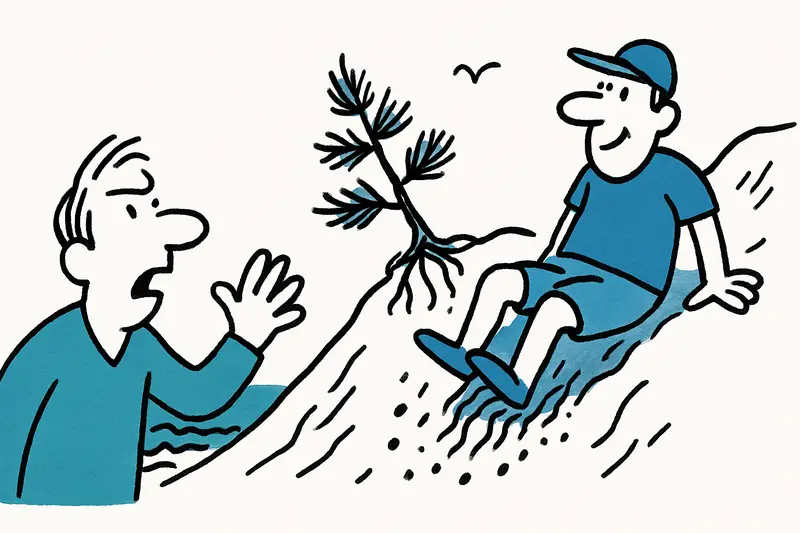
If you walk along the beach of s'Estanyol in the morning, the first thing you hear is the sea, then the distant squawking of gulls and — depending — the soft crunch under your shoes when you cross a dune. Harmless at first glance. On closer inspection, however, there are spots with exposed tree roots, small pines leaning sideways, and the soft contours of the hills are washed out. Not by the force of the storm, but by people entering the dunes, sliding down them or simply lying on them.
The central question is: why are a few footsteps enough to change a coastal landscape, and what happens if we continue as before? The answer brings everyone from the early jogger with a dog on Carrer de s’Estanyol to the school class taking the “short route” in the morning back to responsibility — and to the responsibility of the authorities, as documented in Las dunas de s'Estanyol en Llucmajor están en peligro.
The dune system: more than just sand
Dunes are not a heap of loose sand; they are a living buffer. Grasses, beach plants and the fine tangles of roots hold the grains together. In storms they protect the inland, in high tides they curb erosion. Once vegetation is destroyed, sand slips away or is blown off by the wind. In some places in s'Estanyol you can observe how a single path, narrow at first, widens into a straight scar over the summer months — a loud sign that many small habits together have a large effect. Local reporting such as Cuando la duna respira: cómo s'Estanyol en Llucmajor se pierde poco a poco documents how these paths expand over time.
Less known but crucial: the exposed roots of the pines are important for the ecosystem. They network the sand, provide support for young plants and thus form the basis for dune regeneration. If this network is destroyed, the balance shifts. Within a few years the dune shrinks, and in some sections a complete loss is even threatened.
What is currently missing
The public debate often lacks concrete practice: who is responsible? The municipality of Llucmajor, local conservation bodies or volunteers? And how much does information help compared to enforcement? On weekends and holidays police or regulatory services are quickly overstretched. Strict fines are possible, but they do not automatically solve the awareness problem.
Moreover, the effect of cumulative use is underestimated. An Instagram photo on a dune that appears to be harmless fun can inspire others to take the same “short” route. This creates paths that permanently alter the original structure. In the background, rising visitor numbers and warmer, windless summers reinforce this dynamic — the dunes have less chance to regenerate.
Concrete, immediately implementable measures
1. Markings and targeted boardwalks: In sensitive areas, for example near the MA-6014 or the access roads, raised wooden walkways and clear barriers would have an immediate effect. They guide visitor flow without destroying the landscape.
2. Information instead of mere deterrence: Signs at beach access points, short explanatory texts in parking areas and a local campaign — also in schools — help build understanding. The biologist from Palma who works on dune projects put it succinctly: showing photos of damaged roots is not enough. People need to understand how the system works and how their behavior changes the coast.
3. Replanting and securing paths: Close exposed areas, plant site-appropriate grasses and pioneer species, involve local volunteer groups for support. Such measures have shown visible success in other municipalities and are cost-effective.
4. Networking of stakeholders: Municipality, environmental authorities, beach operators, schools and neighborhood associations need a clear plan with responsibilities and a timeline. Small projects can often be funded through public funds and donations.
Controls, fines — or conversations in the shade of the pine?
Clearly: controls and sanctions have their place. But everyday dialogue is just as important. A beach warden who politely points out the paths, a sign explaining why “the shortest way” is not the right one, or a school activity where children plant seedlings — that changes norms. People react when they understand that the dune is not decoration but part of their coastal household.
A pragmatic outlook: if markings are drawn now in s'Estanyol, boardwalks built at critical points and local planting actions organized, much can be saved. It costs less than you think. Much worse would be to watch as the hills shrink and one day are gone — then no sign will help.
Therefore the appeal to everyone: use the designated access points, spread the word, and give the coastal system a chance to repair itself. The dunes are not a backdrop for the perfect photo. They are our first line of defense.
Frequently asked questions
Why are the dunes at s'Estanyol in Mallorca so vulnerable to foot traffic?
Can you walk across the dunes at s'Estanyol in Mallorca?
What damage do dune paths cause on Mallorca beaches like s'Estanyol?
When is the best time to visit s'Estanyol in Mallorca if you want a quiet beach walk?
What should you wear or bring for a walk near the dunes in Mallorca?
Why are pine roots important in the dunes at s'Estanyol?
What is being proposed to protect the dunes at s'Estanyol in Mallorca?
Is coastal erosion a real problem for Mallorca beaches like s'Estanyol?
Similar News
Release after bloody attack in Palma: Why the court's decision raises questions
An 18-year-old who allegedly inflicted a serious neck injury on a man at Plaza Gomila using a wristwatch wrapped around ...
Kidnappings in Inca: Three young men forced into car trunks and abused in the forest – a reality check
In Inca, three 18-year-old men were forced into car trunks by masked assailants at the Plaça des Bestiar, taken to a for...
Spreading Massification: The Brake That Still Has Much Work to Do
Marga Prohens announces limits on volume tourism. The measures sound harsh — but are they enough to save everyday life, ...
Through the Keyhole onto the Party Yacht: How Daniela Katzenberger Is Planning Her 40th on Mallorca
Daniela Katzenberger turns 40 and wants to celebrate it on the island — likely with a boat, cake and her mother. A relax...
By Boat Instead of the Road: Palma's Water Bus — a Reality Check
The 'Bus Nàutic' launches in two stages — but questions remain over interim operations, fares and environmental requirem...
More to explore
Discover more interesting content

Can Cap de Bou

Townhouse Lleo 72
