
E-Scooters: Online Register Coming — Who Will Check Insurances in Mallorca?
E-Scooters: Online Register Coming — Who Will Check Insurances in Mallorca?
The Spanish government plans a nationwide online register for e-scooters. But what does this mean for users in Mallorca, for the Policía Local, and for the promised insurance checks that have been delayed? A reality check with concrete everyday suggestions.
E-Scooters: Online Register Coming — Who Will Check Insurances in Mallorca?
Main question: Is a central register alone enough to effectively enforce the insurance requirement for e-scooters in Mallorca, or will it remain good intentions without practical benefit?
What has been announced is a sober administrative measure: owners should register their e-scooters online with the traffic authority DGT. Interior Minister Fernando Grande-Marlaska named this as the next step. At the same time, the planned enforcement of the insurance obligation, which was supposed to take effect on 2 January 2026, is on hold — not because no one wants to pay, but because the technical tool is missing: the register is not yet activated.
Critical analysis: Why a register alone is not enough
A central register can help make responsibilities clearer, make thefts easier to trace and link insurance data. But administrative records and reality on the street are two different worlds. On Mallorca you encounter e-scooters everywhere: in the morning on the Passeig Marítim where delivery riders weave between joggers and cyclists, or in the evening on the Plaça Major when guests are looking for bars. An online form alone does not solve the problem if local police patrols do not know how to retrieve data or if rental companies lend devices for short periods without properly recording user addresses. Recent reports such as Serious E-Scooter Accident in Palma: More Than Just an Accident? illustrate the consequences when enforcement lags.
Practically, several hurdles remain: What data will be stored in the register? How quickly can the Policía Local Palma check during an inspection whether a scooter is registered and insured? Who is liable when rentable scooters are used by multiple people? And what about data protection if movement data could later be linked?
What is missing from the public debate
The debate often revolves around fundamental questions — mandatory or not — and less about everyday practicality. Missing are clear answers to: integration mechanisms between the DGT and local police databases; technical standards for rental operators (QR codes, clearly assignable identifiers); and transition rules for scooters already in circulation. There is also little discussion about how tourists, short-term renters or seasonal workers should be registered, even though they make up a large part of the usage, as discussed in Cruising Safely on Mallorca: What Tourists and Authorities Should Finally Do Differently.
Everyday scene from Mallorca
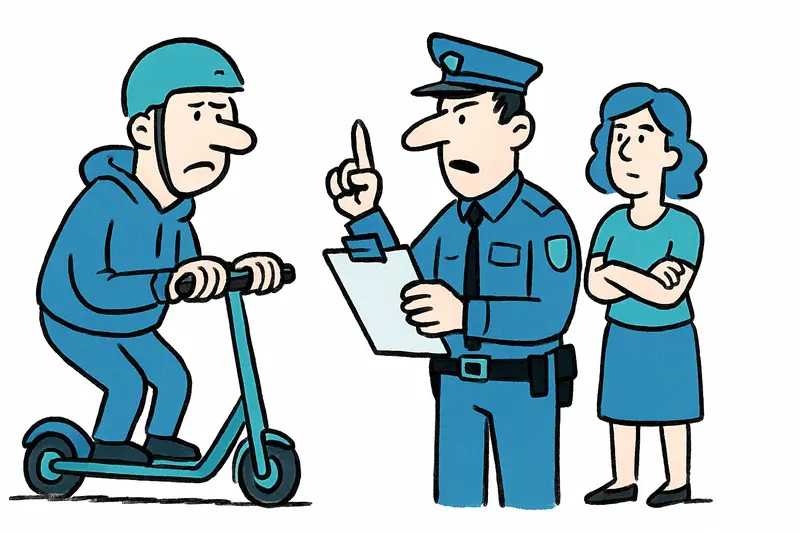
Imagine a Tuesday morning on Avenida Gabriel Roca: the sun sparkles on the bay, children shout at the playground, and two Policía Local officers are speaking with a young man about his scooter. He has an app and a receipt from the rental company — but no entry in the DGT register because the system is not yet active. The small conflict dissolves with a shake of the head and the instruction to wait until everything is officially in place. Such gaps create spaces where rules are not enforced — not out of malice, but out of pragmatism. More serious outcomes, like Dead E-Scooter Rider in Alcúdia: Roads, Lighting and Protection — the Uncomfortable Questions, underline the need for swift action.
Concrete solution approaches
1. Prioritize interfaces: The DGT must create interfaces to the systems of the Policía Local so that checks yield results with a few clicks. A verified API access for local authorities would be useful.
2. Two-step registration: First, a simple basic registration using serial number and QR, then extended data for owners or operators. This reduces barriers and enables quick queries.
3. Mandatory QR on rental vehicles: Rental companies must attach clearly visible, tamper‑proof QR codes. During checks the police app scans the code and immediately sees the insurance status.
4. Transition rule and amnesty: There should be a short amnesty for scooters already issued, coupled with active information campaigns at airports, ports and popular tourist streets.
5. Clear fines and liability rules: Communicate who is liable — the rental company, owner or rider — depending on the case. Without clear liability allocation, practice remains fuzzy.
6. Data protection and minimal data retention: Store only necessary data and communicate transparent deletion periods. Otherwise residents and visitors will lose trust.
Who must do what?
The responsibility does not lie with Madrid alone. Municipalities must equip their Policía Local technically and in terms of personnel. Rental companies need clear requirements — and users a simple, German-language guide for Mallorca: where to register, how to insure, how to prove it. The Balearic government can coordinate, but implementation happens locally — on Palma's bike paths, at Playa de Palma, in the streets of Pollença.
Conclusion: An online register is necessary, but not a miracle cure. Without practical interfaces, clear rules for rental operators and a transition period, the announced insurance checks will remain piecemeal. In Mallorca, where sun, tourism and narrow streets meet, pragmatic solutions and rapid coordination between the DGT, Policía Local and providers are needed. Only then will a bureaucratic announcement become a measure that actually reduces accidents, uncertainty and disputes.
Frequently asked questions
Will e-scooters in Mallorca need to be registered online with the DGT?
Why is the e-scooter insurance requirement in Mallorca not being enforced yet?
Can the Policía Local in Mallorca actually check if an e-scooter is insured?
What should tourists in Mallorca know before renting an e-scooter?
Do rental e-scooters in Mallorca need special identification like a QR code?
What problems can happen if e-scooter rules in Mallorca are not enforced properly?
Will the new e-scooter register in Mallorca affect people who already own one?
What is still missing before Mallorca can properly enforce e-scooter insurance?
Similar News
Mistaken identity with fatal consequences: Brutal assault in S'Aranjassa — what's missing in the follow-up?
At S'Aranjassa a visitor to a finca was tied up, beaten and thrown out of a van. Three men have been arrested, including...
High heel slips, car accelerates: accident on Camí de Son Hugo
A woman lost a high-heeled shoe on the forecourt of the sports facility at Camí de Son Hugo. The car accelerated, mounte...
Phone Scam: How Two Hotel Employees at Playa de Palma Lost Thousands of Euros
One morning in September, two reception employees at Playa de Palma were pressured by alleged alarm-company staff — in t...

When the Wallet Becomes a Danger: Attack in Peguera and Lessons for Mallorca
In Peguera, two women are said to have stolen the wallet from a 75-year-old German couple. When the victim intervened, t...
Plata stays Plata: Young people take over, Llonguets remain
A small bar on Carrer de l'Argenteria will continue: Tolo Serra hands the place over to young Mallorcans at the end of t...
More to explore
Discover more interesting content

Can Cap de Bou

Townhouse Lleo 72
