
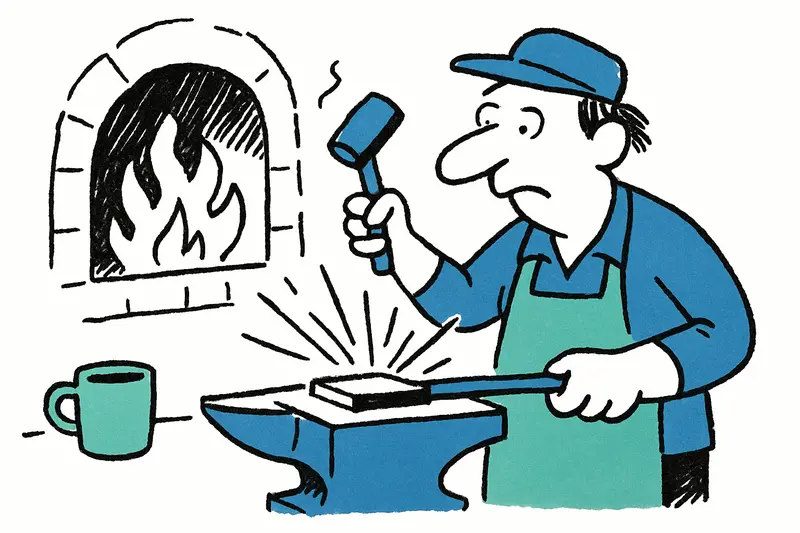
The Blacksmith of the Finca: When Sparks Tell Stories on Mallorca
On an unassuming finca between Lloret de Vistalegre and Pina, Antonio sets the rhythm: sparks, coffee and honest blacksmithing that complements island life and keeps forgotten skills alive.
Between coal, morning coffee and olive trees: A blacksmith on Mallorca
It smells of wet stone and soot, the wind carries dust down the gravel track. Around nine in the morning the finca is still half-asleep; few cars, an old radio somewhere in the house and the scent of freshly brewed coffee. No road signs point the way — just a dust trail that disappears between the fields. At the end stands a workshop, an anvil, a forge and a man with soot-covered hands who knows exactly how to make iron speak.
Antonio: From industrial sites to a rural workshop
Antonio speaks of Zaragoza like a chapter he hasn't forgotten, but one that began on a different page. At eighteen he left, worked in workshops, welded staircases, repaired everyday objects. But that routine did not satisfy him. So he learned blacksmithing: heat, rhythm, patience. Since 2008 he has called Mallorca his workbench. More on his practice is covered in El herrero de la finca: cuando en Mallorca chispean historias.
The sounds in his workshop are hard to put into words: metal sighs, a hammer sings, sparks dance briefly and fade. When Antonio laughs it sounds like a little shower of sparks. He tells stories about his pieces — once it was a rhinoceros head, heavy as armor, he says, pointing to the shimmering edges: "With eyes," he adds, as if the animal had just snorted.
Not a showroom, but honest handiwork
Fincas, not Deckchairs: Mallorca from Plant to PlateOwners of small fincas, people with quirks and character in their homes, search for one-offs. A railing that evokes a wave; a pergola with a hidden pattern; a door handle that carries a story. Antonio works with small hammer blows, more precise than you might think — less brute force, more delicate choreography. Early pieces show rough edges and corners, an open admission of development. Today his forms are more considered, the details more lovingly crafted.
On Mallorca, where drone images and glossy ads set the tone, he preserves something archaic: handling fire and metal, knowing how to shape the raw. And that has its appeal. While outside tourists may be unpacking cars or a delivery van rattles down the road, there is a brief calm here in which something is made by hand.
Networks, exchange and the small blacksmith community
His contacts did not come from a guild hall but via the internet, from blacksmith gatherings and through European encounters. People sit in the yard in the evening, drink a beer, swap techniques — not rigid ritualism, but a loose, international kinship of people who love sparks more than forms. This mix of tradition and mischievous humor is evident in his work: a piece that provokes a little but never becomes kitschy.
For Mallorca this is more than a pleasant pastime. Local craft means repair instead of discard, individuality instead of a one-size template. Visitors who seek not just beaches but island culture find in such studios a counterpoint to mass tourism: real creation that you can feel, not just photograph.
Why this matters — and a small, optimistic look ahead
Craft like this keeps knowledge alive: understanding materials, dosing heat, caring for tools. It creates jobs away from large centers and gives Mallorca's rural estates a character that photos alone cannot provide. And it is sustainable — a repaired railing lasts longer than a disposable product from a hardware store, a principle echoed in Why a Sparkling Water Is More Than Just Minerals — Mallorca's Small Everyday Lessons.
Maybe that's the little magic: a phone call, a commission, Antonio shoulders the hammer, returns to the anvil. The world outside with its bits and pixels falls silent for a moment — there remain sparks, the smell of burnt steel and the certainty that real handiwork on Mallorca still has its place. And when the next unusual project comes along, you can be sure: it will look less like a catalogue item and more like life.
Frequently asked questions
What kind of blacksmith work is still done on Mallorca today?
Why do people on Mallorca choose handmade ironwork instead of factory-made pieces?
Is blacksmithing on Mallorca a disappearing craft?
What should I know before visiting a rural workshop on Mallorca?
What kind of metal pieces do blacksmiths make for fincas in Mallorca?
When is a good time of day to see work happening at a Mallorca forge?
What skills does a blacksmith need to work on Mallorca?
Why is local craftsmanship important in rural Mallorca?
Similar News
After the Fatal Rally Crash: A Reality Check for Mallorca
The death of L’Osteria co-founder Klaus Rader at the Rally 550 Challenge raises questions about safety on Mallorca's cou...
Who really protects Mallorca's coasts? A reality check after the viral beach video
A viral online video compared developed coasts in Turkey with Mallorca's beaches and praised the island. A good moment t...
Arenal: How Two Strangers Stole Jewelry from a 91‑Year‑Old — and What We Should Learn
In El Arenal two young women managed to gain the trust of a 91‑year‑old and steal jewelry from her apartment. A family f...
Cool Night, Mild Days: Autumn Shows on Mallorca – Good for Land and People
The Tramuntana brought the coldest night in months: around 8 °C, 11–12 °C in the lowlands. Daytime temperatures rise aga...
Llucmajor bets on a new waste contract – is it enough to end the waste crisis?
The municipality of Llucmajor has signed a €36.6 million contract with Urbaser for eight years. After summers of overflo...
More to explore
Discover more interesting content

Can Cap de Bou

Townhouse Lleo 72
