
Emergency landing due to cardiac arrest: What the incident in Menorca reveals about our rescue chain
Emergency landing due to cardiac arrest: What the incident in Menorca reveals about our rescue chain
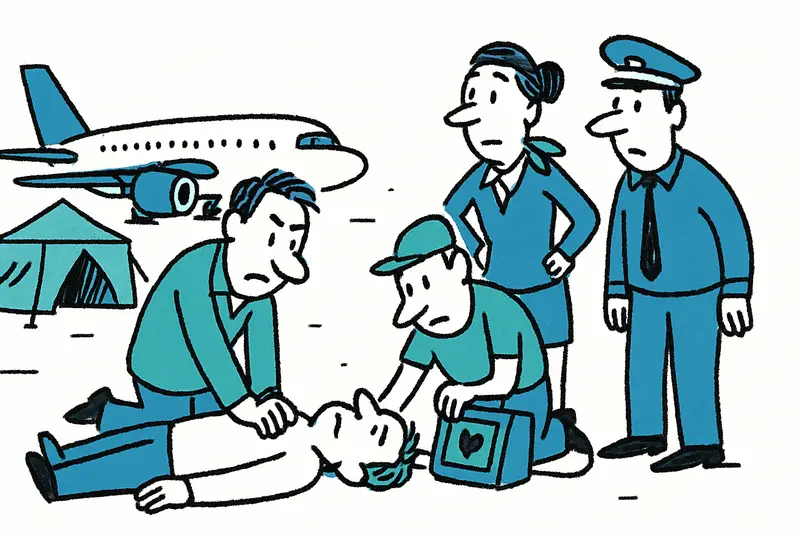
A holiday flight from Paris to Djerba was diverted to Menorca after a passenger suffered a cardiac arrest on board. Two doctors on board performed resuscitation, and a defibrillator was used several times. After about 30 minutes of CPR the man was stabilized and taken to a hospital.
Emergency landing due to cardiac arrest: What the incident in Menorca reveals about our rescue chain
Late on Thursday afternoon a holiday aircraft en route from Paris‑Orly to Djerba had to stop in Menorca for medical reasons: a 44‑year‑old passenger suffered a cardiac arrest on board. Two travelling doctors immediately began resuscitation, a defibrillator was used several times, and the resuscitation lasted about 30 minutes. The Transavia aircraft landed in Menorca at 17:55. On site, the Balearic emergency service 061 took over together with the airport fire brigade; responders set up a tent on the apron to continue resuscitation. Ultimately, the patient was stabilized and urgently transported to a hospital.
Key question
How well is the chain of care between aircraft, airport and hospital actually organised in the Balearic Islands — and where does it break down when every second counts?
Critical analysis
The facts reveal both strengths and weaknesses. Positives: accompanying doctors and an on‑board defibrillator could act immediately. The pilot and crew decided quickly to divert, and on the ground emergency physicians and an intensive care‑equipped ambulance were waiting. This points to functioning emergency procedures. On the other hand, the incident raises questions: How well are small airports like Menorca prepared for such sudden major operations when runways, baggage handling and other flights must be managed at the same time? How quickly can the nearest hospital free up intensive care capacity? And how transparent are the handover and communication steps between flight crew and emergency services?
What is missing from the public debate
In conversations with airport staff and emergency personnel I often hear technical details, but rarely figures: How many automated external defibrillators (AEDs) are required on short‑ and medium‑haul flights? Cardiac Arrest on Can Picafort Beach: Questions Remain and Ideas for the Future underlines the stakes. What equipment is standard at the smaller island aerodromes? Other incidents like Port d'Andratx: Tourist Resuscitated by Bystanders and Police After Cardiac Arrest show bystander response. And: Is there reliable data on how often flights are diverted for medical emergencies — and with what outcomes for those affected? Without this information the debate remains local and emotional instead of fact‑based.
A scene from everyday life here
On Passeig Mallorca a taxi driver sits with the radio on and says in a rough voice: “You hear immediately when a flight is diverted — it creates unease.” At the Plaça in Palma café regulars notice emergency vehicles twitching toward the airport when an alarm comes in. These small observations show that medical emergencies are not abstract for the islands; they permeate everyday life and work processes — from emergency service shift plans to the concerns of hoteliers.
Concrete solutions
- Equipment: More AEDs at airports and on regional routes, plus regular functioning checks. European Resuscitation Council guidelines. - Training: Mandatory refresher courses for cabin crew and ground staff on coordinating medical emergencies. - Data: Unified recording of all in‑flight medical incidents in an island database to identify frequencies and bottlenecks. - Communication: Standardised handover protocols between pilots, cabin crew and emergency services; a clear information chain to destination hospitals. - Capacity: Coordination protocols between airport management and clinics so ICU beds can be released more quickly in emergencies.
Concise conclusion
It is reassuring that a life could be saved through decisive intervention. But the incident in Menorca also makes clear: individual courage is not enough — we need verifiable structures so every minute counts. In the Balearics this depends on small adjustments: AED availability, training, data transparency and pragmatic agreements between island infrastructure and hospitals, as cases such as Cardiac Arrest in Caimari: Are Mallorca's Villages Prepared for Medical Emergencies Involving Tourists? show. That is not a big secret but routine work — and it should be worth the security it provides us.
Frequently asked questions
What happens if someone has a medical emergency on a flight to or from Mallorca?
How well are Mallorca and the Balearic Islands prepared for cardiac arrest emergencies?
Are defibrillators available on flights to Mallorca?
What should travellers pack for a trip to Mallorca if they have heart problems?
Why do flights sometimes divert to Menorca instead of continuing to Mallorca?
How fast can emergency services respond at Mallorca airport?
Can hospitals in Mallorca take emergency patients straight from the airport?
What does the Menorca emergency landing say about island rescue systems in Mallorca?
Similar News
New trick at Palma Airport: suitcase stolen from the belt — a reality check
On September 28 a 36-year-old allegedly stole a suitcase from the baggage belt of a 51-year-old German passenger at Palm...
Urgent Clearing of Palma's Torrents: Flood Prevention or Symptom of Short-Sighted Planning?
The city of Palma is responding to storm forecasts and has cleared several torrents. We ask: Is the short-term clearing ...

Evaneos and Mexico: A Reality Check for Sustainable Travel
Travel advertising often reads like a promise: local, sustainable, unique. But how deep do these promises really go? A c...

From Megapark to the Altar: Party Singer Now Offers Weddings in Mallorca
A well-known party artist combines partying and marriage: instead of a traditional church there are ceremonies at the Me...
The Maricarmen Case: Why an Eviction Is Forcing Spain's Housing Debate
Images of an 87-year-old woman on a stretcher have sparked a debate in Spain that also runs deep in Mallorca. Who protec...
More to explore
Discover more interesting content

Can Cap de Bou

Townhouse Lleo 72
