
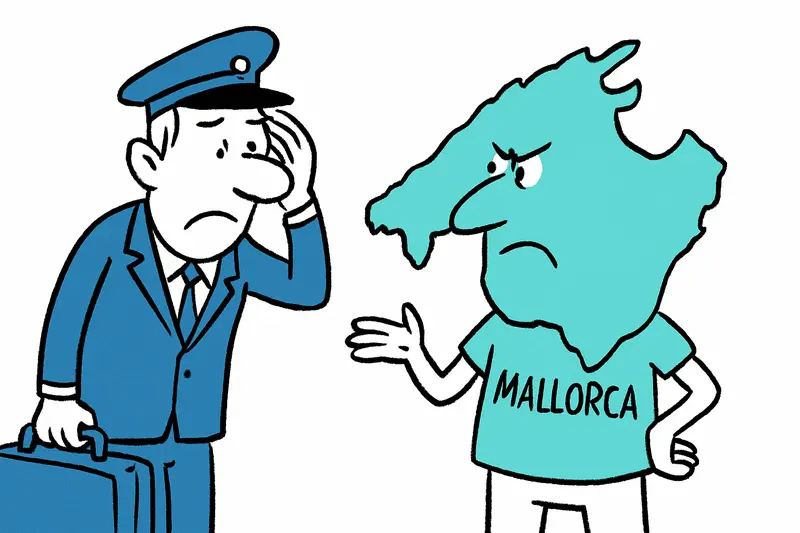
Etihad Palma–Abu Dhabi connection falters: Who bears the risk — the airline or Mallorca?
The planned Etihad Palma–Abu Dhabi connection, from June 12 with three weekly flights, is facing a massive drop in bookings due to the Iran crisis. A reality check for Mallorca.
Etihad Palma–Abu Dhabi connection falters: Who bears the risk — the airline or Mallorca?
Main question: Can a single geopolitical crisis stall a new long-haul connection from Mallorca before it even starts — and what does that mean for the island's economy?
The facts are stark: a new connection, planned from June 12 with three flights per week, was to link Palma directly with Abu Dhabi, as reported in Palma — Abu Dhabi: New Etihad Connection Raises More Questions Than Answers. Etihad planned to use an Airbus A321LR with 195 seats (160 Economy, 35 Business), as detailed in New Etihad Route Abu Dhabi–Palma: Comfort for Guests, a Challenge for the Island. It was expected that around 37 percent of passengers would come from the Balearics. Now, however, bookings have in many cases fallen sharply, a trend also noted in Spanish coverage Palma — Abu Dabi: Nueva conexión de Etihad plantea más preguntas que respuestas — the trigger is the current Iran crisis and the resulting uncertainty for travelers and airlines.
This has consequences we can literally feel here in Palma. On the Passeig Marítim, where taxi drivers wait in the morning for connecting guests, people are already talking about whether the new route will even launch. On the way to Son Sant Joan airport you see luggage carts parked, planes taxiing — and still questions: Who benefits from a route that is barely filled? Who suffers if it is canceled?
Critical analysis
The airline appears to have based its planning heavily on local demand. That is a risky bet when nearly 40 percent of customers are expected from a single region and geopolitical events suddenly trigger purchasing hesitancy. Airlines calculate with many variables — but dependence on a single source of demand increases vulnerability.
A second point is timing: a launch in the middle of elevated global uncertainty and with high fuel prices makes margins thin. The flight times (early departure from Abu Dhabi, late arrival in Palma; return flight during the day) may make operational sense, but they reduce the attractiveness for transfer and leisure passengers when price and risk rise.
What is hardly talked about
Public debate is often dominated by headlines about flight cancellations and passengers. What is missing is an honest discussion about risk sharing. Who bears the costs for a route that is underfilled — the airline, local tourism offices, the airport operator, hoteliers? Equally rarely discussed are the available safeguards (e.g. fuel hedging, cancellation terms, refund pools) and how transparent they are.
There is also a lack of realistic contingency planning: if the Abu Dhabi route collapses, Palma should not simply hope for "resumption later." Clear scenarios are needed for which markets can step in at short notice — Canada was mentioned with a more cautious calculation, but greater precision is required.
Everyday scene in Mallorca
At Plaça de Cort a travel advisor sits with a cappuccino and a tablet. She has appointments with families comparing connections: direct flights are attractive, but with political uncertainty many prefer routes with established transfer points. In Ciudad Jardí hoteliers are considering whether marketing budgets aimed at the Gulf should be redirected to Europe. This is no longer an abstract problem — it affects local jobs and incomes.
Concrete solutions — what to do now
1. Short-term measures: plan capacity flexibly. Reduced frequency instead of a complete cancellation; activate codeshares and transfer partners immediately to raise minimum load factors. Flight schedules can often be adjusted in weeks rather than months.
2. Financial safeguards: the airport operator and regional tourism organizations should negotiate transitional support with the airline — not as a permanent subsidy, but as a time-limited bridge linked to target load factors.
3. Risk diversification: instead of relying on one market (the Gulf), Mallorca should simultaneously push other source markets — for example North America, Scandinavia or Central Europe — with targeted marketing and tailored packages.
4. Transparency and crisis communication: establish joint criteria for when a route is paused or scaled down. Travelers need clear cancellation rules and credible safety guidance.
Concise conclusion
The current situation shows: a bold air connection brings opportunities but also vulnerabilities. The lesson for Mallorca is clear: reliable air links require not only good figures in the brochure but a shared, pragmatic risk structure and fast contingency plans. Otherwise the loudly announced connection will end up as an empty seat and a loud outcry on the Passeig Marítim.
Frequently asked questions
Why can a new Mallorca flight route be delayed before it even starts?
What does a weak long-haul route mean for Mallorca's economy?
How risky is it for Mallorca to depend on one passenger market?
What can Mallorca airlines do if bookings drop before a new route starts?
Should Mallorca tourism rely on new Gulf routes to grow?
What happens at Palma airport if a new route is cancelled?
Why are Mallorca taxi drivers paying attention to new flight routes?
What should travellers from Mallorca know before booking a new long-haul flight?
Similar News

Rental Car Theft in El Arenal: What This Incident Reveals About Our Gaps
A teenager steals a running rental car in El Arenal, flees on foot, climbs over walls and is caught by the Guardia Civil...

Red Rope in Palma's Library: What Helps Against Selfie Tourism — and What's Missing
Palma's city library cordoned off an area with a red rope to keep selfie tourism away from reading and working activitie...

Fort San Carlos: Museum, Harbor Dispute — and a Conflict That Demands Answers
The military museum at Fort San Carlos sits right on Palma's harbor, with unexpectedly quiet rooms filled with cannons a...
Old Town Under Pressure: When a Doorway Becomes a Sleeping and Shower Place
For months a woman has been living with a parasol, a clothes rack and personal belongings next to the social welfare off...
When Shopping Weighs Heavier: Mallorca Demands a Tax Pause on Food and Fuel
Rising prices are putting pressure on households and agriculture. The Balearic Islands are calling for temporary tax rel...
More to explore
Discover more interesting content

Can Cap de Bou

Townhouse Lleo 72
