
When Excursions Become a Luxury: How Tourism Slows Schools in Mallorca
When Excursions Become a Luxury: How Tourism Slows Schools in Mallorca
Rising bus prices and full fleets make school trips on Mallorca unaffordable for many families. Who is left out, and what can the island do about it?
When Excursions Become a Luxury: How Tourism Slows Schools in Mallorca
Guiding question: Can Mallorcan pupils still learn on site in the future if buses and prices are only accessible to tourist budgets?
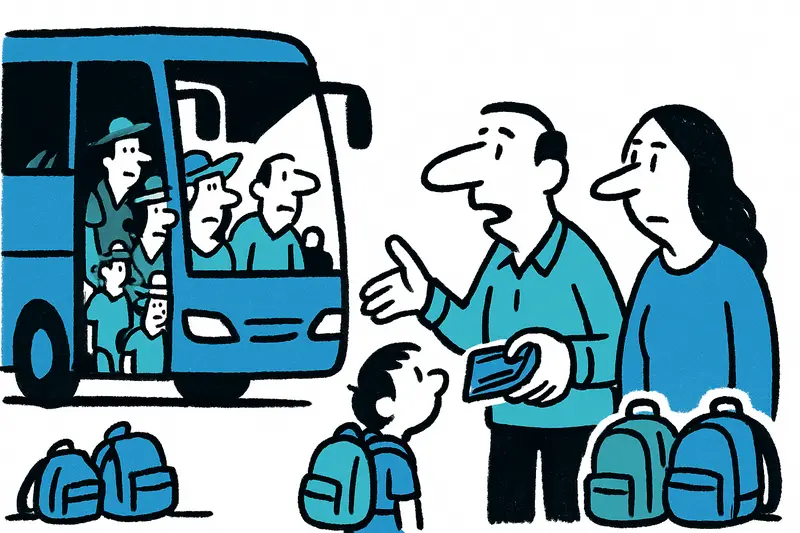
On a gray morning in Marratxí, in front of the school, a coach honks as it unloads tourist groups. Between them are three school backpacks, two parents with thin wallets and a discussion about a trip that is all but cancelled. This scene is now repeating at several schools across the island: excursions that used to be taken for granted are at risk because transport costs are rising and buses are barely available in the high season.
The facts are sparse but clear: some parents are asked for eight to ten euros per child, in other cases up to twelve euros. Meanwhile, reporting highlights rising overall school costs on the islands, as noted in Back to School in the Balearic Islands: Families Suddenly Face a €850 Bill.
Critical analysis: This is not an isolated problem but a systemic failure. Schools are responsible for local education, cultural sites want visitors and educational outreach, and transport firms respond to market prices. When the social costs are not accounted for in this triangle, it is children from lower-income households who lose out. A visit to an archaeological site, museum or nature park is not just leisure: it often substitutes cultural education that does not take place at home. For context on family budgets and where school spending goes, see Back to School in the Balearic Islands: Around €850 per Primary School Child — What Families Can Do Now.
What is missing in the public debate: concrete figures and clear responsibilities. We hear about individual cases and indignation — but hardly reliable data on how many classes are affected, in which months shortages are greatest, and whether municipalities or the island government already recognise budget gaps. Nor is it being asked how strongly pricing actually depends on seasonal peaks and to what extent public transport offerings could serve as substitutes, despite initiatives like Free School Bus for Apprentices: First Ride, Many Questions.
Another blind spot: the students' voices. Adults discuss costs and capacities, while the children remain spectators. Who does not remember how a single school trip produced an aha moment? That experience now risks becoming private — dependent on parents' income.
Everyday scene from Palma: in front of the Museu de Mallorca on a Saturday tourists step down from modern coaches, a street musician tunes his guitar, and a school class waits at the edge. Today their excursion was cancelled. The teacher speaks calmly with the parents while in the distance the ferry sails out to sea. Such images show the problem is not abstract. It sounds like bus engines, vendors shout prices; it smells of coffee from the corner. The social divide opens quietly but visibly.
Concrete, practical solutions (not just from the textbook):
1) Joint booking platform for school transport: A central portal that distributes school trips throughout the school year, organises pooled bookings and fills bus companies' schedules early. Bundling creates pricing effects.
2) Earmarked subsidies: The council or municipalities could set up a small mobility fund to subsidise classes in need. An application system with clear criteria would be sufficient.
3) Off-peak incentives: Cultural centres and transport providers offer reduced rates outside tourist peaks. For schools, spring mornings or late autumn dates would be attractive and cheaper.
4) Partnerships between schools and museums/cultural offers: Institutions grant reduced combo tickets for classes in exchange for predictable visitor numbers.
5) Use of regular public connections: Where possible, regional buses and trains should be more strongly integrated into planning; this requires coordinated timetables and escorts for younger pupils.
These proposals are not miracle cures, but they are concrete steps that administration, educational institutions and the transport sector can take together. They require one simple precondition: political will. Whoever wants excursions to remain accessible to all must adjust budgets, logistics and priorities so that educational purposes do not fall behind tourist demand.
Pointed conclusion: If the island does not treat its children as secondary guests, the imbalance can be corrected. Otherwise memories of museum visits, nature explorations and historical sites will become things only those who can pay will experience. That would not be a coincidence — it would be a political and organisational choice.
In the end the question is back on the schoolyard: should culture and nature in Mallorca remain open to everyone, or will we allow them to become a luxury good piece by piece? Answers must come soon. The buses do not wait, but the children do.
Frequently asked questions
Why are school excursions in Mallorca becoming harder to organise?
How much do school trips in Mallorca usually cost for parents?
Are school excursions in Mallorca being cancelled because of tourist traffic?
What can schools in Mallorca do to keep excursions affordable?
Is there public support for school excursions in Mallorca?
Why do school excursions matter so much for children in Mallorca?
What makes Mallorca school transport more expensive in the high season?
What are the most affected places in Mallorca when school trips are delayed?
Similar News
When the Wallet Becomes a Danger: Attack in Peguera and Lessons for Mallorca
In Peguera, two women are said to have stolen the wallet from a 75-year-old German couple. When the victim intervened, t...
Plata stays Plata: Young people take over, Llonguets remain
A small bar on Carrer de l'Argenteria will continue: Tolo Serra hands the place over to young Mallorcans at the end of t...
Unnoticed in the Luggage Compartment: How a Boy Traveled More Than 100 Kilometers in a Team Bus
A minor traveled in the undercarriage of a team bus for more than 100 kilometers until his cries for help were heard. A ...

Cap Vermell Grand: Second Michelin Key – a Gift for the East
The Cap Vermell Grand in Capdepera has been awarded its second Michelin key. For the region this elevates the luxury off...
Eurowings lets four aircraft carry names – a friendly idea that also reaches Mallorca
Eurowings is launching a campaign: four Airbus A320s are to carry the first names of people who help others in everyday ...
More to explore
Discover more interesting content

Can Cap de Bou

Townhouse Lleo 72
