
Eyesore on the Princes' Wall: Palma's Baluard del Príncep neglected despite restoration
Eyesore on the Princes' Wall: Palma's Baluard del Príncep neglected despite restoration
The recently restored Baluard del Príncep shows trash, graffiti and signs of sleeping. How could a showcase site deteriorate so quickly — and what needs to be done?
Eyesore on the Princes' Wall: Palma's Baluard del Príncep neglected despite restoration
How could a freshly renovated site decay so quickly — and who will really clear up the problem?
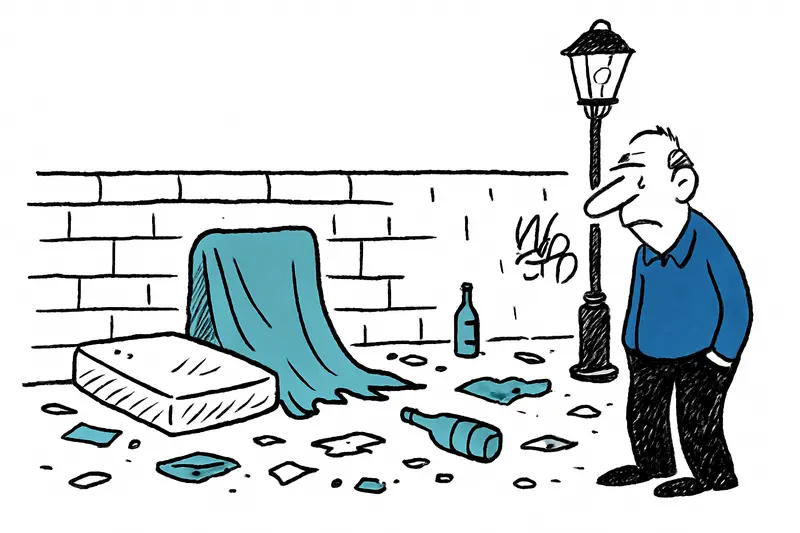
The fortress wall, from which one should enjoy views across the bay, currently looks less like a monument and more like a storage area. Torn packaging lies next to broken glass, a worn piece of mattress sits half under a curtain, and lamp posts are covered in graffiti. Visitors coming from Passeig del Born through the narrow alleys toward Sa Calatrava stop and shake their heads. The city is noisy, but at this spot, where people would like to look out to sea, there is only a sense of neglect.
Key question: How can a historical structure treated so recently fall back into a state that is not only unattractive but also dangerous? Who is responsible — and is a provisional barrier enough?
Critical analysis: Shortly after the interior areas of the wall were cleared and secured, the usual weak points became apparent: a fence in need of repair, gaps in nighttime surveillance and a lack of upkeep of the outdoor space. Sealing off the interiors only solves the problem superficially; similar problems have led to structural incidents elsewhere in Palma, for example when a medieval tower at the exit of the Es Baluard museum has partially collapsed. The exterior area continues to be used as a sleeping place, which encourages the accumulation of rubbish and residue. The presence of broken glass is not only unsightly, it increases the risk of injury for pedestrians and playing children. At the same time, the site is in direct view of new hotels in Sa Calatrava and Dalt Murada — the image of decay competes with the ambition to present Palma as a high-quality destination.
What is often missing from public discourse is a sober look at the causes; a part of the medieval Baluard de Sant Pere has collapsed illustrates the stakes. It is not just about a poorly locked access or vandalism. There is a lack of continuous maintenance infrastructure: regular emptying of waste bins, clearly marked storage areas, evening cleaning routes. Equally important is the social component. People who sleep there often have no alternative and need services that go beyond mere evictions — for example coordinated emergency shelters, low-threshold care services and social work on site.
An everyday scene from Palma: An elderly couple sits on a bench near Plaça de la Llotja, their café cups from the street café still steaming. They come specifically to watch the sunset over the bay. Instead, their eyes fall on a curtain on the ground and scattered bottles. A group of young hotel employees finishing their shift walk by, shake their heads and take photos with their phones — not out of admiration. Such small observations accumulate and shape the image that locals and visitors receive of the city.
Concrete solutions: First, maintenance must be considered part of the restoration, not an afterthought. That means fixed cleaning intervals, robust bins that do not overflow easily, and quick technical repairs to the fence. Second: link social policy measures. Evictions alone only shift the problem. Coordination between monument preservation, social services and police is necessary so that affected people receive support and safe alternatives are available. Third: visibility and prevention. Information signs, discreet lighting and targeted patrols by municipal officers in the evening can act as deterrents without militarizing the site. Fourth: consider a sponsorship model in which neighborhood associations, local hoteliers and the city coordinate regular maintenance actions — voluntary actions do not replace the administration's duty, but can be effective and strengthen a sense of responsibility. Fifth: short-term immediate measures such as removing shards, replacing damaged barriers and quick removal of bulky waste immediately reduce the danger potential.
The debate also lacks reliable numbers: How often was the Baluard cleaned in recent months? What resources does the city provide for the aftercare of historic sites? Such data would allow responsibility to be distributed more clearly, as discussed in Baluard del Príncep: Final Sprint at the City Gate – Is the Financial Boost Enough?. The role of tourism actors is also rarely discussed: hotels see the consequences but are hardly involved in long-term maintenance concepts.
Conclusion: This is not just an aesthetic nuisance. If a restored section of the city wall falls into disrepair soon after restoration, it reveals gaps in planning and responsibility. A combination of regular maintenance, social support and clear responsibility could make the Baluard del Príncep the viewpoint it is intended to be — not a storage site. In the short term, cleaning and securing works are necessary. In the medium term, a binding maintenance concept that brings together monument preservation and social policy is needed. Until that happens, passerby complaints remain justified — and the Princes' Wall a visible testament to how quickly good intentions fade in everyday life.
Frequently asked questions
Why does Palma's Baluard del Príncep look neglected again after restoration?
Is it safe to walk near Baluard del Príncep in Palma?
What should be done to prevent historic sites in Palma from falling into disrepair?
Why do some restored places in Palma become sleeping spots?
What does the Baluard del Príncep say about Palma's city image?
What can visitors expect near the Baluard del Príncep viewpoint in Palma?
Are broken glass and graffiti common problems at Palma's historic walls?
Who is responsible for maintaining Palma's restored city walls?
Similar News

High heel slips, car accelerates: accident on Camí de Son Hugo
A woman lost a high-heeled shoe on the forecourt of the sports facility at Camí de Son Hugo. The car accelerated, mounte...

Phone Scam: How Two Hotel Employees at Playa de Palma Lost Thousands of Euros
One morning in September, two reception employees at Playa de Palma were pressured by alleged alarm-company staff — in t...

When the Wallet Becomes a Danger: Attack in Peguera and Lessons for Mallorca
In Peguera, two women are said to have stolen the wallet from a 75-year-old German couple. When the victim intervened, t...
Plata stays Plata: Young people take over, Llonguets remain
A small bar on Carrer de l'Argenteria will continue: Tolo Serra hands the place over to young Mallorcans at the end of t...

Unnoticed in the Luggage Compartment: How a Boy Traveled More Than 100 Kilometers in a Team Bus
A minor traveled in the undercarriage of a team bus for more than 100 kilometers until his cries for help were heard. A ...
More to explore
Discover more interesting content

Can Cap de Bou

Townhouse Lleo 72
