
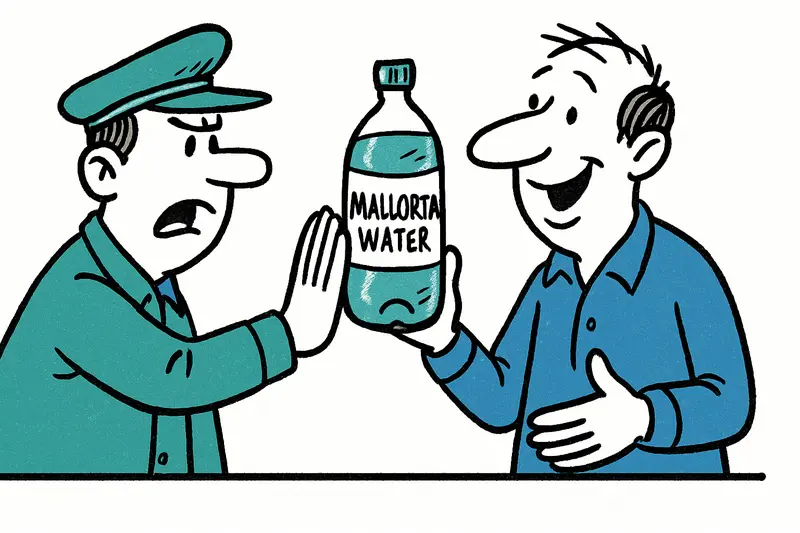
More than 2,000 bottles seized: Who benefits from the 'Mallorca' label?
More than 2,000 bottles seized: Who benefits from the 'Mallorca' label?
At Palma Airport in 2020, over 2,000 bottles labeled 'Agua de Mallorca / Mallorca Water' were seized — although they had been bottled off the island. A case that raises questions about controls, retailer responsibility and protection of local producers.
More than 2,000 bottles seized: Who benefits from the 'Mallorca' label?
Key question: Why do supposedly 'Mallorcan' products end up in shoppers' carts at the airport, and who really controls the supply chain?
On a windy morning in the departure area of Palma, amid rolling suitcases and announcements over the loudspeakers, it is easy to overlook one thing: a pretty label sells origin. In 2020, food inspectors at the airport seized more than 2,000 bottles labeled 'Agua de Mallorca / Mallorca Water'. The bottles had not been filled on Mallorca. A complaint from within the industry had prompted the inspection, a dynamic seen in other cases such as Big Blow Against Product Counterfeiting: What Mallorca's Role Really Reveals.
This is not trivial bureaucratic detail. Origin claims determine who benefits from a region's good reputation. On Mallorca, names and landscapes mean income for producers, fishers, bottlers — and ultimately a piece of identity, increasingly sensitive amid concerns highlighted in Water scarcity in Mallorca: Why hotels must now take responsibility.
Critical analysis
The authorities found that the origin was misleadingly declared. The rules set minimum penalties for serious violations of geographical indications — in this case at least 3,000 euros. The Directorate General for Agricultural and Food Quality and Local Products emphasized that only products with an actual Mallorcan origin may use that designation. That's good. But the question remains: is that enough?
Controls are reactive. An industry complaint led to the inspection. In a busy airport operation, sales often take place through intermediaries, duty-free shops and small kiosks. Who checks in day-to-day business whether the supply chain is transparent all the way back to the original bottler? And what role do shoppers' purchasing habits — often quick, language-driven and in search of souvenirs — play in the spread of such products?
What is missing from public debate
First: the responsibility of retailers often remains in the dark. Retailers like to claim they have 'documentation' when inspected; practice shows that certificates can be easily copied or incomplete. Second: traceability along the supply chain — from manufacturer via wholesaler to the airport stall — is rarely publicly audited. Third: consumer information. Travelers cannot tell at a glance whether a label has been officially verified or is just a marketing gimmick, even while authorities sometimes resort to measures described in Water alarm in Mallorca: Seven municipalities turn off the tap — is saving alone enough?.
Everyday scene from Mallorca
Imagine it like this: On the Passeig Mallorca a family from Germany waits for their taxi. The children hold a plastic water bottle labeled 'Mallorca Water', and the parents are sure they are supporting a piece of the island. At the gate, a businessman in a shirt puts the same bottle in his backpack because it 'looks regional'. None of them have the time or the means to check proof of origin. That is the gap that is being exploited.
Concrete solutions
1) Systematic random checks at points of sale in the airport, not only following industry tips. Inspections should include anonymous test purchases and a review of delivery documents.
2) Mandatory digital traceability: QR codes on labels that link to an official database listing bottlers, production locations and certificates. Easy for consumers and quickly verifiable for inspectors.
3) Transparency requirements for retailers: disclosure of sources for products with geographical indications, plus sanctions for false claims. The airport authority and chamber of commerce should anchor this in lease agreements.
4) Consumer protection campaign in multiple languages — at the airport and online — explaining how to recognize genuine local products (origin statement, operation number, official seals).
5) Strengthened cooperation between island control authorities and customs, so that movements of goods across regions can be traced more effectively.
Concise conclusion
The seizure of over 2,000 bottles was a necessary step. But it must not remain a one-off headline. If labels siphon money from genuine producers and tourists do not notice the deception, everyone loses: producers, honest retailers and trust in regional goods. Zero tolerance must be accompanied by concrete procedures: more random checks, digital traceability, mandatory disclosures by retailers and clear information for travelers. Only then will 'Mallorca' be more than a pretty label — it will be an economic value that can be protected.
Frequently asked questions
How can I tell if a product sold as Mallorcan is actually from Mallorca?
Why are fake local labels a problem in Mallorca?
Can airport shops in Mallorca sell products with a local label if they were made elsewhere?
What do travelers in Mallorca need to know before buying souvenirs or local drinks?
How are misleading origin claims on Mallorca products usually detected?
What penalties can apply for false Mallorca origin labels?
What would make it easier to verify whether a Mallorca product is authentic?
Who should be responsible for stopping false Mallorca labels at the point of sale?
Similar News
Injured captain, big plans: Germania Mallorca before the away match in Consell
The newly founded FC Germania Mallorca travels to Consell on Saturday. Captain Bastian Müller is out injured, but coach ...
Palma, Palma de Mallorca, Palma‑Mallorca: What is it really about?
The debate over the city's name is more than grammar: it concerns identity, law and branding policy. A sober reality che...
Warning to Bathers: Nipping Fish in Cala Major and Other Coves — a Reality Check
In Cala Major and several beaches around Mallorca, bathers report painful “nips”. Who are the animals, why are they gett...
Rental Car Theft in El Arenal: What This Incident Reveals About Our Gaps
A teenager steals a running rental car in El Arenal, flees on foot, climbs over walls and is caught by the Guardia Civil...

Red Rope in Palma's Library: What Helps Against Selfie Tourism — and What's Missing
Palma's city library cordoned off an area with a red rope to keep selfie tourism away from reading and working activitie...
More to explore
Discover more interesting content

Can Cap de Bou

Townhouse Lleo 72
