
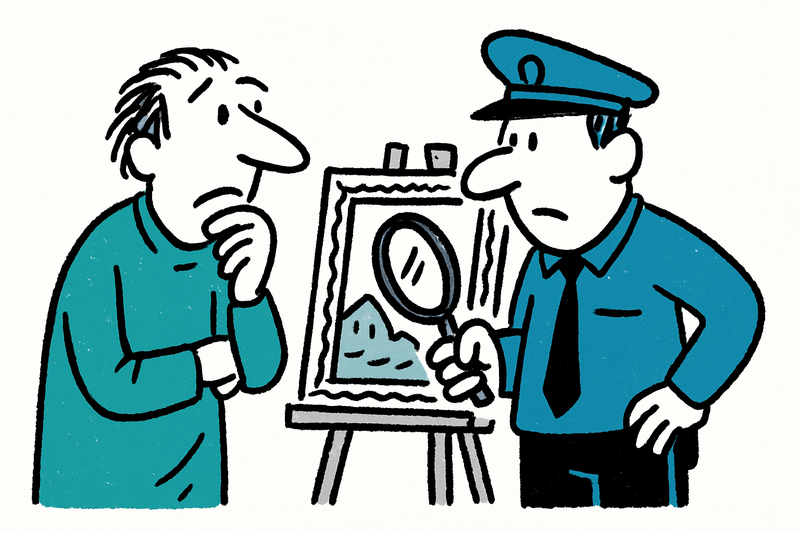
Forgery Scandal in Palma: Who Protects the Life's Work of Our Artists?
In Palma, the National Police are investigating a gallery owner on suspicion of art forgery. The affair raises the question: How will Mallorca protect artists, collectors and trust in the island's art going forward?
Forgery Scandal in Palma: Who Protects the Life's Work of Our Artists?
In the narrow streets of the old town, between the clinking of espresso cups and the occasional roar of the Tramuntana wind, a matter has quietly begun to unfold that could shake Mallorca's otherwise lively art scene to its foundations. The Spanish National Police are currently investigating a gallery owner in Palma on suspicion of art forgery (When Pictures Lie: Why Mallorca's Art Market Must Rethink Now): works on display are said to be inauthentic, and certificates allegedly manipulated.
Main question: How can Palma restore trust in its art world?
This question hangs over the whole debate like a fine brushstroke. It's not only about one gallery owner or a few paintings — it's about the credibility of galleries in La Lonja (Forgery Scandal in Palma: Who Protects the Life's Work of Our Artists?), collectors on Passeig del Born, and the livelihood of those who depend on art.
What has happened so far
According to investigations, the accused bought two works by a well-known Mallorcan artist years ago — including certificates of authenticity. Later, additional works supposedly lacking the original paperwork appeared and were sold. The artist's family, having grown suspicious, requested new certificates, which led the trail to the authorities. The gallery owner was briefly detained (Forgery Scandal in Palma: Gallerist Arrested — Trust in Mallorca's Art Market Shaken) and later released under conditions. The allegations range from fraud and document falsification to copyright infringement.
What is often overlooked
Public debate has left some aspects underexamined: the mechanisms of the secondary market, the role of informal intermediaries in the art trade at the port and markets like Mercat de l'Olivar, and the economic incentives in an island economy driven by high seasons. Tourists searching for a piece of Mallorca often buy on impulse — and rely on the credibility of galleries. In a port city where many dealers operate seasonally, this creates room for gray areas.
There is also the issue of estate management: families seeking to protect a local artist's oeuvre face legal and practical hurdles when certificates are missing or forged. Pigment lab tests are expensive, catalogues raisonnés are often incomplete, and many smaller artists never built formal documentation of their work.
What consequences could the island face?
A loss of trust could depress prices in the long term, burden reputable galleries, and complicate museum acquisitions. Collectors who once sat in cafés on the Passeig with purchase plans may become more skeptical. The fragile ecosystem of artists, galleries, curators and visitors could suffer — a danger to Mallorca's cultural capital, which lives not in stone but in conversations, exhibitions and afternoons by the harbor.
Concrete solutions
Some steps seem pragmatic and doable: first, a publicly accessible provenance registry (the Art Loss Register) for works above a certain value — maintained locally but compatible with national databases. Second, mandatory minimum information and standardized certificates of authenticity for galleries on the island; electronic signatures could make manipulation harder. Third, partnerships with universities and mainland laboratories for cost-effective material analyses, complemented by a voluntary seal of quality for vetted dealers.
Other ideas: buyer education — for example short checklists in galleries or information flyers at Mercat de l'Olivar — as well as a tip hotline and whistleblower protections for employees. In the long run, a joint catalogue raisonné for important Mallorcan artists would create transparency. Finally, local government could help professionalize authentication procedures with modest funding.
A call to the art community
The investigations are still at an early stage, and the justice system must do its work. For the affected artist and their family, however, this is personal: the right to their own history, their work as an inheritance. Mallorca's art world should use this moment to build structures that make wrongdoing harder and restore trust more easily. Between the noise of receipts in the café and the voices in the plaza, there is plenty of room for change.
When you stroll through Palma, you smell the salty harbor wind in the evening and see lights dancing on the sea. Art thrives on that atmosphere — but it also needs protection. It would be a pity if forgeries spoke louder than the stories real works tell.
Frequently asked questions
How can buyers in Mallorca check whether a painting is authentic?
Why do art forgery cases matter so much in Palma?
What should I ask a gallery in Mallorca before buying art?
Is it safe to buy art from galleries in Palma?
What happens if a Mallorcan artist's works are sold with forged certificates?
Why is provenance so important when buying art in Mallorca?
What can Mallorca do to prevent art forgery in the future?
What is the role of the art market in La Lonja and Passeig del Born?
Similar News
When the Wallet Becomes a Danger: Attack in Peguera and Lessons for Mallorca
In Peguera, two women are said to have stolen the wallet from a 75-year-old German couple. When the victim intervened, t...
Plata stays Plata: Young people take over, Llonguets remain
A small bar on Carrer de l'Argenteria will continue: Tolo Serra hands the place over to young Mallorcans at the end of t...
Unnoticed in the Luggage Compartment: How a Boy Traveled More Than 100 Kilometers in a Team Bus
A minor traveled in the undercarriage of a team bus for more than 100 kilometers until his cries for help were heard. A ...

Cap Vermell Grand: Second Michelin Key – a Gift for the East
The Cap Vermell Grand in Capdepera has been awarded its second Michelin key. For the region this elevates the luxury off...
Eurowings lets four aircraft carry names – a friendly idea that also reaches Mallorca
Eurowings is launching a campaign: four Airbus A320s are to carry the first names of people who help others in everyday ...
More to explore
Discover more interesting content

Can Cap de Bou

Townhouse Lleo 72
