
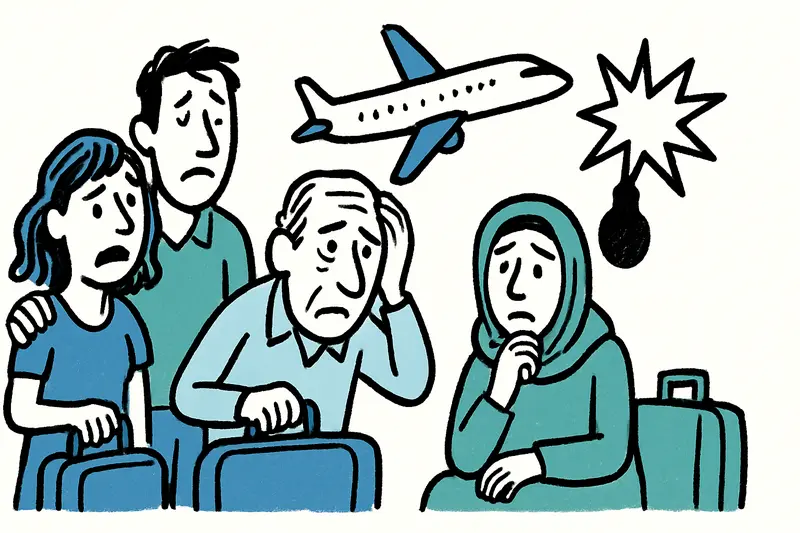
Fear of War: How Mallorca's Everyday Life and Tourism Are Shaken
The conflict in the Middle East reverberates on Mallorca: flight cancellations, stranded travelers, unsettled families with roots in Iran and Amsterdam — our island feels the consequences. A reality check with voices from Palma, Dubai and Persépolis.
Fear of War: How Mallorca's Everyday Life and Tourism Are Shaken
Key question: How close does the Middle East conflict feel to people on Mallorca — and what is missing in the preparation?
On a cool morning on Passeig Mallorca you see delivery scooters honking at the corner, and two women in front of a cafe in Santa Catalina discussing rebookings. The topic is everywhere: even though the combat zones are several thousand kilometers away, we feel the force of the escalation here on the island.
In practice, hundreds of Balearic residents are affected by flight cancellations and delays; about half have already been able to return, many are still waiting. For roughly 13,000 Spaniards in the Emirates and around 30,000 compatriots in the wider region, the foreign ministry is checking options — a logistical task that requires time, coordination and transparent information.
On the island live people who are torn twice over: families with relatives in Tehran fear for their loved ones, expats working on the Persian Gulf see travel and assignments wobble. The owner of the Persian shop Persépolis in Palma senses the uncertainty in his business and in conversations with customers. Actors, entrepreneurs and agents who commute between Mallorca and Dubai report a mood characterized more by concern than by panic. This echoes findings in Between Welcome and Wariness: Germans in Mallorca — What's Really Happening.
The effects are tangible for tourism and the economy: rebookings, changed flight routes and longer travel times increase costs. Hotel bookings shift, and some guests are considering whether to travel at all; such trends are discussed in When the Germans Stay Away: Opportunity or Risk for Mallorca?. At the same time the island could temporarily receive inquiries from regions that become destinations for evacuation or relocation — a double-edged picture.
What has been missing in the public discourse so far is the everyday perspective: How are people on Mallorca being supported psychologically? What clear rules apply for insurance cases when flights are canceled and additional costs arise? And: is there a binding plan for state-organized repatriations or coordinated charter flights if the situation escalates?
Another blind spot is transparency between airlines, insurers and travelers. Many affected people report that rebookings become expensive and that insurers do not automatically cover costs. The result: people stand at the airport with uncertain return options and large bills.
Everyday scene: On the way from the Mercat de l'Olivar toward Portixol I hear the church bells of La Lonja, see a couple with backpacks standing puzzled in front of the departure board. A bakery TV plays Spanish news while the owner scrolls messages from Dubai on her phone. These small scenes show: the distant is suddenly near.
Concrete solutions can be derived and are practicable: first, a central, easily accessible information channel for those affected in the Balearics — coordinated between the foreign ministry, the consulate and local authorities — would reduce uncertainty. Second, clear guidelines for travel insurance and a binding framework for when extra costs are refundable should be communicated at EU and national level. Third, travel associations, airlines and hotels should consider quick pooled solutions for emergency transfers — for example coordinated rebooking windows without exorbitant fees or temporary collective charters along safe routes.
For psychological strain, local services would be important: municipalities and initiatives could organize low-threshold counseling offers, provide interpreters and pastoral care, and actively inform neighborhoods with a higher number of affected residents (for example areas with many Persian families). Similar strains are visible in the hospitality sector in pieces like Empty Tables, Growing Worries: Why Mallorca's Gastronomy Is on Low Flame.
On the economic level a short-term monitoring is advisable: hoteliers and tour operators should integrate developments in fuel and flight prices into their scenarios and offer flexible cancellation models to maintain guest confidence, as recommended in After Eleven Years at the Top: What Mallorca's Tourism Radar Really Needs to See. The island administration can take on a moderating role here.
What must be avoided urgently is hysteria: local solidarity, reliable information and pragmatic aid work best against panic. At the same time realism is needed: if oil prices remain elevated or maritime trade tightens, the island economy could suffer.
Conclusion: Mallorca is no longer an island of ignorance. Conflicts in the Middle East reach us via airports, phone lines and family ties. The most important task for politics, business and civil society now is to bridge information and action — quickly, practically and with common sense. That way it is possible to prevent uncertainty from becoming long-term damage for people and the economy.
In short: The situation is serious for many individuals, but manageable if authorities, the travel industry and local communities finally deliver clear, coordinated steps.
Frequently asked questions
How is the Middle East conflict affecting everyday life in Mallorca?
Are flights to and from Mallorca being delayed or cancelled because of the conflict?
Will travel insurance in Mallorca cover extra costs if a flight is cancelled?
What should Mallorca travellers do if their return flight is disrupted?
How are tourism and hotels in Mallorca being affected by the conflict?
Is there help in Mallorca for people worried about relatives in the Middle East?
What role could Mallorca authorities play if the situation gets worse?
Should Mallorca travellers be worried about higher prices and fuel costs?
Similar News
High heel slips, car accelerates: accident on Camí de Son Hugo
A woman lost a high-heeled shoe on the forecourt of the sports facility at Camí de Son Hugo. The car accelerated, mounte...
Phone Scam: How Two Hotel Employees at Playa de Palma Lost Thousands of Euros
One morning in September, two reception employees at Playa de Palma were pressured by alleged alarm-company staff — in t...
When the Wallet Becomes a Danger: Attack in Peguera and Lessons for Mallorca
In Peguera, two women are said to have stolen the wallet from a 75-year-old German couple. When the victim intervened, t...
Plata stays Plata: Young people take over, Llonguets remain
A small bar on Carrer de l'Argenteria will continue: Tolo Serra hands the place over to young Mallorcans at the end of t...
Unnoticed in the Luggage Compartment: How a Boy Traveled More Than 100 Kilometers in a Team Bus
A minor traveled in the undercarriage of a team bus for more than 100 kilometers until his cries for help were heard. A ...
More to explore
Discover more interesting content

Can Cap de Bou

Townhouse Lleo 72
