
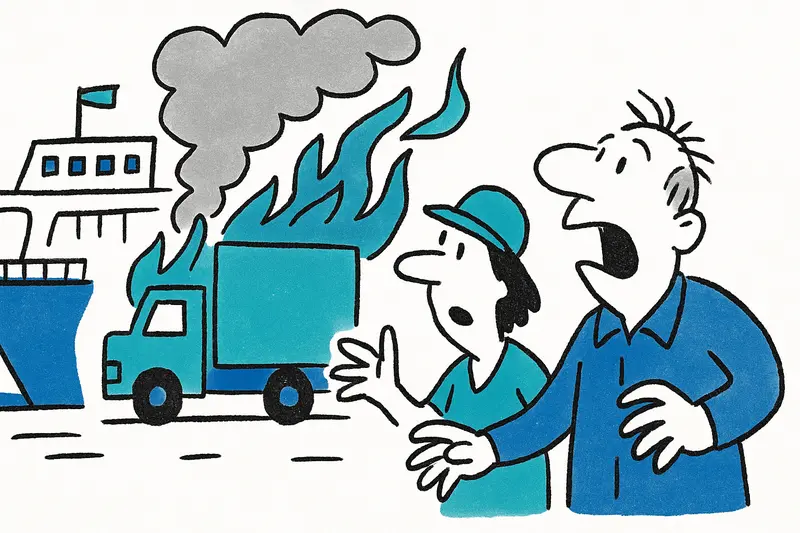
Fiery drama on board: What happens when a truck catches fire on a ferry?
Fiery drama on board: What happens when a truck catches fire on a ferry?
Fire in a vehicle compartment on the ferry Golden Bridge – the blaze was extinguished quickly, but smoke and panic exposed weaknesses. A reality check for Mallorca and its ferry connections.
Fiery drama on board: What happens when a truck catches fire on a ferry?
Key question: Are our ferry connections technically and organizationally prepared to reliably protect people and cargo?
Early in the morning, before the cafés on Passeig Mallorca served their first espressos, the report came in: a truck on the vehicle deck of the ferry Golden Bridge had caught fire. The ship was estimated to be about 50 nautical miles off Palma when the crew raised the alarm at 6:30 a.m. Maritime rescue units, including the vessels Salvamar Libertas and Marta Matas, the helicopter Helimer 203, the Guardia Civil, Palma fire brigade and ambulances were mobilized.
On board: 126 passengers and 46 crew members. The Golden Bridge of the operator GNV later berthed in the port of Palma. According to initial reports, the fire was brought under control quickly, extinguished within minutes; nevertheless, the smoke spreading from the vehicle deck caused considerable unrest among those on board. According to available information, the firefighters ultimately did not have to perform active extinguishing.
Important for Mallorca: GNV is one of several shipping companies that connect the island with the mainland; companies such as Baleària and Trasmediterránea also serve ports in Barcelona, Valencia and Denia. The island is economically and logistically heavily dependent on these connections – any disruption therefore hits us twice: people and goods.
Critical analysis: A vehicle fire on board is not surprising; trucks carry fuel, goods and sometimes more hazardous items. What matters is how quickly a fire can be detected, located and extinguished without passengers panicking. Two factors played a role in this incident: firefighting in the enclosed cargo deck and the spread of smoke into passenger areas. Smoke is often more dangerous than the flames themselves.
What is often missing from public debate is technical details and prevention; local incidents such as Fire on the Paseo Marítimo: A Blaze, Many Questions highlight this gap. It has been reported that the fire was extinguished – but hardly anyone talks about early fire detection systems on vehicle decks, automatic extinguishing systems or the rules for loading and parking vehicles carrying dangerous goods or electric vehicle batteries. The question of how quickly and transparently the operator and authorities provide information afterward is also hardly raised.
Everyday scene: On a windy morning in the port of Palma one sees the usual pictures – seagulls screech, fishermen mend nets, dockworkers drive forklifts. The ferry eases up to the quay; passengers disembark, the buzzing of phone chargers and rolling suitcases mixes with a distant horn. Such routines make it easy to forget how vulnerable sea transport is; similar local incidents are described in Fuego en el Paseo Marítimo: un coche en llamas, muchas preguntas.
Concrete solutions: 1) Prevention before arrival: mandatory checks for vehicles with a focus on leaks, electrical systems and carried hazardous substances. 2) Early detection: thermal imaging cameras and smoke detectors in private and commercial vehicle zones, linked to the bridge alarm. 3) Extinguishing technology: review and retrofit of automatic solutions for vehicle decks (e.g. water mist or sprinkler systems, suitable extinguishing agents). 4) Loading and parking rules: defined distances between vehicles, separate areas for hazardous goods and electric vehicles. 5) Training and drills: regular, publicly documented evacuation and firefighting exercises with crew, port fire brigade and maritime rescue. 6) Transparent communication: a standardized information chain for passengers and ports, including app notifications in emergencies.
Conclusion: That the fire was brought quickly under control this time is luck and good action by the crew. Luck must not be the only safety concept. Our island's supply and the safety of people require that technical standards, inspections and the frequency of drills are visibly increased. We should derive concrete requirements from such incidents and not only feel relieved when everything turns out well in the end.
Frequently asked questions
What should passengers do if a fire breaks out on a ferry to Mallorca?
How dangerous is smoke on a ferry when a truck catches fire?
Are ferries to Mallorca prepared for truck fires on the vehicle deck?
Why is ferry safety so important for Mallorca?
What happens after a ferry fire reaches the port of Palma?
Which ferry companies connect Mallorca with the mainland?
What safety checks should trucks go through before boarding a ferry to Mallorca?
How can ferry fire risks be reduced on routes to Mallorca?
Similar News
Magaluf: Watchtower Alarm – Lifeguards Pull Unconscious Beachgoer from the Water
After a drama in the late afternoon, two lifeguards at Magaluf beach rescued an unconscious 44-year-old man. He was stab...
Turquoise in the City: How dangerous is the color play of the Sa Riera?
The Sa Riera in Palma suddenly turned turquoise — a pretty motif, but behind the effect lies a discharge of saline waste...

Jeckliner at Sunnesching: Cologne spirit sets sail from Palma
In September 2027 the Mein Schiff 2 briefly becomes a floating carnival stage: four days with Cologne bands, comedy and ...
Finally Home: Mike and Leyla Heiter Buy Villa with Sea View in Mallorca
The reality TV couple Mike and Leyla Heiter have bought a house in Mallorca with a roof terrace and sea view. An Instagr...
Arrest after series in Palma: Who protects apartments from repeat offenders?
The National Police arrested a man in Palma who investigators say may have broken into several apartments. In one incide...
More to explore
Discover more interesting content

Can Cap de Bou

Townhouse Lleo 72
