
Five chalets per week: How Mallorca is gradually losing its rural land
Five chalets per week: How Mallorca is gradually losing its rural land
A new analysis of satellite images provides hard figures: between 2021 and 2024, 546 hectares of agricultural and forest land were affected and 846 single-family homes were built. What does this mean for the island?
Five chalets per week: How Mallorca is gradually losing its rural land
Guiding question
Can an island whose landscape is part of its body keep granting individual building plots indefinitely without eventually losing the whole?
In short
A recent study, based on analyzed satellite images and expert review, reports a rapid advance of construction on so-called suelo rústico, that is, agricultural and forestry land. According to the study, around 546 hectares of such land were built over between 2021 and 2024 and 846 single-family houses were erected — on average about five individual chalets per week. The researchers estimate the annual pace of sprawl at about 180 hectares, roughly 28 percent more than in the previous comparison period. Added up over a decade, this amounts to an area comparable to a medium-sized municipality. Such pressures on land and services are related to broader questions of capacity and growth, as reviewed in How many residents can Mallorca sustain? Growth, pressure and ways out of overcrowding.
Critical analysis: Why the numbers say more than red areas on a map
Satellite images provide clear area figures, but the effects are local, audible and visible: where olive trees, grain or rows of pines once stood, pools, driveways and walls appear. This fragmented settlement growth is dangerous because it hides in many small decisions — a building application here, a plot sale there — avoiding political attention. Ecologically, the dispersion means more sealed surfaces, more traffic on rural roads, disruption of wildlife corridors and a higher water demand per household. For local residents, problems grow in infrastructure and public services: waste collection, firefighting water supply, road maintenance — everything becomes more expensive and complicated when houses are scattered across the landscape. The situation is compounded where second homes dominate local housing stocks, as documented in When Villages Become Seasonal Backdrops: Why Second Homes Dominate in Mallorca.
What is missing in the public discourse
There is much talk about tourist numbers, hotels and urban centers, but less about the mundane question: who owns the land and how are plots actually used? Transparency in the sale of small plots, clear statistics on building permits issued on suelo rústico, and a public map of planned interventions are largely missing. Also little discussed is the link between short-term rentals and demand for individual luxury villas; investigations into seasonal occupancy and its effects are explored in Part-time Villages: How Second Homes Are Hollowing Out Mallorca's Communities. Without measurable incentives or controls, much happens behind the scenes.
An everyday scene from the island
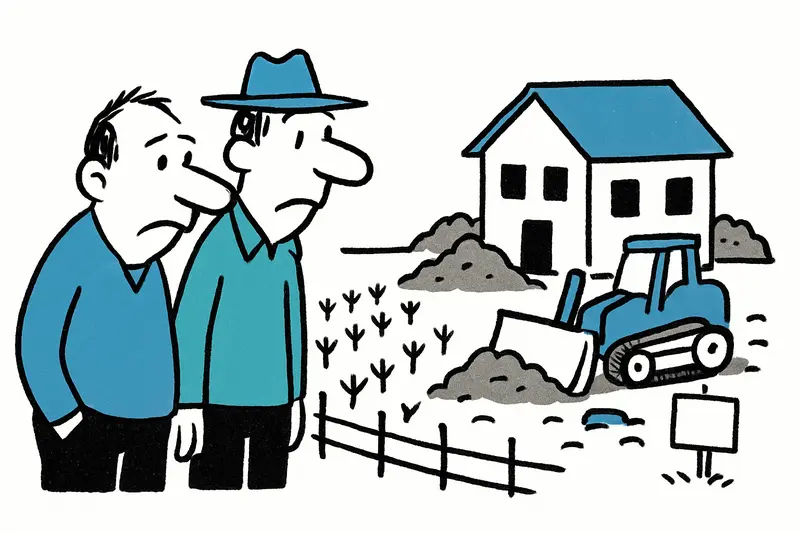
Last week I stood on Passeig Mallorca; the newsroom on the Calle hears the buses, seagulls cry over the bay, and at the same time emails arrive from the island interior: a farmer from the Pla de Mallorca reports that a fence went up next to his field, then a digger, then a sign reading "construction started." For the people on the ground this is not a statistic but a piece of home that is disappearing — step by step, without a big meeting in the village square.
Concrete solutions
No utopia is needed, but instruments that work: first, an immediate public register of all building permits on suelo rústico, accessible and searchable; second, a temporary moratorium on new single-family houses in particularly affected zones until mappings and impact analyses are available; third, stricter linking of building permits to permanent residential use instead of holiday rentals, combined with controls and sanctions; fourth, promotion of the rehabilitation of vacant farmhouses instead of allocating new plots; fifth, regional coordination between municipalities so that a border between municipalities cannot be used to bypass rules, a coordination need made urgent by the fact that 40 of 53 municipalities in Mallorca are growing faster than Palma. Tax incentives for land consolidation and support programs for sustainable agriculture could be additional levers.
Conclusion
The study's figures are no longer an abstract research result, they are everyday reality: roads getting noisier; drinking water becoming scarcer; and landscapes turning into a patchwork of walls and gardens. Those who want to stop this must start now: more transparency, clear rules for suelo rústico, and a debate that does not decide the island's future only in Palma but with the people where the excavators are rolling.
Frequently asked questions
Why is Mallorca losing so much rural land to new construction?
How many new chalets are being built in Mallorca each week?
What does building on suelo rústico mean in Mallorca?
Why is scattered housing in Mallorca a problem for roads and services?
Is Mallorca’s rural construction linked to second homes and holiday rentals?
What parts of Mallorca are seeing more pressure from rural development?
Can old farmhouses in Mallorca be reused instead of building on new land?
What measures could slow down rural sprawl in Mallorca?
Similar News
Injured captain, big plans: Germania Mallorca before the away match in Consell
The newly founded FC Germania Mallorca travels to Consell on Saturday. Captain Bastian Müller is out injured, but coach ...
Palma, Palma de Mallorca, Palma‑Mallorca: What is it really about?
The debate over the city's name is more than grammar: it concerns identity, law and branding policy. A sober reality che...
Warning to Bathers: Nipping Fish in Cala Major and Other Coves — a Reality Check
In Cala Major and several beaches around Mallorca, bathers report painful “nips”. Who are the animals, why are they gett...

Rental Car Theft in El Arenal: What This Incident Reveals About Our Gaps
A teenager steals a running rental car in El Arenal, flees on foot, climbs over walls and is caught by the Guardia Civil...

Red Rope in Palma's Library: What Helps Against Selfie Tourism — and What's Missing
Palma's city library cordoned off an area with a red rope to keep selfie tourism away from reading and working activitie...
More to explore
Discover more interesting content

Can Cap de Bou

Townhouse Lleo 72
