
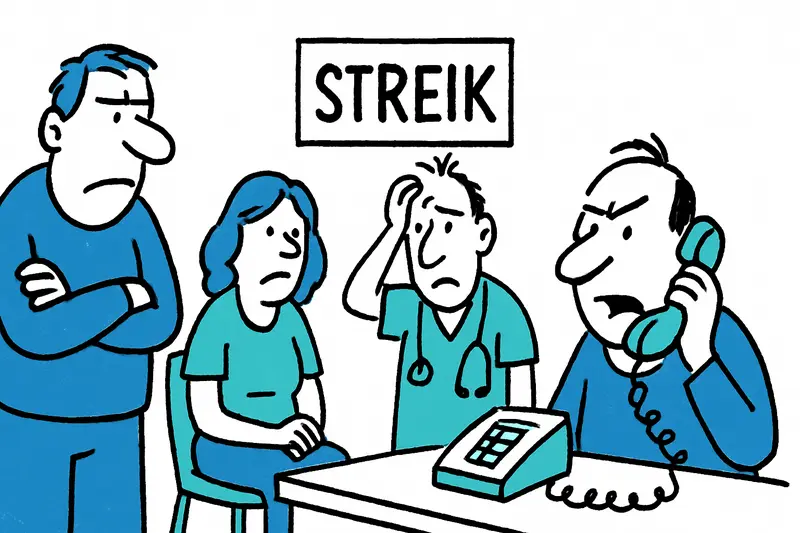
Five-day doctors' strike in the Balearics: why waiting lists are growing
Five-day doctors' strike in the Balearics: why waiting lists are growing
The five-day doctors' strike on Mallorca postponed hundreds of operations and tens of thousands of appointments. Quiet hospital corridors, overloaded phone lines — and one question remains: how should patients and staff fill the gap?
Five-day doctors' strike in the Balearics: why waiting lists are growing
Key question
What happens to patients whose procedures and appointments were canceled because of the doctors' strike — and what are the consequences for Mallorca's health system if the protests recur monthly?
Summary of the facts
From Monday to Friday a large portion of healthcare staff across the Balearic Islands stopped working. On Mallorca this week 278 operations were canceled; in addition 15,626 consultations and examinations did not take place. Across the Balearics the cancellations add up to more than 20,000 appointments. The health authority IB-Salut announces it will reschedule all appointments, but expects longer waiting lists, as discussed in Waiting lists in the Balearic Islands: Too many patients, too little OR time — and what must be done now. If no agreement is reached, the strikes are planned to take place once a month. The background are planned reforms from Madrid to reorganize working hours and on-call duties, as well as doctors' demands for a clearer professional classification.
Critical analysis
The picture is twofold: on one hand there are understandable professional concerns — doctors complain that long shifts and night on-call duties are not sufficiently counted as regular working hours, with consequences for pay and future pension entitlements. On the other hand is the reality of patients: empty operating theaters, postponed diagnoses, elderly people unsettled in waiting areas; these operational effects are chronicled in Day Two of the Doctors' Strike: Why Healthcare in Mallorca Is Faltering. The announced rescheduling of appointments sounds good, but it is not a short-term reassurance. Waiting lists do not only arise in practice because appointments are postponed; they also grow when staff are exhausted, additional shifts cannot be scheduled, or when rooms and equipment are already fully booked.
What is missing from the public debate
1) A clear presentation of how many of the canceled appointments were urgent and how many could be postponed. 2) Transparency about the actual financial effects a reorganization of working time would have on salaries and pensions. 3) A look at primary care: how does the doctors' strike affect general practices and emergency departments? 4) A realistic timetable for catching up on appointments — without these details "catching up" remains a vague promise.
Everyday scene from Palma
In front of Son Espases hospital it is unusually quiet. The typical beeps from the emergency rooms seem less frequent; at the kiosk opposite two taxi drivers sit with the radio on, watching the street. In the square in front of the main entrance older people are searching for information, a woman flips through a printed letter from the clinic, a bicycle courier parks and speaks quietly with a nurse. Scenes like these show: the disruption on the island is not abstract, it happens on the corners where we organize our daily lives, a reality mirrored in Doctors' strike in the Balearics: Why the demonstration in Palma is more than a labour dispute.
Concrete solutions
1) Prioritization categories: An independent body should classify canceled appointments (urgent, time-critical, deferrable) and set a clear repeat schedule. 2) Agree on counting working time: Introduce short-term binding rules on which parts of on-call duty fully count as working time — with transition periods. 3) Staffing and shift buffers: Temporary increases through coordinated short-term contracts and mobilization of non-physician professionals for organizational tasks. 4) Digital coordination hub: A central online portal with real-time information on waiting lists and planned make-up appointments as well as a hotline for at-risk patients. 5) External audit: An independent workload analysis for doctors to create the basis for a fair classification.
Why this matters now
The reform from Madrid touches not only working time rules; it directly affects the organisation of care. If on-call times continue to be marginalised, financial and health imbalances will remain. If staff concerns are ignored, the likely consequences are: staff turnover, fewer applicants for rural posts, and increased pressure on emergency departments.
Key conclusion
The doctors' strike has legitimate causes and severe consequences at once. Anyone in Palma or Manacor with a postponed appointment does not want abstract statements but a plan: when will the new appointment be, who will take over, and how will urgency be prioritised? Policymakers and health administrators must do two things at once: 1) plan concrete short-term measures to secure patient care and make waiting lists transparent; 2) work on a medium- to long-term fair regulation of working hours and a clear professional classification. If neither happens, the protest wave risks becoming a permanent subscription of disruptions, a concern explored in No Submission: What the four-day doctors' strike in Mallorca really reveals — and that would be costly for everyone on the island.
Frequently asked questions
Why are waiting lists in Mallorca getting longer after the doctors' strike?
Will cancelled hospital appointments in Mallorca be rescheduled after the strike?
How many operations and appointments were cancelled in Mallorca during the doctors' strike?
Could doctors' strikes in Mallorca happen again every month?
What should patients in Palma do if their hospital appointment was cancelled?
Why are Mallorca doctors protesting the working-time reform from Madrid?
How does the doctors' strike affect emergency care in Mallorca?
What are the main effects of the doctors' strike on healthcare in Mallorca?
Similar News

"Expensive chaos" and many open questions: What clients can do when a lawyer suddenly stops responding
Several clients complain that a well-known German lawyer in Mallorca has been unreachable for months. Key question: What...
TV tip: 'The Last Problem' — Mallorca as the setting of a classic crime
A classic whodunit on Mallorca: A new miniseries set in spring 1959 brings storm, an isolated hotel and a dense web of s...

Nipping Sea Creatures: Why Bathers in Cala Major and Elsewhere Should Be Cautious
In Cala Major, bathers have reported being nipped by small fish. What is behind it, how can problems be avoided — and wh...
Forced eviction in Santa Catalina: When a 65-year-old slept in her car and showered on the beach — a question of responsibility
The story of Pilar López from Santa Catalina represents a problem affecting many Mallorcans: How can an island with a bo...
New traffic rules from October 1: What Mallorca visitors and locals need to know
From October 1, 2026, Spain will implement far-reaching changes to traffic regulations. Important for Mallorca: greater ...
More to explore
Discover more interesting content

Can Cap de Bou

Townhouse Lleo 72
