
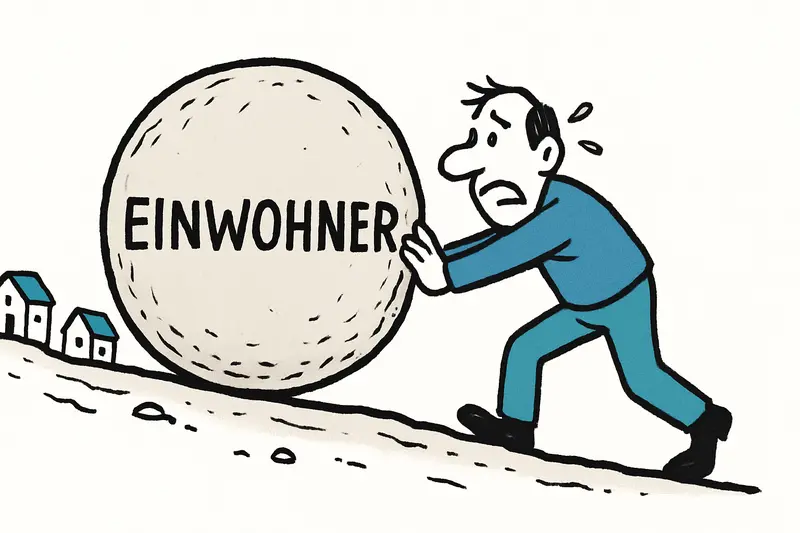
Five Municipalities Lose Residents – Who Gets Left Behind?
Five Municipalities Lose Residents – Who Gets Left Behind?
Sant Llorenç des Cardassar, Escorca, Estellencs, Mancor de la Vall and Banyalbufar recorded declines. Why are small municipalities particularly affected — and what needs to be done?
Five municipalities lose residents – who gets left behind?
Key question: Why are these places shrinking even though Mallorca as a whole is growing?
The numbers are clear: Sant Llorenç des Cardassar, Escorca, Estellencs, Mancor de la Vall and Banyalbufar saw their populations fall last year. At the same time, the island as a whole grew and now has 960,270 inhabitants. This is discussed in When the Surroundings Overtake Palma: Opportunities, Risks and the Quiet Revolution on the Island.
This raises a simple but uncomfortable question: what is going wrong when individual villages have to fight against the general trend? The obvious answers — lack of housing and very high property prices — are on the table, as shown by When Rent Decides: How Villages Lose Their Families. But they are not enough to fully explain the phenomenon.
Critical analysis: It’s not just about square metres. In the affected places several factors come together. First: traditional local housing is often converted into holiday rentals; the supply for families and young people shrinks. Second: prices and additional costs make life in rural areas unattractive, even if jobs remain on the island. Third: infrastructure — bus connections, fast internet, medical care — is more sensitive in small municipalities than in Palma. If the bus runs less frequently or the practice closes, young parents are more likely to choose a city address.
What is usually missing from the public debate is the perspective of those who stay or leave. Behind the dry figure “199 residents” there is a daily life with concrete problems: empty school benches, ice cream shops that are open only on weekends, and the post office where older people pick up their mail in front of the cemetery. In the village square of Escorca maybe a handful of people sit having coffee in the morning, while the youth leave the mountains because their housing budget is not enough for a small house.
Concrete approaches that could work beyond mere paper plans: First, municipal and regional incentives for affordable housing are necessary — more municipal flats, targeted grants for families and subsidized loans with low interest rates. Second, tighten rules for converting residential properties into holiday homes. Many municipalities already have lists of vacant properties; these could be prioritized for renovation and rental. Third: strengthen mobility — better bus frequency, expand ride-sharing hubs, subsidies for commuters. Fourth: digital infrastructure: bringing fibre to mountain villages enables remote work and keeps professionals on site. Fifth: strengthen local jobs through support for small businesses, crafts and agriculture that bind young people to the place.
On Mallorca it is often the case that tourism and housing compete for the same land. That does not necessarily mean tourism must suffer, but it requires rules and priorities that are sustainable in the long term. Examples that could already work: transferring vacant old apartments into civic hands, municipal housing cooperatives and cooperation between municipalities for shared services (doctor visits, school bus, broadband). In contrast, Mallorca's new residential axis: Villages grow, Palma keeps moving describes Marratxí, Consell and small municipalities like Mancor that are growing rapidly.
Everyday scene: On a windy morning in Banyalbufar the promenade is almost empty, the sea glints silver, and the local baker counts the few regular customers while wiping the counter. In Mancor de la Vall a young mother waits at the bus stop for the school bus, worried about the scarce timetables. Such images show: it’s not just about numbers, but about quality of life.
What is often missing in the public discourse is a shared responsibility: the state, municipalities, regions and private investors should sit at the same table — but not only to discuss funding programs, rather to present binding local plans. Such plans should include deadlines, concrete projects and measurable goals: number of new social housing units, improved bus connections, fibre-optic links.
A pointed conclusion: If you want small municipalities to remain vibrant, more is required than condolence tweets about “demographic change.” It takes the courage to plan locally, financial resources and clear rules for housing use. Otherwise the island risks another problem in a few years: a map with beautiful place names — but without the people who live there.
Frequently asked questions
Why are some Mallorca villages losing residents while the island as a whole is growing?
Is it still possible to live in a smaller village in Mallorca without a car?
How do holiday rentals affect housing in rural Mallorca?
What makes life in small Mallorca municipalities harder for young families?
What can Mallorca municipalities do to keep villages from shrinking?
What is life like in Banyalbufar for year-round residents?
Why is Escorca especially vulnerable to depopulation in Mallorca?
Are there villages in Mallorca that are still growing?
Similar News
Released with Conditions: The Plus Ultra Suspicion and a Mallorcan Finca as Residence
A Dutch entrepreneur, sought in connection with the Plus Ultra case, was extradited to Spain after his arrest in Germany...

Haute Nuit in Puerto Portals: Fashion, Art and Indulgence by the Water
On October 2 the Lobster Club in Puerto Portals will be transformed into a stage for curated fashion, art and culinary e...

Magaluf: Watchtower Alarm – Lifeguards Pull Unconscious Beachgoer from the Water
After a drama in the late afternoon, two lifeguards at Magaluf beach rescued an unconscious 44-year-old man. He was stab...

Turquoise in the City: How dangerous is the color play of the Sa Riera?
The Sa Riera in Palma suddenly turned turquoise — a pretty motif, but behind the effect lies a discharge of saline waste...

Jeckliner at Sunnesching: Cologne spirit sets sail from Palma
In September 2027 the Mein Schiff 2 briefly becomes a floating carnival stage: four days with Cologne bands, comedy and ...
More to explore
Discover more interesting content

Can Cap de Bou

Townhouse Lleo 72
