
German Standard-Bearer in Coll d’en Rabassa: A Stranger Who Belongs
Roman Hillmann, once a cultural organizer in Palma, walks through Coll d'en Rabassa as a standard-bearer during Holy Week. A personal look at integration, neighborhood and old rituals.
German Standard-Bearer in Coll d’en Rabassa: A Stranger Who Belongs
How a former cultural-space operator from the Rhineland became part of a Mallorcan Holy Week
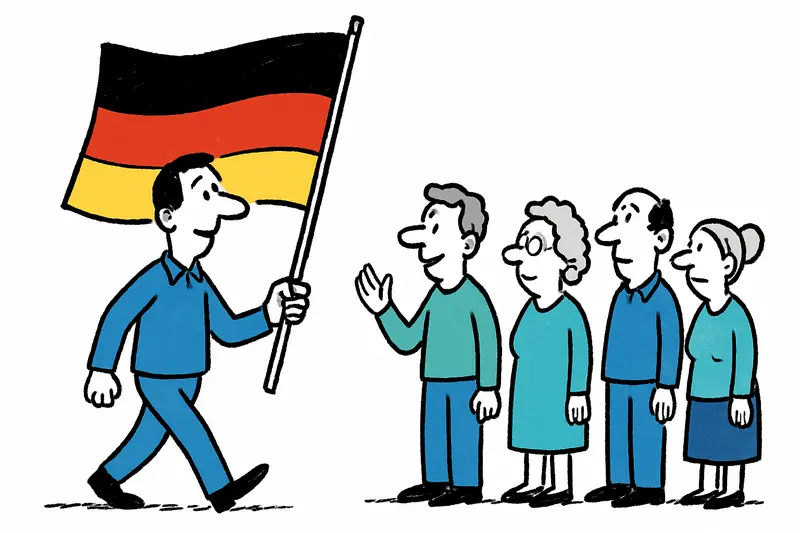
In the early evening in Coll d’en Rabassa, the ringing of the iglesia bells mingles with the sound of the sea. It smells of damp stone and a hint of orange blossom. Between the narrow streets of the neighborhood, where neighbors greet one another and children stand curiously on the sidewalk, a man carries a flag: Roman script, heavy cloth, steps in time. Roman Hillmann is German—and for several years now a fixed part of the Easter processions here.
Hillmann is not a tourist; he has built a piece of everyday life in Palma: he used to run the cultural space “Exprésate” in the neighborhood, and before that he worked in television in Germany and lived in Berlin and Paris. His story echoes other expats' accounts such as My Heart Pulled Me to Palma – How a German‑Austrian Couple Is Putting Down Roots Here.
In 2023 he took part in a procession for the first time; since then he has been joining regularly. For him it is not a spectacle, but a way to experience community and contribute.
This week Hillmann will be seen again: on Tuesday evening the procession in Coll d’en Rabassa starts at 8:00 PM at the Plaza de la Iglesia and moves through the neighborhood for about two hours. If you walk slowly through the streets, you hear the clack of wooden boards, the whispers of passers-by and sometimes the rhythmic stamping of the brotherhood—the procession is a quiet but striking interplay of ritual and neighborhood.
On Maundy Thursday the larger procession Crist de la Sang is on the program. Meeting point is at 7:00 PM at the Plaza del Hospital, above the cultural center Misericòrdia; they set off from the Iglesia de la Anunciación and will arrive at the cathedral late at night—around 1:00 AM. Many participants in this event are veiled; hoods are traditional. Hillmann has announced that he will wear such a hood; only those who look closely will recognize him then.
Why does he do it? For Hillmann, participating in the processions is a practical way to become part of everyday life. He does not see it as cultural appropriation, but as a form of participation: by helping, by showing up on time, by respecting rituals that have been kept here for generations. Many residents have accepted him by now—some approach him after the processions to ask about his story or ask for a photo when the hood comes off.
Such scenes bring something real into the discussion about integration: it is not only about languages and papers, but about shared streets, common appointments and the small gestures—the holding of a door, the silence when passing a paso (processional float), the mutual smile after the service. These nuances are explored in Between Welcome and Wariness: Germans in Mallorca — What's Really Happening.
In Coll d’en Rabassa, where boats lie on the horizon and the promenade slowly fills with evening strollers, this form of participation has a special quality: it connects the everyday with the festive.
Practically speaking, Hillmann’s path is also an invitation: those who are new on the island do not have to wait until others invite them. Getting involved in local initiatives, joining a brotherhood or simply coming regularly to the meeting points—these are small steps with big effects; seasonal workers and new arrivals often take such steps, as in In Germany I was often alone: Why Sali swapped Düsseldorf for Mallorca. The brotherhoods themselves benefit: volunteers who are punctual and respectful of the procedures are welcome.
In the end, the impression remains of an evening in which different lives briefly intersect: the tourist filming with his phone, the old woman watching the scene with a thin scarf, and a German man with a heavy flag who naturally falls into the rhythm. It is not a loud statement, more a quiet finding of one’s place. When the bells have faded and the streets are emptier again, the feeling remains that community is created through small, repeated gestures—and that there is room for that in Mallorca if one works for it.
For those who want to join: Tuesday, 8:00 PM Plaza de la Iglesia in Coll d’en Rabassa; Maundy Thursday, 7:00 PM Plaza del Hospital (Iglesia de la Anunciación) to the cathedral, arrival around 1:00 AM. The weather in Palma is currently showing some sun and clouds at around 15°C—a typical spring evening to participate.
A quiet, neighborly tone, a flag in the wind and a man who shows: you can often belong simply by turning up.
Frequently asked questions
What is Holy Week like in Mallorca?
Can visitors watch the processions in Palma and Coll d’en Rabassa?
What time does the procession in Coll d’en Rabassa start?
Where does the Crist de la Sang procession in Palma begin?
What should I wear to a Holy Week procession in Mallorca?
Can newcomers join local traditions in Mallorca?
Is it cold in Palma during Holy Week?
Why are processions important in Mallorca?
Similar News
Palma, Palma de Mallorca, Palma‑Mallorca: What is it really about?
The debate over the city's name is more than grammar: it concerns identity, law and branding policy. A sober reality che...
Warning to Bathers: Nipping Fish in Cala Major and Other Coves — a Reality Check
In Cala Major and several beaches around Mallorca, bathers report painful “nips”. Who are the animals, why are they gett...

Rental Car Theft in El Arenal: What This Incident Reveals About Our Gaps
A teenager steals a running rental car in El Arenal, flees on foot, climbs over walls and is caught by the Guardia Civil...

Red Rope in Palma's Library: What Helps Against Selfie Tourism — and What's Missing
Palma's city library cordoned off an area with a red rope to keep selfie tourism away from reading and working activitie...
Fort San Carlos: Museum, Harbor Dispute — and a Conflict That Demands Answers
The military museum at Fort San Carlos sits right on Palma's harbor, with unexpectedly quiet rooms filled with cannons a...
More to explore
Discover more interesting content

Can Cap de Bou

Townhouse Lleo 72
